North Carolina State University Athletics
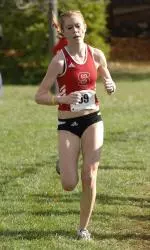
Life in the Woods: A Harrier's Perspective
9/16/2011 12:00:00 AM | Cross Country
Sept. 16, 2011
Bona Jones was a member of the NC State women’s cross country and track teams from 2006-2010. Jones earned All-America, all-region, and All-ACC honors in cross country while a student-athlete, and is now interning with the media relations department.
RALEIGH, N.C. -- Chances are, if you’ve driven anywhere within a five-mile radius of NC State’s campus on an early weekday morning, you’ve noticed a pack of scrawny runners – a group of guys wearing tiny shorts that reveal shockingly white legs, or toned girls in sports bras and spandex – making their way down Hillsborough St. or Western Blvd. These packs of runners are comprised of the student-athletes who make up the NC State cross country team.
The Wolfpack cross country program is one of the most successful in history, having won a combined 34 ACC championships between the men’s and women’s programs. The teams have qualified for the NCAA Championships a combined 48 times since 1984. Both teams are looking to have a strong season this year. The men are ranked 13th in the USTFCCCA’s preseason Division I poll, while the women are 21st. In order to achieve all of this success, they put in extensive training each year. As a former member of the Wolfpack cross country team, I was excited to be given the assignment of describing a glamorous day in the life of a Division I runner.
Distance running is unlike any other sport on campus – you don’t sit and watch a game tape and then practice drills over and over or scrimmage each other. You just simply run for a designated amount of time at a certain speed, and combine those runs with a combination of supplements, strength training, and in some cases, extensive rehab programs.
During my days of competition, the alarm would typically blare around 6:30 a.m. From there the routine was roll out of bed, choke down some liquid iron (a delicious, metal-tasting supplement for those of us whose bodies don’t absorb it in the pill form), grab my backpack and perhaps one of my three roommates and drive to campus.
I was frequently injured, so for me it was then off to the training room to get in the hot tank, roll out my legs on the foam roller, a long, log-shaped piece of foam that you’re supposed to slide your legs across multiple times to loosen tight muscles. While it may not look like a weapon of torture, this roller can inflict some serious pain on your body. If that wasn’t enough to get things loosened up, a good lathering in Flex-All or Icy Hot could help get the job done. Once that was finished it was time to dart back into the locker room, grab my stretching mat – a blue mat similar to those used by preschoolers to take naps on – and head down to the track by 8 o’clock to warm up.
There are many different types of runs during cross country – continuous-run days, workout days, pre-race days, race days, recovery days, moderate-long-run days and long run days – with a continuous being the most common practice. The warm-up routine for each type of run differs, but on a continuous run day it consisted of two laps around the track, drills that required my uncoordinated body to move itself in awkward positions, and an extensive stretching routine before it was finally time to begin running. This stretching routine wasn’t just a touch your toes a few times and hit the pavement kind of routine. It lasted about fifteen minutes or so and involved all sorts of weird contortions.
While everyone has the option to do the occasional run by themselves, most of the time people pair up into groups of three or four and head out around town. A typical continuous-run day would vary from five to eight miles, depending on what point of the season it was. In the early fall, runners tend to put in more mileage, and then cut back as it gets closer to ACCs and NCAAs. When I was healthy, my average mileage would be about 60 per week.
After the run was finished and everyone went through a static stretching routine, it was off to the weight room for the second part of practice. Here we went through a variety of strength-training exercises. These exercises varied from push-ups to planks to weird back exercises where you were supposed to pretend like you were doing the breaststroke out of water. You can imagine how interesting that one looked.
Once the strength training was completed, it was time to rinse off and head back to the training room. After more stretching or strengthening exercises and the occasional muscle rub down it was into the cold tank. Being from Florida, the cold tank was probably my least favorite part of practice. I don’t enjoy being cold and had a hard time willingly lowering myself into a tub of freezing water, but the benefits outweighed the uncomfortable temperature.
Once all that was done, about four hours after I had woken up, it was time to get some breakfast and head to class for a few hours. Then, depending on what day of the week it was and what point of the season we were at, I would head back home, pick up one of my roommates, and head to Lake Johnson for a three-mile run on the bark chip.
After that was completed, we would head home to make dinner, do homework, and prepare to do it all again the next day. Maybe it wasn’t so glamorous after all, but when I look at the ACC championship ring that my teammates and I won in 2006, it certainly was worth it.