North Carolina State University Athletics
CARR: College Tennis' Greatest Match
7/31/2010 12:00:00 AM | Men's Tennis
July 31, 2010
BY A.J. CARR
RALEIGH, N.C. -
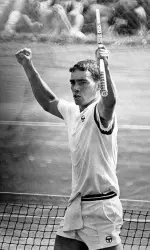
It was Sadri's usual pre-match attire, which often provoked a "Who is this guy?" response from fans unfamiliar with the Wolfpack's No.1 player.
"This Guy" was a bullet-serving, two-time All-America who pushed McEnroe to the brink in what is still regarded, more than three decades after the last point, as the best championship match in NCAA history.
It didn't last as long as John Isner's epic win this summer at Wimbledon, the 11-hour, five-minute shootout that stretched over three days. But that John vs. John college clash in Athens, Ga., was drenched with drama, suspense, and enough tension to almost break their racquet strings.
Finally, after a grueling four hours and 13 minutes, McEnroe claimed the title with a 7-6, 7-6, 5-7, 7-6 triumph that was even closer than the score seemed. Overall, the precocious Cardinal star won just one more point (144-143) and one more game (26-25).
Though a college rookie, McEnroe was ranked No. 15 in the world and had already made his debut at Wimbledon. Sadri, a senior, was No. 12 in the amateur polls and was armed with a 135 mph serve believed to be the fastest among collegians.
"I really felt I was going to win; I felt I could overpower him,'' Sadri, who never lost his serve during the match, said recently. "If I had been just a little bit better off the ground, I believe I would have won."
McEnroe, who came up with the big shots in the biggest moments, won each tiebreaker 5-4. Sadri had his chances. He served at 3-3 in the first tiebreaker, but missed two forehand volleys. He was serving again at 3-3 in the third, but couldn't crack the Mac Machine.
McEnroe was tempestuous and extra ordinarily talented. Sadri was strong, skilled and undaunted, never one to back down. And both players blazed with competitive fire.
Cognizant of the potential for combustible moments, the NCAA for the first time ever allowed coaches - State's J.W. Isenhour and Stanford's Dick Gould - to sit at courtside.
Prior to the match, Isenhour's advice to Sadri was "act mad at him, but don't be bad...don't be intimidated" if McEnroe launched into distracting antics.
Once, when McEnroe got upset, Sadri snapped: "Hey, let's play tennis; let's not carry on like that; I'm not going to take this..."
So they played, matching stroke for stroke. Every shot was under pressure, every point pivotal. Sadri flashed power and foot speed. McEnroe competed with craftiness, a mixture of artful shots. Sadri equated McEnroe's style to a baseball pitcher who kept batters off balance with a varied repertoire.
"He would take you wide, then dink a shot to the other side,'' Sadri said. "He had so much control, had uncanny hands. I always admired him for that. He was a great player.
"We both wanted it. I played my heart out. I gave 120 percent. I hit every serve as hard as I could. I ran every ball down..."
And McEnroe?
"He could make shots when it mattered most,'' Sadri said. "(He) had a sixth gear. Everybody else had a fifth gear."
When the match finally ended, Isenhour remembered seeing McEnroe just shake his head and exhale in a big sigh of relief.
"I shook his hand, told him I was glad I got to see that match,'' Isenhour recalled. "He said: 'It was probably more fun watching than playing.'"
Sadri played the best match of his college career that day. And he gladly would have exchanged his big cowboy hat for that NCAA crown.
"I always thought if I had won, it might have changed my life,'' said Sadri, who has started the John Sadri Tennis Academy in Charlotte after 15 years as a construction company owner.
McEnroe, as the NCAA champion, got more than a trophy. The laurels included an automatic wild card into the U.S. Open, plus other pro tour tournaments, exempting a player from grueling qualifying rounds. The victory also created instant endorsement opportunities.
While Sadri came up a stroke or two short, he developed into a bona fide star at State under Isenhour, who polished his pupil's game and tweaked his serve. In return, Sadri compiled a 55-4 singles record his last two seasons, won two ACC singles crowns, two league doubles titles and helped State claim its only two conference team championships.
"I wish I had been able to do more for J.W.,'' Sadri said, almost apologetic. "He was such a good man and such a good coach."
NEXT LEVEL
After that classic NCAA match, McEnroe joined the pro tour and, as predicted, burgeoned into one of the game's greatest players.
Competing with fury and skill, he won 17 grand slam crowns and a total of 154 titles - 77 singles and 77 doubles.
Sadri went on to play 10 years as a professional, facing McEnroe 13 more times. But he never beat him.
Flashing a bit of wit, Sadri quipped: "Nobody beats John Sadri 15 times in a row. He's lucky I retired."
While unable to conquer McEnroe, Sadri had his professional moments.
He won two singles tournaments and reached four other finals, including the 1979 Australian Open championship. He captured three doubles crowns - partnering twice with former NC State teammate Andy Andrews - and finished runner-up five times.
In 1980 Sadri achieved a career high No. 14 world singles ranking. He wanted more.
"I could have been better,'' he said. "I had a good serve. I had good speed. There's no reason I shouldn't have been in the Top 10. I wish I had played (tournaments) every week."
LOVE STORY
Sadri wasn't all about trying to beat an opponent love and love.
During the Lipton International one year at Key Biscayne, Fla., he spotted a young lady at restaurant, wrote a note inviting her to watch him play and asked a waitress to deliver the message.
Allison came to the match, sent him a note at courtside that included her phone number. Sadri called her and, as he put it, "the rest is history."
They married and have two children - son Jordan, a junior at NC State, and daughter Madison, a sophomore at College of Charleston.
"She is the best trophy I ever got,'' Sadri said of his wife.
DIFFERENT STROKES
At age 35, Sadri switched sports and took up golf only because he thought playing with clients would help his business.
The game became more than business. Sadri hit hundreds of balls, same as he once did in tennis, and turned into a par-busting player. He was good enough to qualify for multiple tournaments, including the North Carolina Amateur and Carolinas Mid-Amateur.
He'd like to be longer off the tee, but at 53 can post rounds in the low 70s, partly because of a solid short game.
"I like hitting golf balls as much as I did hitting tennis balls,'' said Sadri, who has remained physically fit. "And I'll watch four hours of a PGA tournament on TV."
After the economy spiraled downward, he gave up the construction business and returned to tennis - coaching and launching his academy.
And sure, he followed Isner's Wimbledon "Match That Would Never End, But Finally Did."
While that was intriguing theater, Sadri suggests Wimbledon go to tiebreakers, noting that a match that long can "ruin the tournament" and eliminate a potential champion's chances of winning the title.
As for his NCAA duel with McEnroe, Sadri says he "rarely" thinks about the match.
But 32 years later, tennis buffs still remember two All-Americans playing like champions. Sadri was brilliant. McEnroe was just one point better.