North Carolina State University Athletics

TIM PEELER: Making the Most of a Mental Game
8/9/2005 12:00:00 AM | Women's Tennis
Aug. 9, 2005
BY TIM PEELER
RALEIGH -- Tennis, like golf, is a mental game, one in which challenges are as much with self as with an opponent.
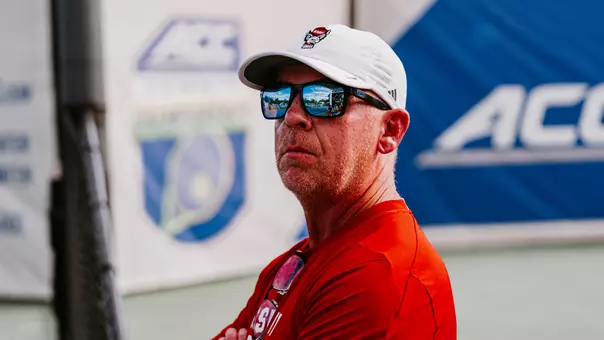
Throughout his career, NC State women's tennis coach Hans Olsen has tried to develop his players' mental proficiencies as much as their backhand, forehand or serve.
"Especially at this level, the difference between two players in the ACC is usually some kind of mental advantage," Olsen said. "Most of the time, the two are pretty even skills-wise. So whatever edge there is will be something mental. That is the biggest improvement that someone can make between the ages of 18 and 22.
"Sure, they will improve with their fitness and with refining their on-court skills. But where they will make the biggest jump in their games and what makes the biggest difference in terms of their performance is how they handle successes and adversity mentally. Most of the players coming onto campus might have done a little bit in that area, but not as much as they would when they get here and start focusing on it full time."
Before he arrived at NC State, Olsen teamed with sports psychologist Anne Ferris to produce a training video called "The Mental Game: A Mental Skills Training Program for Athletes." It deals with training in imagery, relaxation techniques, concentration and goal-setting, all things Olsen uses in helping his players develop their mental toughness on the court.
"These are things that take a good mental performer and make them into a world-class level mental performer," Olsen said. "A lot of junior players should be able to relate to that: they have been in that zone before. What we try to do is talk about the skills that allow you to bring yourself to that zone more often."
Heading into this school year, Olsen believes his philosophies and techniques will be beneficial on a team that, for the first time in his career with the Wolfpack, will be made up entirely of players he recruited. That's not a knock on any former players, Olsen is quick to point out, it's just that it's easier to mold players who know before they get here what the coach's expectations will be.
He believes he will have a strong group of senior leaders in Nandita Chandrasekar and Barbara Orlay, who will all step in to replace the four senior leaders lost from last year's team. Chandrasekar, who led the team in victories as a sophomore, will return to action after missing most of last year with a knee injury.
"I really believe we need to set our expectation level higher," said Olsen, who was a successful player at Charleston Southern and eventually the men's and women's coach at his alma mater. "That's where strong leadership can make a difference. We need that competitive determination as a team.
"I would say probably that the level of expectation when I got here was maybe around a three out of 10. Now, I think it is a seven or an eight. It was hard to measure that level of expectation in terms of ACC wins last year, because of some injuries we had. But that needs to go up. Hopefully, this coming year is the next chapter. Hopefully, the girls are saying it is time for us to be a more dominant team, match-in and match-out, in the ACC.
"That part hasn't happened yet."
But, just as with the men's team and head coach Jon Choboy, there has been solid improvement with the Wolfpack women's team, at least in the eyes of athletics director Lee Fowler.
"He's done a great job of adding credibility back to our program," Fowler said. "He took over a program that was in shambles, I would say. It was a program that had not had a lot of attention.
"He has done a good job of bringing pride and instilling that work ethic back into our women's program. We are really excited about it and we look for good things in the future."
Olsen believes having access to the Wolfpack's new state-of-the-art JW Isenhour Tennis Center will also pay huge dividends.
Before the center -- with its four indoor courts, seven outdoor courts and lockerrooms for both the men's and women's teams - opened in June of 2004, the men's and women's teams had no nearby indoor practice facilities.
They would make a 45-minute drive to a private club in Chapel Hill, where they had access to three indoor courts for 90 minutes.
Now, players have access to indoor facilities for individual work-outs up to 18 hours a day, 6 a.m. to midnight.
"An athlete that really wants to achieve their potential in a sport, especially in tennis, they want to be able to do whatever they can, any time that they need to," Olsen said. "This facility offers that, with everything being right here in the same building.
"Our team feels a pride to have a home."
And that's just another little mental edge that should be beneficial for the Wolfpack next season.
You may contact Tim Peeler at tim_peeler@ncsu.edu.