North Carolina State University Athletics
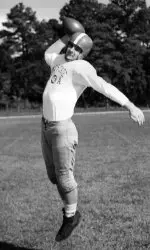
CARR: When 'Big Red' Roamed Riddick
9/22/2010 12:00:00 AM | Football
Sept. 22, 2010
BY A.J. CARR
RALEIGH, N.C. - Riddick Stadium, where Alex Webster once rambled as a running back, has been dismantled. The old fieldhouse, where he dressed in cramped quarters, also is gone.
Much has changed since "Big Red" left NC State in 1953. But unlike the battered structures, the Wolfpack star's name remains in the athletic archives and in the memory of old timers.
"He was a very good, very tough football player,'' said Leon Simon, an end on the Pack teams.
That Webster went on to toil 10 years as an offensive back with the New York Giants, play in two Pro Bowls, and later coach in the NFL was a testament to his toughness, talent and durability.
Those years in the Big Apple were the best of times for him as player. He became a neon name and was a "classical nice guy," wrote a Greensboro Daily News reporter in 1962.
Prior to going pro, Webster had some good moments in college as well. Besides succeeding in football, he met his future wife, Louise, who died this year.
"I enjoyed my four years at State," said the affable Webster, now 79 and living in Hobe Sound, Fla.
DIFFERENT TIMES
When he matriculated from Kearney, N.J., NCSU was State College, struggling in football and playing in a small stadium.
Living conditions weren't luxurious, either. Most athletes had rooms beneath the stands, where it was sultry in the summer and frigid in the winter. Close by was a train track, which coaches hoped wouldn't ramble past during halftime strategy sessions.
It was a different era. On the field, players wore leather helmets with no face masks.
"I suffered a broken nose six times; it was just part of the game back then,'' shrugged Webster, who finally got a mask about his third year in the pros.
Big Red, tagged with the nickname because of his reddish hair, was a big man. He packed 225 pounds on a 6-foot-3 frame, was a power runner as a single-wing tailback, and returned kicks and played in the secondary on defense.
It wasn't enough. Only one of his four teams had a winning season (5-4-1) and Webster never made All-America or All-Conference. He rushed for 634 yards in '51 and 459 in '52, but his career numbers aren't available because only team stats were kept his first two seasons.
A target for opponents, Webster flashed an innovative gift and developed his own play, according to Simon.
From the tailback spot, he would fake a handoff to the wingback with his left hand, hide the ball behind his back, then take the ball with his right hand and run an end sweep.
Asked why the versatile Webster didn't gain all-star recognition, Simon replied: "All I can say, he was good."
Good enough for the Washington Redskins to draft him in the 11th round -- and then put him at safety. Lacking a defensive back's speed, he was the last player cut.
That's when former Wake Forest coach Peahead Walker -- remembering how Webster had returned a punt 86 yards against his Deacons -- brought him to Calgary for a two-year stint in the Canadian Football league.
Big Red responded by winning team MVP honors as a running back in 1954.
"I liked it up there,'' he said. "(Peahead) was a heck of a coach."
Then along came the Giants with a $12,500 offer and the rest is history. Well-rounded and bullish, Webster's biggest seasons unfolded in 1961 (928 yards rushing) and 1962 (743 yards) after the Giants switched him from halfback to fullback, a magical move.
He played when the NFL had a plethora of talented halfbacks, though overall athletes weren't as big, strong and fast as today's stars. A 300 pound lineman was viewed as too fat.
"They told Rosey Greer to come in at 275 pounds,'' Webster recalled. "He came in at 312 and they fined the heck out of him."
DIFFICULT DAYS
After retiring as a player, Webster became a Giants assistant, then served as head coach from 1969 - 1973. In '70 he captured Associated Press Coach of the Year honors, but the job was burdensome.
"When I became a head coach, that was my downfall,'' said Webster, who went 29-40-1 overall. "I wasn't prepared to be a head coach at that time. It was hard for me to keep everybody together. It was a tough five years."
Finished with coaching, Webster worked 27 years for a food company, mainly in a public relations role that required speaking, traveling -- and playing golf. Moving around, he re-connected with Simon at Hound Ears , where both owned vacation homes.
"He's a solid individual; I have a lot of respect for him,'' Simon says today.
More than a decade ago Webster and Louise moved to the warmth of Hobe Sound, Fla. Her recent death "was a big blow,'' Webster said mournfully. "She did everything for me."
Time marches on and eventually it also slows the strongest, most durable of running backs. Approaching 80, Webster's main workout now is walking in a swimming pool.
But on October 16, Webster plans to travel to a Giants reunion in New York, where he no doubt will hear stories of how he used to run to daylight.