North Carolina State University Athletics
PEELER: Burning Down The (Out) House
11/16/2010 12:00:00 AM | Football
BY TIM PEELER
RALEIGH, N.C. - The students took to the street, and burned down the house. Well, to be more exact, the outhouse.
On Oct, 28, 1899, the North Carolina School for Agriculture and Mechanic Arts hosted the University of North Carolina on the old NC State Fairgrounds across the Hillsboro Street from the current location D.H. Hill Library.
It wasn't one of the games that was played during the week of the State Fair, as many other games in this long-standing series have been, but the atmosphere was quite similar: loud, festive, crowded.
The Farmers, as the newspapers liked to call the athletic teams from A&M, were led by first-year coach Dr. John McKee, a Raleigh physician who had agreed to instruct the young college men on the finer points of the game that so many of the students were curious to learn.
A&M's players had never had much in the way of instruction or support. The school's board of trustees limited its financial contribution to all athletic endeavors to just $50 and was actually opposed to sponsoring intercollegiate athletics.
Carolina had established varsity and scrub (or second team) football as early as 1888 and clearly had the upper hand in the early years of the rivalry. The first time the two teams faced each other, in the spring of 1893, A&M sent a collection of untrained students to face UNC's scrub team. The second-string Tar Heels beat the Farmers 22-0.
That game is not recognized by either school among the first 99 games in this sometimes heated rivalry, which will be renewed for the 100th time on Saturday at North Carolina's Kenan Stadium. Kickoff is slated for noon.
The rivalry goes all the way back to the beginning of North Carolina A&M, the name by which NC State was familiarly known after it opened its doors in 1889.
The two schools played a pair of games against each other in 1894, with the UNC varsity beating A&M 44-0 in the first game and the UNC scrubs winning a little less handily 16-0 in the second. The teams met three times over the next three years, varsity against varsity, but the Farmers failed to score in any of those games.
When the 1899 season opened in Chapel Hill, McKee's team fell once again, 34-0. Newspaper reports of the day, however, said the Farmers "played a plucky game," despite a lopsided score.
It was an unusual time on A&M's campus. The school had a new president, George Tayloe Winston, who had taken over just before the start of the new academic year. One of his first acts was to hire Capt. Gresham, a West Point graduate and U.S. Calvary officer, as the school's commandant to implement a more stringent military system for the school's 186 students, since the school was expected to supply officers for the United States' participation in the Spanish-American War.
Everyone was required to wear gray, Confederate-style wool uniforms. Roll call every morning was before 6:30 breakfast. All lights were turned off at 11 p.m. And there was a lot of misery among the student body because of mandatory military marching, manual labor in the school's trade shops and the required Sunday morning church services.
So, when A&M hosted UNC in Raleigh in the second meeting of the rivalry that season, the cadets were looking for a reason to cut loose a little.
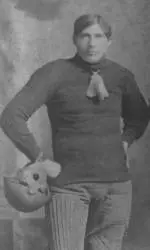
The outcome was completely different and unexpected from the first game. A&M back J. Platt Turner scored the school's first touchdown against UNC, as the Farmers built an 11-5 advantage at halftime at the open field on the fairgrounds.
A late score by UNC tied the game, allowing the early version of the Tar Heels to save a little face against its younger neighbors. But when the contest ended in an 11-11 tie, it set off an unprecedented celebration for fans of the home team.
"It sent the A&M students off on a wild celebration in Raleigh," reported the News & Observer. "With drum and bugle and flags, they paraded the streets, leaving a perfect din in their wake and stopping now and then to give the college yell."
Students were so excited about the unexpected outcome, they celebrated by torching "Old No. 7," the school's original outhouse. (At the time, there were just six buildings on campus.) It was a regrettable decision for the students, who had no indoor plumbing at the school, other than 10 showers that had been retro-fitted in the basement of Watauga Hall after two young women attending a summer teacher's course died of typhoid caused by a lack of running water.
"[T]he students wished many times they had not been so rash on that night, for it was a long way to the woods across the railroad," R.H. Morrison wrote in an account of his A&M days in the November 1956 edition of the Statelog.
But the deed was done, and the A&M gridiron heroes went on to beat Bingham Academy of Asheville, and play scoreless ties against Guilford and Davidson. It ended the season with a 10-0 loss to Oak Ridge Academy, to finish with a 1-3-2 record.
That didn't prevent the overexcited A&M fans from laying claim to a mythical state championship of colleges and schools, which conveniently left out the University, which at the time was the largest school in the state.
A&M, led by future North Carolina governor and team captain O. Max Gardner, produced two more ties with UNC, in 1902 and 1904. But the teams began to feud over eligibility standards and UNC ended the rivalry from 1906-1918.
That meant A&M's two best teams, in 1907 and 1910, did not play against UNC while rolling to undefeated seasons that earned them the self-proclaimed South Atlantic Championship.
The two teams were firm in refusing to face each other in football, but they did schedule a regular-season basketball game in 1913 in downtown Raleigh, shortly after both schools began their varsity programs. A&M rolled to a 26-18 victory in that game, which the News & Observer described as "the Techs of Raleigh against the classicists of Carolina."
And in March 1919, after both basketball teams laid claim to the state championship, the administrations of the two schools agreed to play a special championship game, again in Raleigh's downtown auditorium, to decide the title.
The Farmers won that game, as well, 39-29. More importantly, the tensions between the two athletics departments eased significantly, and they agreed to face each other again in football. North Carolina won the first game in the renewed rivalry, 13-12, in front of 8,000 fans on the Thursday of the State Fair.
The rivalry game became an annual attraction, and in the following season, NC State College, as the school was now known, finally scored its first victory over its blue-and-white opponents.
John "Runt" Faucette dominated the Tar Heels for two consecutive years, setting up a pair of second-half touchdowns in a 13-3 victory in 1920 and scoring the game's lone touchdown in a 7-0 victory the following year on a 30-yard fumble return.
By then, the school had been fully equipped with indoor plumbing, and there were no outhouses to ignite in celebration of either victory.
You may contact Tim Peeler at tim_peeler@mindspring.com.