North Carolina State University Athletics
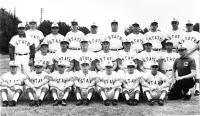
TIM PEELER: Recalling Esposito's 'River Rats'
5/29/2008 12:00:00 AM | Baseball
BY TIM PEELER
It didn’t happen in football or basketball, but on the baseball diamond, behind the guidance of former Chicago White Sox utility-man Sam Esposito.
Four decades later, as the Wolfpack prepares to host the first NCAA Regional in the history of Doak Field at
Esposito, who never had a losing season in his 21 seasons as State’s head baseball coach, didn’t know what kind of team he would have in 1968. In his initial year at the helm, State went 11-11 and there was no reason to believe that the Wolfpack would contend for the school’s first Atlantic Coast Conference championship.
But Esposito had two freshman pitchers, future major leaguer Mike Caldwell of Tarboro and Joe Frye of
It was not an offensively dominant team, though third baseman Chris Cammack and outfielder Steve Martin both won All-America honors that year, thanks in part to timely hitting. The Wolfpack also got help from a pair of football cross-overs, outfielder/defensive end Freddie Combs of Hertford and shortstop/quarterback Darrell Moody of Asheboro, plus some solid catching from Freddie’s brother, Francis Combs.
But it was pitching that helped the Wolfpack win the school’s first ACC title.
Caldwell, who went on to pitch in the majors for 14 years for four different clubs, beat the nationally third-ranked Seminoles 4-1 that evening with a five-hitter, qualifying the Wolfpack for the College World Series in Omaha, Neb., and giving the baseball world a peek at his future success.
The native of Tarboro eventually pitched for the San Diego Padres, the San Franscisco Giants, the Cincinnati Reds and the Milwaukee Brewers. He had a career record of 137-130, including two of the Brewers’ victories in the 1982 World Series. In 1978,
As a freshman, however, his fastball/sinker combination helped the Wolfpack accomplish something that hadn’t been done in the school’s 65 seasons of baseball before or the 38 seasons afterwards: a trip to the College World Series.
The three pitchers each compiled 8-2 records for the season, and combined to pitch 21 complete games during the Wolfpack’s 34-game schedule. The three pitched 14 complete games in the Pack’s final 16 regular-season games, with Cheek pitching the second half of the season with a broken toe he suffered while jumping down steps while trying to sneak out of the school infirmary.
It was a remarkable season for Esposito’s two dozen “River Rats,” all but three of whom hailed from
There wasn’t a lot of power on the team, even though the Wolfpack averaged nearly seven runs a game. Most of them were manufactured, with steals, hit-and-runs and squeeze plays, the kind of go-go game that Esposito played with the White Sox.
The Wolfpack, which hit only 12 home runs all season, stole more than three times as many bases (59-19) as its opponents and averaged more than nine hits a game.
It was a team that was well-schooled in fundamentals of hitting.
“Esposito made us work hard at the fundamentals,” said Francis Combs, the starting catcher in 33 of the 34 games that season. “We did a lot of hit-and-run, a lot of bunting. He played the game the way it should be played.
“He didn’t let us overlook the little things, like hitting the ball to right side with a man on second to get him to third base. We did a lot of double-steals and squeeze plays. We did a lot of fundamental stuff in practice, like pitchers covering first base, the kind of stuff you hate to do. But we did it all the time, stuff I don’t remember us working on before.”
In
The next game was against powerful
Smith pitched admirably against the nation’s top-ranked team, allowing eight hits in eight innings. But, for the first time all season, the Wolfpack offense failed to produce a run, and the season ended with a 2-0 loss.
The offense had three opportunities late in the game, but each was squelched by a big defensive play. In the sixth, Francis Combs led off with a single. After a fielder’s choice by Smith, Clem Huffman hit a shot to the gap between centerfield and leftfield that was snagged by the Trojan centerfielder.
The Wolfpack loaded the bases with three singles in the seventh, but that threat ended on a double play. Martin, the outfielder from Lawsonville who was the Wolfpack team captain in 1969, opened the ninth inning with a double, but no one was able to get him in against USC starter Bob Vaughan, one of the few times during the 25-9 season that the Wolfpack failed to get a clutch hit.
And, even though the Pack came up short in that trip to
“They are so proud of this school and so proud of what they accomplished,” Avent said. “I know all those guys, from Chris Cammack to Mike Caldwell, whose son played here, to Francis Combs, whose two sons played here. Freddie Combs still comes out here to shag fly balls every now and then. Alex Cheek, who lives here in
“They are all so proud of what they did, so proud of their university and so proud of what this program continues to do.”
The only thing that would have made them prouder would be if they had gotten a little more offense in
You may contact Tim Peeler at tim_peeler@ncsu.edu.