
North Carolina State University Athletics
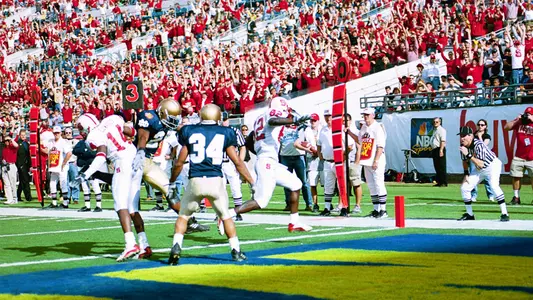
Wolfpack Has Storied History Playing in the Gator Bowl
12/31/2020 8:23:00 AM | Football
Editor's Note: In advance of Saturday's TaxSlayer Gator Bowl matchup between NC State and Kentucky, here's a brief history of NC State's previous four Gator Bowl appearances.
By Tim Peeler, for GoPack.com. He can be reached at tmpeeler@ncsu.edu.
2nd Gator Bowl
Jan. 1, 1947
Oklahoma 34, NC State 13
It was the year that the Wolfpack was supposed to fade away.
Instead, the 1946 NC State College football team did exactly what its head coach promised when a preseason nickname squabble erupted.
"We'll field a growling, rip-snorting team no matter what the mascot," said Beattie Feathers. "So the choice [for a new nickname] better be good to keep pace with the boys."
By the time the season ended, with the growling Pack headed to Jacksonville, Fla., to face Oklahoma in the first bowl game in NC State College history and the second Gator Bowl ever played, the Wolfpack was stronger than it had been before the first great war, back when the teams were still known as "Farmers", "Aggies" and "Techsters."
At issue prior to the 1946 season was the football team's 25-year-old nickname, "The Wolfpack" – which will celebrated its 100th anniversary in 2021. Chancellor John W. Harrelson, a U.S. Army colonel who served in both world wars, didn't like the moniker because of its association with the German U-boat fleet.
"[It] should have never been chosen in the first place," Harrelson said. "The only thing lower than a wolf is a snake in the grass."
Since 1921, when an anonymous alumnus suggested "Wolfpack" as a new nickname, the football team was the only athletics team on campus to use that canine name. All others were known as the "Red Terrors."
Feathers, the former Tennessee standout and the first running back in the history of the NFL to rush for 1,000 yards, didn't really care about the name. The third-year coach just wanted to build a winning football program, using the single-wing offense he helped made famous with the Volunteers as a hall of fame tailback.
His first two seasons were successful – especially given that NC State was drawing from a small pool of qualified athletes. The Pack went 7-2 and 3-6 during those seasons, led by the exploits of speedy half back Howard "Touchdown" Turner of Rocky Mount, N.C., even though the team pulled from just 700 college and military 4-F (medically unqualified to serve) students.
Feathers had high expectations for his third edition of the Wolfpack, but the opposition did not: State was chosen as the Homecoming patsy for Clemson, Wake Forest and Virginia Tech. The season started with a difficult task – facing the mighty Duke Blue Devils of head coach Wallace Wade at Riddick Stadium. The Pack hadn't beaten the Blue Devils since 1932 and was outscored 359-32 during the 12-game losing streak. Just three years earlier, in the Blue Devils' last trip to Riddick Stadium, it whipped the Wolfpack 75-0.
In a rare occurrence, the Big Four neighbors opened the season against each other. It was the first time since the Japanese attack on Pearl Harbor that the Wolfpack fielded a team drawn from a fully stocked student body that had swelled to nearly 5,000 recent high school graduates and discharged war veterans.
Turner, a two-time All-Southern Conference player who was eager to have a big senior year, and junior tailback back Charlie Richkus were two of just 14 lettermen who returned for Feathers' Wolfpack.
The rest of the lineup was stocked with newcomers, like lineman Barney "Killer" Watts, a Pacific Theater Marine veteran, who anchored the offensive and defensive lines at just 168 pounds; Texas-born George "Buck" Blomquist, who had played basketball on one of the Everett Case-coached Iowa Pre-Flight basketball teams during the war and followed Case to Raleigh to play end for the football team; dangerous fullback and punter Leslie "Footsie" Palmer and speedy tailback Gwyn Fletcher, who joined Turner in the high-scoring backfield.
Others, like twins John and Fred Wagoner, had played football at State long before Feathers arrived and returned to complete their careers. John later became a longtime star in the Canadian Football League, and later in life he and Fred operated a Greensboro Christmas tree lot. Team captain Curt Ramsey first enrolled at NC State in 1938, missed a year because of a broken leg, played semi-pro baseball in his native West Virginia, enlisted in the U.S. Army in 1940, spent three rugged years serving in Belgium and France and returned to NC State to play football and baseball and earned a degree in textiles in 1949. [Read more about veterans who played on that team in this NC State Magazine story.]
Blomquist wasn't the only contribution Case made to the football squad – the coach's top assistant, Carl "Butter" Anderson, was also an assistant football coach for the Wolfpack, along with Lyle Rich, Bob Suffridge and Babe Wood.
The Blue Devils were again coached by Wallace Wade, who had enrolled in the Army soon after leading Duke in the 1942 Rose Bowl, the only time before the 2020 season the game was not played in Pasadena, California. He returned expecting to continue his team's roll over the Wolfpack. Early in the game, that seemed likely, as the Blue Devils scored on its first possession to take a 7-0 lead.
The Wolfpack defense held for the rest of the game, and Richkus quickly became a hero by throwing a 33-yard touchdown pass in the third quarter and then scored the winning touchdown with just 10 seconds to play to give his team the upset victory.
The Wolfpack won its next three games – over Clemson, Davidson and Wake Forest – and rose to No. 12 in a national football poll. Even after it lost two of its next three games – road losses at Virginia Tech (14-7) and Vanderbilt (7-0) – the Wolfpack was still in position to have its best season in years.
For Homecoming, the Pack rolled over Virginia at Riddick Stadium, then traveled to Tampa, Fla., to whip Florida 37-6. It closed out the regular-season with a 28-7 win over Maryland, giving State eight regular-season victories, the most since the 1927 Pack won the school's only Southern Conference championship with a 9-1 overall record.
The entire school and Raleigh community responded to the Wolfpack's opportunity to play the powerful Sooners in Jacksonville, Fla., in the second-annual Gator Bowl. Special trains with school officials traveled to Florida just after Christmas. A train full of State College students left Raleigh at 10 p.m. on New Year's Eve, celebrated the change in calendar on the rails and arrived just in time for the 3:30 p.m. game.
More than 10,000 people squeezed into Municipal Stadium, which at the time had seating for just 7,600 spectators. The Wolfpack, unaccustomed to postseason play, was led onto the field by State College's Red Coat Band, which had previous bowl experience, having entertained the crowd at halftime of the 1942 Rose Bowl between Duke and Oregon State.
Oklahoma, which entered the game a three-touchdown favorite under first-year head coach (and UNC graduate) Jim Tatum, scored in the game's first two minutes, but the Wolfpack answered with a 58-yard touchdown pass from Turner to Al Phillips.
The Sooners scored three times in the second quarter to seize the game's momentum and the Pack squandered three more scoring chances. Every member of the Wolfpack roster went to his grave believing that Tatum's team had somehow acquired a copy of Feathers' playbook and capitalized on that knowledge to thwart three State scoring opportunities.
Palmer scored on an 8-yard run in the third quarter, but the Sooners answered for a 34-13 victory that fulfilled the odds makers' prophecy to the point in Oklahoma's first ever bowl victory.
The legacy of that first bowl season, and the Case-coached Southern Conference basketball championship that followed that spring, was that Harrelson's charge to change the school's nickname fell flat on its snout.
Students eventually voted overwhelmingly to continue calling the football team the "Wolfpack," with all other sports team adopting that nickname at the beginning of the 1947 school year.
48th Outback Gator Bowl
Dec. 31, 1992
Florida 27, NC State 10
The dense fog that rolled in off the St. Johns River on New Year's Eve 1992 was not exactly biblical. It didn't come in low to the ground.
So maybe it's a stretch to say that every first-born son in the crowd of 71,233 at Jacksonville's Gator Bowl Stadium was in jeopardy on that Thursday night, but not one of them would have been surprised if Charlton Heston or the late Yul Brynner from The Ten Commandments showed up for halftime entertainment.
All day long, a winter low-pressure front covered the city of Jacksonville in a dull gray mist. When the game between NC State and Florida began that evening, visibility was fine, though neither of the high-scoring teams could find the end zone in the scoreless first quarter.
By the second quarter, neither team could actually see the end zone, as the odorless miasma settled in over the top of the stadium.
"It was real foggy," says Anthony Barbour, the Wolfpack's leading rusher that season and now the head coach at Durham's Jordan High School. "It affected everything we wanted to do in the game."
How foggy was it?
"By the second half, we couldn't see the fans at all from the field," Barbour says.
Likewise, few in the stadium that night saw what happened after halftime. NC State's assistant coaches left the press box at halftime and never returned, making all play calls from the sidelines the rest of the night.
The commentary of the TBS crew of Gary Bender and Pat Haden should have come with a "inspired by real events" message, because their account of what happened was as fictionalized as the ticker-reading radio broadcaster calling road games in Bull Durham.
When a smoke bomb was thrown from the stands onto the field late in the game, Haden said "I couldn't tell."
The low visibility gave press box wags, unencumbered by seeing actual plays of the game, the opportunity to wax poetic in their next morning editions.
"A thick fog tumbled over the north stands and began filling the stadium in the first quarter," wrote Orlando Sentinel columnist Larry Guest. "From the press box, the players on the field soon became hazy wisps, and the far side of the stadium was a rumor."
Maybe that's a good thing.
Dick Sheridan's No. 12 Wolfpack, looking to become the first team in school history to reach double-digit victories and finish in the top 10 of the final Associated Press poll, were favored going into the game against the No. 14 Gators. It had a staunch defense, a high-scoring offense led by low-rumbling Barbour and a coach that was 2-1 against third-year Florida coach Steve Spurrier.
Sheridan's Wolfpack had beaten Spurrier-coached Duke two out of three years in the latter's ACC days.
On this night, however, not even the Cape Hatteras Lighthouse would've helped the Wolfpack against the home-standing Gators.
Spurrier's team came out for the game dressed in all-blue uniforms, looking more like a slow-pitch softball team than a Southeastern Conference power. However, the Gator defense, for the first time all season, played like it had an additional hitter, holding the Wolfpack scoreless in the first half for the first time all season.
Barbour entered the game as the ACC's top rusher, with 1,204 yards in the regular season. He managed a season-low 50 yards on the ground against a Gator defense that had been ranked ninth in the SEC.
Meanwhile, a Gator offense that had relied all season long on the arm of senior quarterback Shane Matthews turned to a different source of power: junior tailback Errict Rhett.
Rhett had led the SEC in rushing the year before, but had been hampered all season by a sore ankle and inexperienced offensive line. He rushed for a career-low 3.6 yards per carry and a total of 903 yards on the ground, more than 200 yards fewer than the year before.
That night in Jacksonville, however, Rhett rolled in silently like the fog and slipped through the Wolfpack defense throughout the game.
The Galloping Ghost carried the ball 39 times and gained 182 yards, which was the second most ever given up by the Wolfpack to an opposing player in a bowl game. He caught a team-high seven passes for another 60 yards. He was the obvious choice as the game's Most Valuable Player.
"I've never carried the ball that many times in my career," an exhausted Rhett said after the game. "I felt it, too."
Meanwhile, the Wolfpack scored twice in the second half, thanks both times to Florida turnovers, though its lone touchdown (an 11-yard pass from Terry Jordan to Aubrey Shaw) in the 27-10 defeat did not affect the game's outcome.
State finished the year 9-3-1 and ranked No. 15 in the final coaches' poll and No. 17 in the final AP poll. It wasn't until nine years later that the Pack finally got its first 10-win season, when Chuck Amato's team beat Notre Dame in the Gator Bowl to finish 11-3 on the year.
One last thing disappeared into the fog that night: Dick Sheridan, though no one would know for another six months that it was his last game with the Wolfpack.
Sheridan waited through spring practice and most of the off-season before announcing his retirement for health reasons on June 30, barely a month before his team began preparing for the 1993 season.
58th Toyota Gator Bowl
Jan. 1, 2003
NC State 28, Notre Dame 6
No one likes to be called a cheater, especially former NC State coach Chuck Amato.
Nor Wolfpack standouts Philip Rivers, Jerricho Cotchery nor Dantonio Burnette.
They all took it a little personally, then, when Notre Dame coach Tyrone Willingham and his staff accused the the Wolfpack of just that in the days leading up to the 58th Gator Bowl on New Year's Day 2003.
And it's one of the primary, if little remembered, reasons that Amato's team wanted so badly to smash the Fighting Irish at what was then called Alltel Stadium.
The rhetoric started before the teams ever arrived in Jacksonville when Willingham and defensive coordinator Kent Baer both questioned the legality of a Wolfpack formation in which four players ran off the field after the offense broke the huddle and four substitutes ran on before the ball was snapped.
They even began lobbying, from afar, the Conference USA crew that was scheduled to officiate the game.
ACC coordinator of officials Tommy Hunt seemingly put the matter to rest with authority, saying as long as the new players were in position for at least three seconds before the snap, it was a legal play. It had not been an issue for any team during the regular season, in which the Wolfpack won its first nine games, lost three in a row, then beat Florida State in its finale to earn a surprising bid to the Gator Bowl for its first ever meeting with the Irish.
"There is nothing wrong with what they do," Hunt said before the game.
Twice during the regular season the Wolfpack had been flagged for illegal substitution and both times the penalty was waved off.
But Willingham, who had coached at NC State for three seasons in the early 1980s, pushed the issue to Defcon 1 with some of his pre-arrival words in which he questioned not only the legality, but also the sportsmanship of the move.
"I think I'm concerned about it in terms of the legality of it and how it affects the overall flow and the sportsmanship and especially our function as a defensive team," he said. "Is that not permitted in the rules? Then it should be prohibited. If it is, then the defense should be allowed equal opportunity to get their people on, so we can match up.
"I would imagine that the Conference USA officials will get films from both our teams and if they see things that are outside the rules, they will make decisions on them. I'm not contending any point of view. I'm just saying if the officials look at this particular patter of substitution and they view it not within the structure of the rules or sportsmanship, that they will make a decision."
Amato, of course, didn't take the veiled pressure on the officials lightly and he went on his own offensive.
"Well good, we'll tell the officials to look at the Purdue game and watch [Notre Dame] beat the crap out of the center on extra points and field goals,'' Amato said.
Notre Dame was penalized for that against the Boilermakers.
It made for some interesting pregame chatter for two teams that had little in common other than Willingham's brief stint as an assistant under Tom Reed with the Wolfpack and a shared relationship with former head coach Lou Holtz.
The Irish came into the game as college football's most storied program, while the Wolfpack and its brash coach yearned for national prestige and acceptance.
Throughout that week, the Irish coaching staff was chafing like a sweaty golfer walking 36 holes on a hot day. They had to deal with a slew of injuries that cost them two offensive linemen and a starting linebacker in their season finale. And they had they distraction shortly after arriving of dealing with senior safety Chad DeBolt was arrested for trespassing after "rowdy and rambunctious" behavior at a Jacksonville Beach nightclub. His bloody mug shot, with both eyes swollen shut and visible marks on his face, was plastered on the front of the local sports page.
Willingham, quite forcefully, refused to talk about the incident and would not discuss DeBolt status for the game.
"Let's make sure we all start on the same page: There will be no reference to Chad DeBolt," Willingham told a gaggle of reporters at practice after the incident. "Just so you know. All right, let's start.''
Amato and his team, huge underdogs against the No. 11 Irish, were loose throughout for several reasons, one of which was the inclusion of a five recruits who joined the team for the bowl trip, including future All-America and No. 1 overall NFL draft pick, defensive end Mario Williams.
Williams, linebacker Ernest Jones and offensive lineman Yomi Ojo had just finished their high school careers and were planning to enroll at NC State when its winter break was over 10 days after the bowl game. The early enrollment was something Rivers popularized three years earlier, but going to the bowl game was a new wrinkle Amato added just for this game. Two remnants from the previous recruiting class, Garland Heath and LaMart Barrett, also joined the team in Jacksonville, as tight end Sean Berton, a transfer from West Virginia, had done the previous year at the Tangerine Bowl.
They all participated in practices, attended team activities and received the same copious amounts of bowl-branded loot that included a watch, a travel bag, a travel alarm clock and various pieces of logoed apparel. They also got championship rings after the game.
It was all perfectly legal, of course, something that Amato had thought about doing at Florida State, but never really found many takers in graduating high school and enrolling early in college. Rivers changed all that, and others followed.
It was a perk that helped Williams—one of the most highly recruited defensive players in the nation—choose NC State over Ohio State, Tennessee and Clemson, all of whom quickly offered up an invitation to join them at their bowl games after they heard Williams' plan to go to Jacksonville.
"Well, why didn't they think of it first?" said the former coach.
The acrimony of the week spilled over into the game. In the first quarter, with the Irish seemingly headed for a touchdown, NC State linebacker Dantonio Burnette knocked Fighting Irish quarterback Carlyle Holliday out of the game with a separated shoulder. The Irish had to settle for a field goal and a 3-0 lead. Carlyle's replacement, Pat Dillingham, threw three interceptions, all to Wolfpack safety Rod Johnson, while the Wolfpack had no turnovers.
The Wolfpack scored three touchdowns in the second quarter, two rushing by freshman T.A. McLendon and a 9-yard pass from Rivers to Cotchery. The first of those drives covered 96 hard-fought yards to give NC State a lead it never gave up. Notre Dame added another field goal after a goal-line stand, but the Wolfpack answered with a touchdown on a 7-yard pass from Rivers to All-ACC tight end Sean Berton.
Notre Dame, hampered by the loss of DeBolt, two suspended linemen and one injured linebacker, committed five personal fouls in the game, as the teams combined for 19 total penalties.
One of those penalties was late in the game, when Amato ran onto the field to argue that Notre Dame broken its huddle with 12 players, an infraction that wasn't called. It was exactly the violation Willingham and his staff had accused the Wolfpack of earlier in the week.
The penalty gave Notre Dame a first-and-goal on the NC State 1-yard line. Amato put his first-team defense back on the field. It stuffed the Irish on four consecutive plays with less than a minute to play and prevented them from entering the painted end zone, as it had done all day long.
The final score, 28-6, didn't seem to indicate just how much the Wolfpack dominated the game.
"I didn't expect to win this game so easily," Berton said afterwards. "I thought they would play hard. But it was an easy win. You saw it.
"We expected to win, but we didn't expect it to be this easy."
For a while, the victory gave the Wolfpack the national respect Amato and his players craved. Rivers was on the front page of USA Today the next day. The team finished No. 12 in the final Associated Press poll, the second highest finish in school history. Sports Illustrated ranked them in their preliminary Top 10 for the 2003 season.
"It was a day we wanted to make one last statement," said Burnette, who is now the Wolfpack's strength and conditioning coach and its designated chief motivator for games against Notre Dame. "It seemed like we were the 'other team' here all week. It was Notre Dame this, Notre Dame that.
"We thought we had something to prove, not just against [the Irish] but to the nation. People have said we were a fraud, that we didn't play anybody, that we were a flukey team, even though we knew we were a good team.
"What do they say now? We just smacked Notre Dame around. What do they say now?"
One thing they couldn't say was that the Wolfpack cheated their way to the victory.
74th TaxSlayer Gator Bowl
Dec. 31, 2018
Texas A&M 52, NC State 13
So, who won the 2018 Gator Bowl?
The scoreboard at TIAA Bank Field clearly showed that Texas A&M owned the team outcome of the game after scoring 31 consecutive points in the second half of a 52-13 victory. The thoroughness of the defeat was as obvious as the Wolfpack's win over Notre Dame some 15 years earlier.
However, there was subplot to that game involving several individual players that is still playing out, one whose conclusion has yet to be determined.
The story preceding the 74th Gator Bowl was about the key players who were opting out of the game, as NC State star Bradley Chubb had done the year before when the Wolfpack played in the Sun Bowl in El Paso, Texas. His absence had little to no bearing on the outcome of a 52-31 Wolfpack win over Arizona State, in which head coach Dave Doeren's team scored a record six rushing touchdowns, three of them by current Indianapolis Colts star Nyheim Hines.
Missing that game did not hurt Chubb's standing in the 2018 NFL draft, as he was taken with the No. 6 pick by the Denver Broncos. Hines' performance may have even increased his draft value, with the Colts taking him in the fourth round of the same draft. Now, the Colts, with Philip Rivers as their quarterback and Jacoby Brissett as his backup, are leading the NFL's AFC South Division going into the final week of regular-season play.
After a strong 5-0 start to the 2018 season, the Pack lost three times in four weeks to Clemson, Syracuse and Wake Forest. It finished the season with decisive wins at Louisville, at North Carolina and against East Carolina, in a season-finale makeup after Hurricane Florence wiped out a September game against nationally ranked West Virginia.
The finish put the Pack in second place in the ACC's Atlantic Division and earned the program's fourth invitation to the Gator Bowl. However, two key players chose to follow in Chubb's footsteps from the previous year and skip the bowl: leading receiver Kelvin Harmon and top tackler linebacker Germaine Pratt. Both were first-team All-ACC selections.
Meanwhile, Southeastern Conference selection Texas A&M, making their first appearance in a Florida postseason game in more than half a century, arrived in Jacksonville with a full roster, including running back Trayveon Williams, who entered the game fourth in the nation with 1,524 rushing yards.
Williams had a career day against the Wolfpack. He not only broke the Gator Bowl's 30-year-old rushing record with his 236-yard, three-touchdown performance, he leapfrogged Clemson running back Travis Etienne to finish third in the NCAA rushing yardage list with a school-record 1,524 yards on the year.
His rushing was a big part of the Aggies' second-half surge. Williams, a junior, celebrated with abandon and was named the game's offensive most valuable player. Missing Pratt certainly didn't help the Wolfpack defense, and Harmon's absence gave Wolfpack junior quarterback Ryan Finley one less weapon to counter the Aggies' offensive explosion. At game's end, however, the Aggies owned a decisive victory.
Shortly afterwards, Williams announced that he would forego his final year of eligibility and join both Pratt and Harmon in the 2019 Draft.
And that's what created the on-going subplot. Both Pratt (third round) and Williams (sixth round) were both taken by the Cincinnati Bengals in the 2019 NFL Draft, and Finley followed as a fourth-round pick by the team in 2019. Pratt has been a regular linebacker for the Bengals, starting in 23 of his 34 career games. He shares the team lead with five tackles for loss and is fourth in tackles. Finley, after starting three games as a rookie in 2019, was recently the Bengals starter once again in a 27-17 win over the Pittsburgh Steelers.
Williams, meanwhile, has not been a big contributor for the Bengals in his first two seasons. He's played in 20 games, with no starts, no touchdowns and a total of 83 yards on 22 carries.
The hard-luck Bengals haven't exactly turned around the franchise's fortunes, missing the playoffs for the fifth consecutive season.
Harmon, a sixth-round pick of the Washington Redskins in the 2019 draft, stepped immediately into the team's starting lineup as a rookie and had an exception season for a late-round pick, with 30 receptions for 365 yards. However, during a summer off-season workout, Harmon suffered a torn ACL and has missed the Washington Football Team's improved 2020 season, which stands at 6-9 going into its final game.
By Tim Peeler, for GoPack.com. He can be reached at tmpeeler@ncsu.edu.
2nd Gator Bowl
Jan. 1, 1947
Oklahoma 34, NC State 13
It was the year that the Wolfpack was supposed to fade away.
Instead, the 1946 NC State College football team did exactly what its head coach promised when a preseason nickname squabble erupted.
"We'll field a growling, rip-snorting team no matter what the mascot," said Beattie Feathers. "So the choice [for a new nickname] better be good to keep pace with the boys."
By the time the season ended, with the growling Pack headed to Jacksonville, Fla., to face Oklahoma in the first bowl game in NC State College history and the second Gator Bowl ever played, the Wolfpack was stronger than it had been before the first great war, back when the teams were still known as "Farmers", "Aggies" and "Techsters."
At issue prior to the 1946 season was the football team's 25-year-old nickname, "The Wolfpack" – which will celebrated its 100th anniversary in 2021. Chancellor John W. Harrelson, a U.S. Army colonel who served in both world wars, didn't like the moniker because of its association with the German U-boat fleet.
"[It] should have never been chosen in the first place," Harrelson said. "The only thing lower than a wolf is a snake in the grass."
Since 1921, when an anonymous alumnus suggested "Wolfpack" as a new nickname, the football team was the only athletics team on campus to use that canine name. All others were known as the "Red Terrors."
Feathers, the former Tennessee standout and the first running back in the history of the NFL to rush for 1,000 yards, didn't really care about the name. The third-year coach just wanted to build a winning football program, using the single-wing offense he helped made famous with the Volunteers as a hall of fame tailback.
His first two seasons were successful – especially given that NC State was drawing from a small pool of qualified athletes. The Pack went 7-2 and 3-6 during those seasons, led by the exploits of speedy half back Howard "Touchdown" Turner of Rocky Mount, N.C., even though the team pulled from just 700 college and military 4-F (medically unqualified to serve) students.
Feathers had high expectations for his third edition of the Wolfpack, but the opposition did not: State was chosen as the Homecoming patsy for Clemson, Wake Forest and Virginia Tech. The season started with a difficult task – facing the mighty Duke Blue Devils of head coach Wallace Wade at Riddick Stadium. The Pack hadn't beaten the Blue Devils since 1932 and was outscored 359-32 during the 12-game losing streak. Just three years earlier, in the Blue Devils' last trip to Riddick Stadium, it whipped the Wolfpack 75-0.
In a rare occurrence, the Big Four neighbors opened the season against each other. It was the first time since the Japanese attack on Pearl Harbor that the Wolfpack fielded a team drawn from a fully stocked student body that had swelled to nearly 5,000 recent high school graduates and discharged war veterans.
Turner, a two-time All-Southern Conference player who was eager to have a big senior year, and junior tailback back Charlie Richkus were two of just 14 lettermen who returned for Feathers' Wolfpack.
The rest of the lineup was stocked with newcomers, like lineman Barney "Killer" Watts, a Pacific Theater Marine veteran, who anchored the offensive and defensive lines at just 168 pounds; Texas-born George "Buck" Blomquist, who had played basketball on one of the Everett Case-coached Iowa Pre-Flight basketball teams during the war and followed Case to Raleigh to play end for the football team; dangerous fullback and punter Leslie "Footsie" Palmer and speedy tailback Gwyn Fletcher, who joined Turner in the high-scoring backfield.
Others, like twins John and Fred Wagoner, had played football at State long before Feathers arrived and returned to complete their careers. John later became a longtime star in the Canadian Football League, and later in life he and Fred operated a Greensboro Christmas tree lot. Team captain Curt Ramsey first enrolled at NC State in 1938, missed a year because of a broken leg, played semi-pro baseball in his native West Virginia, enlisted in the U.S. Army in 1940, spent three rugged years serving in Belgium and France and returned to NC State to play football and baseball and earned a degree in textiles in 1949. [Read more about veterans who played on that team in this NC State Magazine story.]
Blomquist wasn't the only contribution Case made to the football squad – the coach's top assistant, Carl "Butter" Anderson, was also an assistant football coach for the Wolfpack, along with Lyle Rich, Bob Suffridge and Babe Wood.
The Blue Devils were again coached by Wallace Wade, who had enrolled in the Army soon after leading Duke in the 1942 Rose Bowl, the only time before the 2020 season the game was not played in Pasadena, California. He returned expecting to continue his team's roll over the Wolfpack. Early in the game, that seemed likely, as the Blue Devils scored on its first possession to take a 7-0 lead.
The Wolfpack defense held for the rest of the game, and Richkus quickly became a hero by throwing a 33-yard touchdown pass in the third quarter and then scored the winning touchdown with just 10 seconds to play to give his team the upset victory.
The Wolfpack won its next three games – over Clemson, Davidson and Wake Forest – and rose to No. 12 in a national football poll. Even after it lost two of its next three games – road losses at Virginia Tech (14-7) and Vanderbilt (7-0) – the Wolfpack was still in position to have its best season in years.
For Homecoming, the Pack rolled over Virginia at Riddick Stadium, then traveled to Tampa, Fla., to whip Florida 37-6. It closed out the regular-season with a 28-7 win over Maryland, giving State eight regular-season victories, the most since the 1927 Pack won the school's only Southern Conference championship with a 9-1 overall record.
The entire school and Raleigh community responded to the Wolfpack's opportunity to play the powerful Sooners in Jacksonville, Fla., in the second-annual Gator Bowl. Special trains with school officials traveled to Florida just after Christmas. A train full of State College students left Raleigh at 10 p.m. on New Year's Eve, celebrated the change in calendar on the rails and arrived just in time for the 3:30 p.m. game.
More than 10,000 people squeezed into Municipal Stadium, which at the time had seating for just 7,600 spectators. The Wolfpack, unaccustomed to postseason play, was led onto the field by State College's Red Coat Band, which had previous bowl experience, having entertained the crowd at halftime of the 1942 Rose Bowl between Duke and Oregon State.
Oklahoma, which entered the game a three-touchdown favorite under first-year head coach (and UNC graduate) Jim Tatum, scored in the game's first two minutes, but the Wolfpack answered with a 58-yard touchdown pass from Turner to Al Phillips.
The Sooners scored three times in the second quarter to seize the game's momentum and the Pack squandered three more scoring chances. Every member of the Wolfpack roster went to his grave believing that Tatum's team had somehow acquired a copy of Feathers' playbook and capitalized on that knowledge to thwart three State scoring opportunities.
Palmer scored on an 8-yard run in the third quarter, but the Sooners answered for a 34-13 victory that fulfilled the odds makers' prophecy to the point in Oklahoma's first ever bowl victory.
The legacy of that first bowl season, and the Case-coached Southern Conference basketball championship that followed that spring, was that Harrelson's charge to change the school's nickname fell flat on its snout.
Students eventually voted overwhelmingly to continue calling the football team the "Wolfpack," with all other sports team adopting that nickname at the beginning of the 1947 school year.
48th Outback Gator Bowl
Dec. 31, 1992
Florida 27, NC State 10
The dense fog that rolled in off the St. Johns River on New Year's Eve 1992 was not exactly biblical. It didn't come in low to the ground.
So maybe it's a stretch to say that every first-born son in the crowd of 71,233 at Jacksonville's Gator Bowl Stadium was in jeopardy on that Thursday night, but not one of them would have been surprised if Charlton Heston or the late Yul Brynner from The Ten Commandments showed up for halftime entertainment.
All day long, a winter low-pressure front covered the city of Jacksonville in a dull gray mist. When the game between NC State and Florida began that evening, visibility was fine, though neither of the high-scoring teams could find the end zone in the scoreless first quarter.
By the second quarter, neither team could actually see the end zone, as the odorless miasma settled in over the top of the stadium.
"It was real foggy," says Anthony Barbour, the Wolfpack's leading rusher that season and now the head coach at Durham's Jordan High School. "It affected everything we wanted to do in the game."
How foggy was it?
"By the second half, we couldn't see the fans at all from the field," Barbour says.
Likewise, few in the stadium that night saw what happened after halftime. NC State's assistant coaches left the press box at halftime and never returned, making all play calls from the sidelines the rest of the night.
The commentary of the TBS crew of Gary Bender and Pat Haden should have come with a "inspired by real events" message, because their account of what happened was as fictionalized as the ticker-reading radio broadcaster calling road games in Bull Durham.
When a smoke bomb was thrown from the stands onto the field late in the game, Haden said "I couldn't tell."
The low visibility gave press box wags, unencumbered by seeing actual plays of the game, the opportunity to wax poetic in their next morning editions.
"A thick fog tumbled over the north stands and began filling the stadium in the first quarter," wrote Orlando Sentinel columnist Larry Guest. "From the press box, the players on the field soon became hazy wisps, and the far side of the stadium was a rumor."
Maybe that's a good thing.
Dick Sheridan's No. 12 Wolfpack, looking to become the first team in school history to reach double-digit victories and finish in the top 10 of the final Associated Press poll, were favored going into the game against the No. 14 Gators. It had a staunch defense, a high-scoring offense led by low-rumbling Barbour and a coach that was 2-1 against third-year Florida coach Steve Spurrier.
Sheridan's Wolfpack had beaten Spurrier-coached Duke two out of three years in the latter's ACC days.
On this night, however, not even the Cape Hatteras Lighthouse would've helped the Wolfpack against the home-standing Gators.
Spurrier's team came out for the game dressed in all-blue uniforms, looking more like a slow-pitch softball team than a Southeastern Conference power. However, the Gator defense, for the first time all season, played like it had an additional hitter, holding the Wolfpack scoreless in the first half for the first time all season.
Barbour entered the game as the ACC's top rusher, with 1,204 yards in the regular season. He managed a season-low 50 yards on the ground against a Gator defense that had been ranked ninth in the SEC.
Meanwhile, a Gator offense that had relied all season long on the arm of senior quarterback Shane Matthews turned to a different source of power: junior tailback Errict Rhett.
Rhett had led the SEC in rushing the year before, but had been hampered all season by a sore ankle and inexperienced offensive line. He rushed for a career-low 3.6 yards per carry and a total of 903 yards on the ground, more than 200 yards fewer than the year before.
That night in Jacksonville, however, Rhett rolled in silently like the fog and slipped through the Wolfpack defense throughout the game.
The Galloping Ghost carried the ball 39 times and gained 182 yards, which was the second most ever given up by the Wolfpack to an opposing player in a bowl game. He caught a team-high seven passes for another 60 yards. He was the obvious choice as the game's Most Valuable Player.
"I've never carried the ball that many times in my career," an exhausted Rhett said after the game. "I felt it, too."
Meanwhile, the Wolfpack scored twice in the second half, thanks both times to Florida turnovers, though its lone touchdown (an 11-yard pass from Terry Jordan to Aubrey Shaw) in the 27-10 defeat did not affect the game's outcome.
State finished the year 9-3-1 and ranked No. 15 in the final coaches' poll and No. 17 in the final AP poll. It wasn't until nine years later that the Pack finally got its first 10-win season, when Chuck Amato's team beat Notre Dame in the Gator Bowl to finish 11-3 on the year.
One last thing disappeared into the fog that night: Dick Sheridan, though no one would know for another six months that it was his last game with the Wolfpack.
Sheridan waited through spring practice and most of the off-season before announcing his retirement for health reasons on June 30, barely a month before his team began preparing for the 1993 season.
58th Toyota Gator Bowl
Jan. 1, 2003
NC State 28, Notre Dame 6
No one likes to be called a cheater, especially former NC State coach Chuck Amato.
Nor Wolfpack standouts Philip Rivers, Jerricho Cotchery nor Dantonio Burnette.
They all took it a little personally, then, when Notre Dame coach Tyrone Willingham and his staff accused the the Wolfpack of just that in the days leading up to the 58th Gator Bowl on New Year's Day 2003.
And it's one of the primary, if little remembered, reasons that Amato's team wanted so badly to smash the Fighting Irish at what was then called Alltel Stadium.
The rhetoric started before the teams ever arrived in Jacksonville when Willingham and defensive coordinator Kent Baer both questioned the legality of a Wolfpack formation in which four players ran off the field after the offense broke the huddle and four substitutes ran on before the ball was snapped.
They even began lobbying, from afar, the Conference USA crew that was scheduled to officiate the game.
ACC coordinator of officials Tommy Hunt seemingly put the matter to rest with authority, saying as long as the new players were in position for at least three seconds before the snap, it was a legal play. It had not been an issue for any team during the regular season, in which the Wolfpack won its first nine games, lost three in a row, then beat Florida State in its finale to earn a surprising bid to the Gator Bowl for its first ever meeting with the Irish.
"There is nothing wrong with what they do," Hunt said before the game.
Twice during the regular season the Wolfpack had been flagged for illegal substitution and both times the penalty was waved off.
But Willingham, who had coached at NC State for three seasons in the early 1980s, pushed the issue to Defcon 1 with some of his pre-arrival words in which he questioned not only the legality, but also the sportsmanship of the move.
"I think I'm concerned about it in terms of the legality of it and how it affects the overall flow and the sportsmanship and especially our function as a defensive team," he said. "Is that not permitted in the rules? Then it should be prohibited. If it is, then the defense should be allowed equal opportunity to get their people on, so we can match up.
"I would imagine that the Conference USA officials will get films from both our teams and if they see things that are outside the rules, they will make decisions on them. I'm not contending any point of view. I'm just saying if the officials look at this particular patter of substitution and they view it not within the structure of the rules or sportsmanship, that they will make a decision."
Amato, of course, didn't take the veiled pressure on the officials lightly and he went on his own offensive.
"Well good, we'll tell the officials to look at the Purdue game and watch [Notre Dame] beat the crap out of the center on extra points and field goals,'' Amato said.
Notre Dame was penalized for that against the Boilermakers.
It made for some interesting pregame chatter for two teams that had little in common other than Willingham's brief stint as an assistant under Tom Reed with the Wolfpack and a shared relationship with former head coach Lou Holtz.
The Irish came into the game as college football's most storied program, while the Wolfpack and its brash coach yearned for national prestige and acceptance.
Throughout that week, the Irish coaching staff was chafing like a sweaty golfer walking 36 holes on a hot day. They had to deal with a slew of injuries that cost them two offensive linemen and a starting linebacker in their season finale. And they had they distraction shortly after arriving of dealing with senior safety Chad DeBolt was arrested for trespassing after "rowdy and rambunctious" behavior at a Jacksonville Beach nightclub. His bloody mug shot, with both eyes swollen shut and visible marks on his face, was plastered on the front of the local sports page.
Willingham, quite forcefully, refused to talk about the incident and would not discuss DeBolt status for the game.
"Let's make sure we all start on the same page: There will be no reference to Chad DeBolt," Willingham told a gaggle of reporters at practice after the incident. "Just so you know. All right, let's start.''
Amato and his team, huge underdogs against the No. 11 Irish, were loose throughout for several reasons, one of which was the inclusion of a five recruits who joined the team for the bowl trip, including future All-America and No. 1 overall NFL draft pick, defensive end Mario Williams.
Williams, linebacker Ernest Jones and offensive lineman Yomi Ojo had just finished their high school careers and were planning to enroll at NC State when its winter break was over 10 days after the bowl game. The early enrollment was something Rivers popularized three years earlier, but going to the bowl game was a new wrinkle Amato added just for this game. Two remnants from the previous recruiting class, Garland Heath and LaMart Barrett, also joined the team in Jacksonville, as tight end Sean Berton, a transfer from West Virginia, had done the previous year at the Tangerine Bowl.
They all participated in practices, attended team activities and received the same copious amounts of bowl-branded loot that included a watch, a travel bag, a travel alarm clock and various pieces of logoed apparel. They also got championship rings after the game.
It was all perfectly legal, of course, something that Amato had thought about doing at Florida State, but never really found many takers in graduating high school and enrolling early in college. Rivers changed all that, and others followed.
It was a perk that helped Williams—one of the most highly recruited defensive players in the nation—choose NC State over Ohio State, Tennessee and Clemson, all of whom quickly offered up an invitation to join them at their bowl games after they heard Williams' plan to go to Jacksonville.
"Well, why didn't they think of it first?" said the former coach.
The acrimony of the week spilled over into the game. In the first quarter, with the Irish seemingly headed for a touchdown, NC State linebacker Dantonio Burnette knocked Fighting Irish quarterback Carlyle Holliday out of the game with a separated shoulder. The Irish had to settle for a field goal and a 3-0 lead. Carlyle's replacement, Pat Dillingham, threw three interceptions, all to Wolfpack safety Rod Johnson, while the Wolfpack had no turnovers.
The Wolfpack scored three touchdowns in the second quarter, two rushing by freshman T.A. McLendon and a 9-yard pass from Rivers to Cotchery. The first of those drives covered 96 hard-fought yards to give NC State a lead it never gave up. Notre Dame added another field goal after a goal-line stand, but the Wolfpack answered with a touchdown on a 7-yard pass from Rivers to All-ACC tight end Sean Berton.
Notre Dame, hampered by the loss of DeBolt, two suspended linemen and one injured linebacker, committed five personal fouls in the game, as the teams combined for 19 total penalties.
One of those penalties was late in the game, when Amato ran onto the field to argue that Notre Dame broken its huddle with 12 players, an infraction that wasn't called. It was exactly the violation Willingham and his staff had accused the Wolfpack of earlier in the week.
The penalty gave Notre Dame a first-and-goal on the NC State 1-yard line. Amato put his first-team defense back on the field. It stuffed the Irish on four consecutive plays with less than a minute to play and prevented them from entering the painted end zone, as it had done all day long.
The final score, 28-6, didn't seem to indicate just how much the Wolfpack dominated the game.
"I didn't expect to win this game so easily," Berton said afterwards. "I thought they would play hard. But it was an easy win. You saw it.
"We expected to win, but we didn't expect it to be this easy."
For a while, the victory gave the Wolfpack the national respect Amato and his players craved. Rivers was on the front page of USA Today the next day. The team finished No. 12 in the final Associated Press poll, the second highest finish in school history. Sports Illustrated ranked them in their preliminary Top 10 for the 2003 season.
"It was a day we wanted to make one last statement," said Burnette, who is now the Wolfpack's strength and conditioning coach and its designated chief motivator for games against Notre Dame. "It seemed like we were the 'other team' here all week. It was Notre Dame this, Notre Dame that.
"We thought we had something to prove, not just against [the Irish] but to the nation. People have said we were a fraud, that we didn't play anybody, that we were a flukey team, even though we knew we were a good team.
"What do they say now? We just smacked Notre Dame around. What do they say now?"
One thing they couldn't say was that the Wolfpack cheated their way to the victory.
74th TaxSlayer Gator Bowl
Dec. 31, 2018
Texas A&M 52, NC State 13
So, who won the 2018 Gator Bowl?
The scoreboard at TIAA Bank Field clearly showed that Texas A&M owned the team outcome of the game after scoring 31 consecutive points in the second half of a 52-13 victory. The thoroughness of the defeat was as obvious as the Wolfpack's win over Notre Dame some 15 years earlier.
However, there was subplot to that game involving several individual players that is still playing out, one whose conclusion has yet to be determined.
The story preceding the 74th Gator Bowl was about the key players who were opting out of the game, as NC State star Bradley Chubb had done the year before when the Wolfpack played in the Sun Bowl in El Paso, Texas. His absence had little to no bearing on the outcome of a 52-31 Wolfpack win over Arizona State, in which head coach Dave Doeren's team scored a record six rushing touchdowns, three of them by current Indianapolis Colts star Nyheim Hines.
Missing that game did not hurt Chubb's standing in the 2018 NFL draft, as he was taken with the No. 6 pick by the Denver Broncos. Hines' performance may have even increased his draft value, with the Colts taking him in the fourth round of the same draft. Now, the Colts, with Philip Rivers as their quarterback and Jacoby Brissett as his backup, are leading the NFL's AFC South Division going into the final week of regular-season play.
After a strong 5-0 start to the 2018 season, the Pack lost three times in four weeks to Clemson, Syracuse and Wake Forest. It finished the season with decisive wins at Louisville, at North Carolina and against East Carolina, in a season-finale makeup after Hurricane Florence wiped out a September game against nationally ranked West Virginia.
The finish put the Pack in second place in the ACC's Atlantic Division and earned the program's fourth invitation to the Gator Bowl. However, two key players chose to follow in Chubb's footsteps from the previous year and skip the bowl: leading receiver Kelvin Harmon and top tackler linebacker Germaine Pratt. Both were first-team All-ACC selections.
Meanwhile, Southeastern Conference selection Texas A&M, making their first appearance in a Florida postseason game in more than half a century, arrived in Jacksonville with a full roster, including running back Trayveon Williams, who entered the game fourth in the nation with 1,524 rushing yards.
Williams had a career day against the Wolfpack. He not only broke the Gator Bowl's 30-year-old rushing record with his 236-yard, three-touchdown performance, he leapfrogged Clemson running back Travis Etienne to finish third in the NCAA rushing yardage list with a school-record 1,524 yards on the year.
His rushing was a big part of the Aggies' second-half surge. Williams, a junior, celebrated with abandon and was named the game's offensive most valuable player. Missing Pratt certainly didn't help the Wolfpack defense, and Harmon's absence gave Wolfpack junior quarterback Ryan Finley one less weapon to counter the Aggies' offensive explosion. At game's end, however, the Aggies owned a decisive victory.
Shortly afterwards, Williams announced that he would forego his final year of eligibility and join both Pratt and Harmon in the 2019 Draft.
And that's what created the on-going subplot. Both Pratt (third round) and Williams (sixth round) were both taken by the Cincinnati Bengals in the 2019 NFL Draft, and Finley followed as a fourth-round pick by the team in 2019. Pratt has been a regular linebacker for the Bengals, starting in 23 of his 34 career games. He shares the team lead with five tackles for loss and is fourth in tackles. Finley, after starting three games as a rookie in 2019, was recently the Bengals starter once again in a 27-17 win over the Pittsburgh Steelers.
Williams, meanwhile, has not been a big contributor for the Bengals in his first two seasons. He's played in 20 games, with no starts, no touchdowns and a total of 83 yards on 22 carries.
The hard-luck Bengals haven't exactly turned around the franchise's fortunes, missing the playoffs for the fifth consecutive season.
Harmon, a sixth-round pick of the Washington Redskins in the 2019 draft, stepped immediately into the team's starting lineup as a rookie and had an exception season for a late-round pick, with 30 receptions for 365 yards. However, during a summer off-season workout, Harmon suffered a torn ACL and has missed the Washington Football Team's improved 2020 season, which stands at 6-9 going into its final game.
Players Mentioned
DE
/ Football
QB
/ Football
WR
/ Football
RB
/ Football
LB
/ FootballTuesday, September 29
Monday, September 28
Sunday, September 27
Sunday, September 27