
North Carolina State University Athletics
Dick Sheridan Has Strong ties to Both NC State and Furman
9/14/2017 8:50:00 AM | Football
BY TIM PEELER
Copyright 2016, The Wolfpacker and Coman Publishing
RALEIGH, N.C. - As soon as he arrived, everyone in NC State's athletics program knew newly hired football coach Dick Sheridan was just a little different.
He was kind of quiet, but unquestionably successful. He had a stubborn streak, but he was doggedly successful. He didn't recruit big name players, but he was consistently successful. He had a staff that, as athletics director and men's basketball coach Jim Valvano once said, made Gomer Pyle look like he was from Manhattan, but they were always well-prepared and successful.
And, unlike anyone before or after him, Sheridan got the job done immediately.
NC State athletics director Willis Casey, who had watched the Sheridan-coached Furman Paladins beat the Wolfpack in Carter-Finley Stadium in both 1984 and '85, had an inkling that would happen, which is why he often said regarding Sheridan, "if you can't beat 'em, hire 'em."
In December 1985, Casey did just that, bringing Sheridan to Raleigh from Furman to replace Tom Reed after three consecutive 3-8 seasons. There was no momentum in the football program, and not much reason to believe there would be any for a while.
Oh, the Wolfpack did have a pretty good quarterback in junior college transfer Erik Kramer, who was named first-team All-ACC as a junior in 1985. But he was the only Wolfpack player to make the first or second team.
Sheridan did inherit a good corps of wide receivers in Haywood Jeffires, who flowed to Raleigh from the old Guilford County pipeline that had funneled so many star players to Carter-Finley Stadium, along with Nasrallah Worthen and Danny Peebles, a pair of track stars whose talents translated to football.
No one, however, expected much other than a long rebuilding process when Sheridan arrived, fresh from taking Furman to the Division I-AA (now Football Championship Series) title game against Georgia Southern. For his efforts, Sheridan was named the American Football Coaches Association I-AA Coach of the Year.
Sheridan, the winningest active coach in I-AA football at the time, had different ideas. He wanted to have immediate success to build some credibility at college football's highest level, after being a South Carolina superstar against high school and small-college competition, despite the fact that he inherited the ACC's worst defense. In 1985, the Wolfpack gave up 28 points and nearly 380 yards a game.
His style seemed a little ill-suited for success against the ACC's top programs, which at the time were Clemson, Maryland and Georgia Tech. Virginia was rising, Duke had Steve Spurrier and North Carolina was fading under the lack-of-personality of head coach Dick Crum.
Sheridan and his staff, though, were certain they could build a program that would compete at the top of the league by taking the existing players, installing their option offense and 50-style defense and preparing them to do the things they wanted done.
And it worked.
The Wolfpack was the nation's most surprising and exciting team in 1986, rolling through the season with come-from-behind victories, unexpected upsets and a style of play that rallied the fanbase and, to some degree, actually saved the Peach Bowl—host of the 2017 College Football Playoff championship game—from extinction. Its defense, though bendable, didn't break often, even holding nationally ranked Clemson to just a field goal.
The Pack handily beat Maryland early in the season, pulled out a shocking win at North Carolina with a defensive stop on a potential game-winning two-point conversion and pummeled Clemson on national television. It beat South Carolina with no time left on the clock in perhaps the most dramatic home win in school history. There were setbacks at Georgia Tech and Virginia, but Sheridan's success and his team's performance gave Wolfpack football fans something they had not had since Bo Rein's departure following the 1979 ACC championship season: a dash of hope.
The Pack finished the regular season with an 8-2-1 record, earned an invitation to the rebranded New Peach Bowl in Atlanta to face old nemesis Bill Dooley and his Virginia Tech Hokies and quelled any doubts that Sheridan was the right person for the job.
The New Peach Bowl, which almost went bankrupt the year before because of a lack of ticket sales, sold out Atlanta-Fulton County Stadium and was bathed in red for the New Year's Eve game. The result was not what Wolfpack fans wanted to see, with the Hokies winning 25-24 on a last-second field goal that was aided by a questionable injury timeout.
The season, however, set the tone for what was to come.
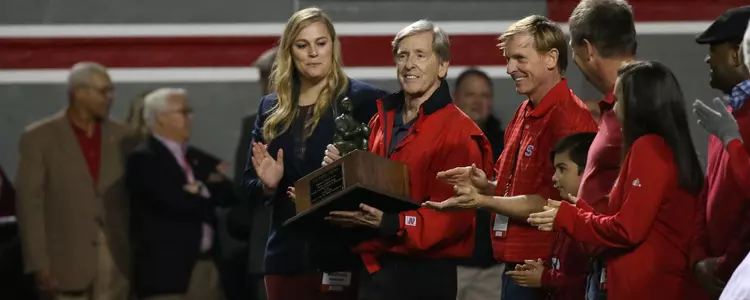
Because of the dramatic turnaround, Sheridan was named the ACC Coach of the Year and won his second national award of the calendar year when he earned the Bobby Dodd National Coach of the Year Trophy, becoming the league's first coach to win the trophy named after the legendary former Georgia Tech coach.
This weekend, Sheridan will be back in Carter-Finley Stadium to see one of his former players, offensive lineman Clay Hendrix, guide the Paladins against the Wolfpack. Hendrix was a starting guard in both 1984 and '85, when the Paladins upset the Wolfpack.
Hendrix then came with Sheridan to Raleigh as a graduate assistant for the Wolfpack in 1986 and '87, working primarily with the offensive line.
Even when Sheridan posted the only losing season of his career in 1987—when his four wins were over Maryland, Georgia Tech, Clemson and Duke—there was no shaking the foundation for excellence on the field and in the classroom he established in that first season. He took the Wolfpack to six bowl games in seven years, back when there were a growing number of postseason games, but not the swollen number there is today.
In seven years, his teams finished second or tied for second three times in the ACC and third twice. When he resigned in the summer of 1992, for health reasons, he had the best winning percentage of any coach in NC State history with an overall record of 52-29-3.
Copyright 2016, The Wolfpacker and Coman Publishing
RALEIGH, N.C. - As soon as he arrived, everyone in NC State's athletics program knew newly hired football coach Dick Sheridan was just a little different.
He was kind of quiet, but unquestionably successful. He had a stubborn streak, but he was doggedly successful. He didn't recruit big name players, but he was consistently successful. He had a staff that, as athletics director and men's basketball coach Jim Valvano once said, made Gomer Pyle look like he was from Manhattan, but they were always well-prepared and successful.
And, unlike anyone before or after him, Sheridan got the job done immediately.
NC State athletics director Willis Casey, who had watched the Sheridan-coached Furman Paladins beat the Wolfpack in Carter-Finley Stadium in both 1984 and '85, had an inkling that would happen, which is why he often said regarding Sheridan, "if you can't beat 'em, hire 'em."
In December 1985, Casey did just that, bringing Sheridan to Raleigh from Furman to replace Tom Reed after three consecutive 3-8 seasons. There was no momentum in the football program, and not much reason to believe there would be any for a while.
Oh, the Wolfpack did have a pretty good quarterback in junior college transfer Erik Kramer, who was named first-team All-ACC as a junior in 1985. But he was the only Wolfpack player to make the first or second team.
Sheridan did inherit a good corps of wide receivers in Haywood Jeffires, who flowed to Raleigh from the old Guilford County pipeline that had funneled so many star players to Carter-Finley Stadium, along with Nasrallah Worthen and Danny Peebles, a pair of track stars whose talents translated to football.
No one, however, expected much other than a long rebuilding process when Sheridan arrived, fresh from taking Furman to the Division I-AA (now Football Championship Series) title game against Georgia Southern. For his efforts, Sheridan was named the American Football Coaches Association I-AA Coach of the Year.
Sheridan, the winningest active coach in I-AA football at the time, had different ideas. He wanted to have immediate success to build some credibility at college football's highest level, after being a South Carolina superstar against high school and small-college competition, despite the fact that he inherited the ACC's worst defense. In 1985, the Wolfpack gave up 28 points and nearly 380 yards a game.
His style seemed a little ill-suited for success against the ACC's top programs, which at the time were Clemson, Maryland and Georgia Tech. Virginia was rising, Duke had Steve Spurrier and North Carolina was fading under the lack-of-personality of head coach Dick Crum.
Sheridan and his staff, though, were certain they could build a program that would compete at the top of the league by taking the existing players, installing their option offense and 50-style defense and preparing them to do the things they wanted done.
And it worked.
The Wolfpack was the nation's most surprising and exciting team in 1986, rolling through the season with come-from-behind victories, unexpected upsets and a style of play that rallied the fanbase and, to some degree, actually saved the Peach Bowl—host of the 2017 College Football Playoff championship game—from extinction. Its defense, though bendable, didn't break often, even holding nationally ranked Clemson to just a field goal.
The Pack handily beat Maryland early in the season, pulled out a shocking win at North Carolina with a defensive stop on a potential game-winning two-point conversion and pummeled Clemson on national television. It beat South Carolina with no time left on the clock in perhaps the most dramatic home win in school history. There were setbacks at Georgia Tech and Virginia, but Sheridan's success and his team's performance gave Wolfpack football fans something they had not had since Bo Rein's departure following the 1979 ACC championship season: a dash of hope.
The Pack finished the regular season with an 8-2-1 record, earned an invitation to the rebranded New Peach Bowl in Atlanta to face old nemesis Bill Dooley and his Virginia Tech Hokies and quelled any doubts that Sheridan was the right person for the job.
The New Peach Bowl, which almost went bankrupt the year before because of a lack of ticket sales, sold out Atlanta-Fulton County Stadium and was bathed in red for the New Year's Eve game. The result was not what Wolfpack fans wanted to see, with the Hokies winning 25-24 on a last-second field goal that was aided by a questionable injury timeout.
The season, however, set the tone for what was to come.
Because of the dramatic turnaround, Sheridan was named the ACC Coach of the Year and won his second national award of the calendar year when he earned the Bobby Dodd National Coach of the Year Trophy, becoming the league's first coach to win the trophy named after the legendary former Georgia Tech coach.
This weekend, Sheridan will be back in Carter-Finley Stadium to see one of his former players, offensive lineman Clay Hendrix, guide the Paladins against the Wolfpack. Hendrix was a starting guard in both 1984 and '85, when the Paladins upset the Wolfpack.
Hendrix then came with Sheridan to Raleigh as a graduate assistant for the Wolfpack in 1986 and '87, working primarily with the offensive line.
Even when Sheridan posted the only losing season of his career in 1987—when his four wins were over Maryland, Georgia Tech, Clemson and Duke—there was no shaking the foundation for excellence on the field and in the classroom he established in that first season. He took the Wolfpack to six bowl games in seven years, back when there were a growing number of postseason games, but not the swollen number there is today.
In seven years, his teams finished second or tied for second three times in the ACC and third twice. When he resigned in the summer of 1992, for health reasons, he had the best winning percentage of any coach in NC State history with an overall record of 52-29-3.
Monday, October 19
Saturday, October 10
Saturday, October 10
Monday, October 05