
North Carolina State University Athletics
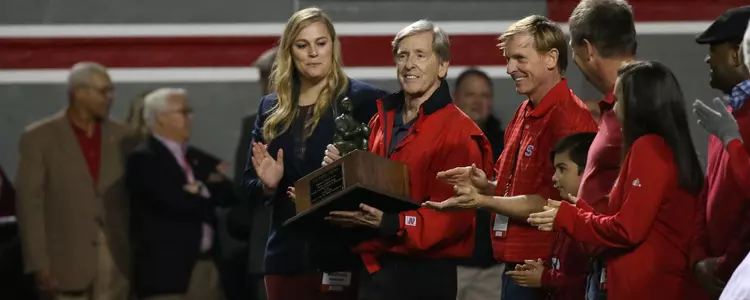
Wolfpack Honors Former Head Coach Sheridan
11/6/2016 10:20:00 AM | Football
RALEIGH, N.C. - There have been better seasons in the history of NC State football, but only a few. None of them, however, was ever as surprising or exciting as the one in 1986, when Dick Sheridan debuted as head coach of the Wolfpack.
After three consecutive 3-8 seasons under Tom Reed, Sheridan seemed like a miracle worker when he took some talented returnees and a quilt of recruiting scraps and came within a faked Virginia Tech injury in the New Peach Bowl of matching the school record for wins. Having just led the Paladins to the 1985 NCAA Division I-AA championship game against Georgia Southern, Sheridan was named the American Football Coaches Association Award as National I-AA Coach of the Year.
By the time he finished his first season with the Pack, Sheridan won a similar award for Division I-A, the Bobby Dodd National Coach of the Year Trophy, becoming the first ACC coach to win the honor named for the legendary Georgia Tech mentor.
How Sheridan took a team with seniors who had never known a winning season to an 8-2-1 regular-season record and the school's first postseason game in nearly a decade is legendary in the annals of NC State football.
That season from 30 years ago, and Sheridan's overall seven-year tenure, were remembered Saturday night at Carter-Finley Stadium during the Wolfpack's game against Florida State, as representative from the Chick-fil-a Bowl honored Sheridan and surviving members of his staff on the field during the first quarter.
Sheridan was twice offered the opportunity to coach the Wolfpack. Then-athletics director Willis Casey—the guy who hired Lou Holtz, Jim Valvano, Richard Sykes, Don Easterling, Rollie Geiger, Bob Guzzo, Kay Yow and other successful NC State coaches—had long identified Sheridan as the Wolfpack's coach of the future. He first offered the job to Sheridan, then the coach at Furman, in the winter of 1983 after Monte Kiffin's departure as head coach.
Sheridan declined, and Casey turned to Miami of Ohio coach Tom Reed. After Reed went 3-8 three consecutive seasons, including back-to-back losses to Sheridan's Furman team in Carter-Finley Stadium, Reed stepped down and Casey went back to Sheridan for the last coaching hire of his 18-year tenure, before turning over the reins of the department to a flabbergasted Jim Valvano, who didn't know exactly what to think of Sheridan and his mostly South Carolina-native staff.
"Those guys make Gomer Pyle look like he was from Manhattan," Valvano once said.
But the two accomplished coaches became good friends after Valvano was named to replace Casey, a remarkable relationship between the fast-talking New Yorker from Queens and the slow-drawling Sandlapper from North Augusta.
The first season was nothing short of remarkable. Sheridan changed everything, from the base offense to the base defense to the school logo (he recommended the Diamond S mark that was similar to what his teams at Furman used). He had a few standout players to rely on—quarterback Erik Kramer had earned first-team All-ACC honors in his first year as a starter in 1985 and wide receiver Haywood Jeffires was one of the most talented players in the league. He also inherited the ACC's worst defense, which gave up 28 points and 380 yards a game in 1985, with little hope of turning it around.
When the team took the field for its season-opener against East Carolina, few people knew what to expect. Not much changed after the 38-10 victory.
The next week, however, Sheridan and his team hosted heavily favored Pittsburgh, which jumped out to a 14-0 lead in the first half. The Wolfpack scored 11 points in the final five minutes of the game to force a morale-building 14-14, thanks to a 49-yard field goal by Mike Cofer as time expired.
The next week, the Pack trailed Wake Forest with less than a minute to play when senior quarterback Erik Kramer hit Danny Peebles with a 17-yard game-winning touchdown pass. The Pack went on the road and beat 13th-ranked and defending ACC champion Maryland 28-16 for the first win over the Terps since 1979.
The Pack's unbeaten record ended with an inexplicable 59-21 loss at Georgia Tech, as the defense reverted to its previous season's status.
The next three weeks suggested Sheridan was building something special in Raleigh earlier than expected.
In Chapel Hill, Kramer engineered a 98-yard drive and led his team to a touchdown in the final minute of play, only to see North Carolina answer with a touchdown with just eight seconds remaining on the clock. The Tar Heels thought it could score two against the Wolfpack's defense, and quarterback Mark Maye hit his tight end on a swing pass. But his knee hit the ground before he could score and the conversion was no good.
The Wolfpack humiliated No. 16 Clemson for its second win over a ranked opponent in front of a sold-out crowd and a regionally televised audience, scoring 27 unanswered points on a rain-drenched field. Peebles caught a 50-yard touchdown and Jeffires scored on a well-timed reverse ended any chance of a Tiger comeback.
Finally, in the most unlikely finish to a game since the 1957 game at South Carolina, the Wolfpack was awarded a final play against the Gamecocks, thanks to an offsides penalty as the clock expired. On a play that was literally drawn up in the dirt on the sidelines during a timeout, a scrambling Kramer threw a 33-yard Hail Mary into a swarm of receivers and defenders.
The ball fell into Pebbles arms for a 23-22 victory that is still celebrated as the most memorable play in the 50-year history of Carter-Finley Stadium.
The win was costly, however, as Kramer was hit as he released the ball and suffered a severely sprained ankle, forcing him to miss the Pack's next game at Virginia, a game that could have secured the program its first ACC title since 1979. Alas, the Cavaliers won 20-16 as reserve quarterback Cam Young threw an interception with 1:11 to play prevent another come-from-behind victory.
The Wolfpack finished the season with wins over Duke and Western Carolina to post an 8-2-1 record, its most wins since 1978, and earned a spot in New Peach Bowl, where they faced former UNC coach Bill Dooley and the Virginia Tech Hokies.
The Pack desperately wanted to finish the season with nine wins, something that had only been done five times in school history. The Hokies, however, were determined to win one last game for Dooley, who had been relieved of his head coaching and athletics director duties midway through the season, and earn the school's first ever bowl victory.
With 1:53 to play and the Pack winning 24-22, the Hokies began a drive on the 20-yard-line and moved quickly down the field, getting a little help when its running back feigned an injury to stop the clock with 38 seconds remaining.
A converted fourth down and a dubious pass interference penalty later, the Hokies were in position for kicker Chris Kinzer to boot a 40-yard game-winning field goal.
"Over the course of a coaching career, you win some like that and you lose some like that," he says. "It all evens out in the end, but we certainly had our share of them go our way that season."
Sheridan became the first ACC coach to win the Dodd Trophy and nine others have followed in his footsteps. He took the Wolfpack to six bowl games in his seven years, including five in a row from 1988-92. He ended with back-to-back nine-win seasons before health reasons forced him to retire just before the 1993 season began. He was succeeded by assistant coach Mike O'Cain.
Much has changed since Sheridan retired to Surfside Beach, South Carolina, where he dabbled in various real estate ventures. The grassy bank and the old press box is one. Both end zones are enclosed, the Murphy Center and Vaughn Towers overlook the stadium and there are four full-size practice fields within walking distance of the stadium, not to mention one of college basketball's biggest arenas.
For Sheridan, whose offices were in the Weisiger-Brown Building on campus, it was all a little disorienting and overwhelming.
"It sure doesn't look like the same place," he said, revisiting the stadium with his two sons and two grandchildren.
But the memories from his 52-29-3 tenure, in which he compiled the best winning percentage in school history, still remain strong for the 75-year-old coach.
"It's nostalgic being back here," Sheridan said, who had been to just one game in the refurbished and renovated Carter-Finley since his retirement. "There are so many memories that just come flooding back, and almost all of them come back to the people.
"There were good memories here."
The same was true for his former staff members who met for lunch, the players who stopped by at an informal reunion at PNC Arena and the many fans who stopped the coach as he made his way from Carter-Finley's field to his seat in Vaughn Towers.
"It felt like coming home," Sheridan said.
After three consecutive 3-8 seasons under Tom Reed, Sheridan seemed like a miracle worker when he took some talented returnees and a quilt of recruiting scraps and came within a faked Virginia Tech injury in the New Peach Bowl of matching the school record for wins. Having just led the Paladins to the 1985 NCAA Division I-AA championship game against Georgia Southern, Sheridan was named the American Football Coaches Association Award as National I-AA Coach of the Year.
By the time he finished his first season with the Pack, Sheridan won a similar award for Division I-A, the Bobby Dodd National Coach of the Year Trophy, becoming the first ACC coach to win the honor named for the legendary Georgia Tech mentor.
How Sheridan took a team with seniors who had never known a winning season to an 8-2-1 regular-season record and the school's first postseason game in nearly a decade is legendary in the annals of NC State football.
That season from 30 years ago, and Sheridan's overall seven-year tenure, were remembered Saturday night at Carter-Finley Stadium during the Wolfpack's game against Florida State, as representative from the Chick-fil-a Bowl honored Sheridan and surviving members of his staff on the field during the first quarter.
Sheridan was twice offered the opportunity to coach the Wolfpack. Then-athletics director Willis Casey—the guy who hired Lou Holtz, Jim Valvano, Richard Sykes, Don Easterling, Rollie Geiger, Bob Guzzo, Kay Yow and other successful NC State coaches—had long identified Sheridan as the Wolfpack's coach of the future. He first offered the job to Sheridan, then the coach at Furman, in the winter of 1983 after Monte Kiffin's departure as head coach.
Sheridan declined, and Casey turned to Miami of Ohio coach Tom Reed. After Reed went 3-8 three consecutive seasons, including back-to-back losses to Sheridan's Furman team in Carter-Finley Stadium, Reed stepped down and Casey went back to Sheridan for the last coaching hire of his 18-year tenure, before turning over the reins of the department to a flabbergasted Jim Valvano, who didn't know exactly what to think of Sheridan and his mostly South Carolina-native staff.
"Those guys make Gomer Pyle look like he was from Manhattan," Valvano once said.
But the two accomplished coaches became good friends after Valvano was named to replace Casey, a remarkable relationship between the fast-talking New Yorker from Queens and the slow-drawling Sandlapper from North Augusta.
The first season was nothing short of remarkable. Sheridan changed everything, from the base offense to the base defense to the school logo (he recommended the Diamond S mark that was similar to what his teams at Furman used). He had a few standout players to rely on—quarterback Erik Kramer had earned first-team All-ACC honors in his first year as a starter in 1985 and wide receiver Haywood Jeffires was one of the most talented players in the league. He also inherited the ACC's worst defense, which gave up 28 points and 380 yards a game in 1985, with little hope of turning it around.
When the team took the field for its season-opener against East Carolina, few people knew what to expect. Not much changed after the 38-10 victory.
The next week, however, Sheridan and his team hosted heavily favored Pittsburgh, which jumped out to a 14-0 lead in the first half. The Wolfpack scored 11 points in the final five minutes of the game to force a morale-building 14-14, thanks to a 49-yard field goal by Mike Cofer as time expired.
The next week, the Pack trailed Wake Forest with less than a minute to play when senior quarterback Erik Kramer hit Danny Peebles with a 17-yard game-winning touchdown pass. The Pack went on the road and beat 13th-ranked and defending ACC champion Maryland 28-16 for the first win over the Terps since 1979.
The Pack's unbeaten record ended with an inexplicable 59-21 loss at Georgia Tech, as the defense reverted to its previous season's status.
The next three weeks suggested Sheridan was building something special in Raleigh earlier than expected.
In Chapel Hill, Kramer engineered a 98-yard drive and led his team to a touchdown in the final minute of play, only to see North Carolina answer with a touchdown with just eight seconds remaining on the clock. The Tar Heels thought it could score two against the Wolfpack's defense, and quarterback Mark Maye hit his tight end on a swing pass. But his knee hit the ground before he could score and the conversion was no good.
The Wolfpack humiliated No. 16 Clemson for its second win over a ranked opponent in front of a sold-out crowd and a regionally televised audience, scoring 27 unanswered points on a rain-drenched field. Peebles caught a 50-yard touchdown and Jeffires scored on a well-timed reverse ended any chance of a Tiger comeback.
Finally, in the most unlikely finish to a game since the 1957 game at South Carolina, the Wolfpack was awarded a final play against the Gamecocks, thanks to an offsides penalty as the clock expired. On a play that was literally drawn up in the dirt on the sidelines during a timeout, a scrambling Kramer threw a 33-yard Hail Mary into a swarm of receivers and defenders.
The ball fell into Pebbles arms for a 23-22 victory that is still celebrated as the most memorable play in the 50-year history of Carter-Finley Stadium.
The win was costly, however, as Kramer was hit as he released the ball and suffered a severely sprained ankle, forcing him to miss the Pack's next game at Virginia, a game that could have secured the program its first ACC title since 1979. Alas, the Cavaliers won 20-16 as reserve quarterback Cam Young threw an interception with 1:11 to play prevent another come-from-behind victory.
The Wolfpack finished the season with wins over Duke and Western Carolina to post an 8-2-1 record, its most wins since 1978, and earned a spot in New Peach Bowl, where they faced former UNC coach Bill Dooley and the Virginia Tech Hokies.
The Pack desperately wanted to finish the season with nine wins, something that had only been done five times in school history. The Hokies, however, were determined to win one last game for Dooley, who had been relieved of his head coaching and athletics director duties midway through the season, and earn the school's first ever bowl victory.
With 1:53 to play and the Pack winning 24-22, the Hokies began a drive on the 20-yard-line and moved quickly down the field, getting a little help when its running back feigned an injury to stop the clock with 38 seconds remaining.
A converted fourth down and a dubious pass interference penalty later, the Hokies were in position for kicker Chris Kinzer to boot a 40-yard game-winning field goal.
"Over the course of a coaching career, you win some like that and you lose some like that," he says. "It all evens out in the end, but we certainly had our share of them go our way that season."
Sheridan became the first ACC coach to win the Dodd Trophy and nine others have followed in his footsteps. He took the Wolfpack to six bowl games in his seven years, including five in a row from 1988-92. He ended with back-to-back nine-win seasons before health reasons forced him to retire just before the 1993 season began. He was succeeded by assistant coach Mike O'Cain.
Much has changed since Sheridan retired to Surfside Beach, South Carolina, where he dabbled in various real estate ventures. The grassy bank and the old press box is one. Both end zones are enclosed, the Murphy Center and Vaughn Towers overlook the stadium and there are four full-size practice fields within walking distance of the stadium, not to mention one of college basketball's biggest arenas.
For Sheridan, whose offices were in the Weisiger-Brown Building on campus, it was all a little disorienting and overwhelming.
"It sure doesn't look like the same place," he said, revisiting the stadium with his two sons and two grandchildren.
But the memories from his 52-29-3 tenure, in which he compiled the best winning percentage in school history, still remain strong for the 75-year-old coach.
"It's nostalgic being back here," Sheridan said, who had been to just one game in the refurbished and renovated Carter-Finley since his retirement. "There are so many memories that just come flooding back, and almost all of them come back to the people.
"There were good memories here."
The same was true for his former staff members who met for lunch, the players who stopped by at an informal reunion at PNC Arena and the many fans who stopped the coach as he made his way from Carter-Finley's field to his seat in Vaughn Towers.
"It felt like coming home," Sheridan said.

Tuesday, September 15
Monday, September 14
Saturday, September 12
Saturday, September 12