
North Carolina State University Athletics
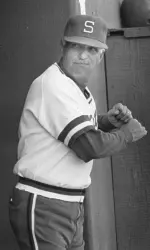
NC State's 2014 Hall of Fame Class: Sam Esposito
9/10/2014 12:00:00 AM | Baseball
Sept. 10, 2014
RALEIGH, N.C. - In 21 years as head baseball coach at NC State, Sam Esposito won a program-record 513 games. He coached 69 All-ACC players and seven All-Americans. In 1968, his second year at the school, he took the Wolfpack to the College World Series. His teams won four ACC championships. He coached 12 future major leaguers, four of whom played for at least a decade in the big leagues.
Those are just some of the highlights. Esposito’s individual achievements are more than enough to warrant his inclusion in the third class of NC State’s Athletic Hall of Fame.
Esposito’s career was more than individual achievements, however. More than anything, Esposito lifted NC State baseball into the national spotlight and made the Wolfpack a national power in baseball for the first time, and had a lasting, often lifelong, impact on his players.
“To me, Sam Esposito is NC State baseball,” said South Carolina AD Ray Tanner, who played four years (1977-80) for Esposito and was his assistant coach for seven more before taking over the program upon Esposito’s retirement in the summer of 1987. “I know there was baseball there before him, but he was the founding father. I was the head coach for nine years, but I was just an extension of his program. What I did [as coach] was everything he taught me and prepared me for. I would not be in college baseball today had it not been for his tutelage and guidance, as a player and a coach.”
Prior to Esposito’s arrival in Raleigh, NC State had won 20 games in a season just once, in 1908. The Wolfpack had a winning record in just 11 of 30 seasons before Esposito took over the program in 1967, and did not have a winning record in any of the four seasons before he became head coach.
Thanks to Esposito, those days are over. The Pack went 11-11 in his first year on the job, and has had nothing but winning seasons since. His second team went 25-9, won the ACC championship (which was decided based on standings) and finished third at the 1968 College World Series. He guided the Wolfpack to the first three ACC Tournament championships in 1973, ’74 and ’75. He became the first coach in school history to win 30 games in a season when his 1981 team went 33-12. Three of his last four teams won 30 games or more, including a 39-16 mark in 1987. His last four teams compiled a .711 winning percentage (135-55).
As a coach, Esposito was colorful, often profane, always irrascible, and very much old-school. His disciplinary methods often bordered on the draconian. Former players love to swap Esposito stories, and there are many worth telling. Once, during a road trip to Charlottesville, Va., and College Park, Md., two players sneaked out of the restaurant where the team was eating dinner and went next door to a package store and bought beer to drink in the van during the trip. Esposito got wind of it, ordered the vans pulled over to the side of the road in the middle of nowhere in northern Virginia, and left the two offending players there to get back to Raleigh on their own.
During practices, pitchers not throwing would sit in the stands and retrieve foul balls. One time in the early ’80s, Esposito screamed at one pitcher who was slow to run after a foul ball, sternly reminding him that “the only reason you’re up there [in the stands] is because I don’t want your sorry [rear end] down here with me.”
If coaches take a kinder, gentler approach with players these days, it’s not necessarily because players don’t need or even want discipline, or that coaches aren’t tempted. Times have changed, however.
“I think kids want that direction just as much as ever,” said Tim Stoddard, who played for Esposito from 1972-75, and then played 12 years in the major leagues. “Whether administration or their parents let you do it is another story. You still try to instill the idea of right and wrong and accountability. If there’s anything missing today, it’s accountability for a kid’s mistakes. Back then, you did something, you paid the penalty. Today, they try to talk their way out of it. Back then, there wasn’t any talking your way out of it.”
Especially when your coach was named Sam Esposito. And his style worked. Tracy Woodson played for Esposito from 1982-84, was the 1984 ACC Player of the Year, an All-American and a member of the ACC’s All-50th-Anniversary Team. Following a lengthy career in professional baseball that included parts of six seasons in the major leagues, Woodson embarked on a coaching career. He has been the head baseball coach at Valparaiso since 2007, and gives Esposito credit for much of what he’s accomplished in his baseball career.
“I loved the way he coached,” Woodson said of Esposito,. “I’ve been on his good side and on his bad side. Thankfully, I was on his good side a lot more than I was on his bad side, but believe me, I caught the wrath once or twice. But you know what? It helped to make me a better player. He made you see that everything was supposed to be done a certain way. He just had a different way of telling you how to do it.”
Opposing coaches also held Esposito in high regard. Former East Carolina and Auburn University head coach Hal Baird, one of college baseball’s most respected and revered coaches, once said that Esposito managed a game better than anyone he had ever seen.
“I used to watch Sam coach a game,” Baird said, “and it was like watching a major league mind in a college dugout.”
Of course, Esposito’s was a major league mind. He spent 10 years as a utility infielder in the big leagues, almost all of it with his hometown Chicago White Sox, and played in the 1959 World Series, when the White Sox lost to the Los Angeles Dodgers in six games.
Esposito was a three-sport superstar at Chicago’s Fenger High School. As a senior during the 1949-50 school year, he was the Chicago metro player of the year in football, basketball and baseball. He played quarterback in football, point guard in basketball and shortstop in baseball, and, in the vernacular of the day, he was too big for the room in all three.
“He was just a phenomenal athlete,” Stoddard said. “He was a multi-sport guy. He was a great handball player. He played college basketball and professional baseball. People just don’t realize. I grew up in Chicago and he was someone I really admired when I was growing up.”
Basketball may have been Esposito’s best sport. Twice his senior season, Esposito scored more than 80 points in a game. On January 23, 1950, he carved up rival Carver High School with 81 points, including 54 points in a half and 32 points in a single quarter. Not surprisingly, despite having many opportunities in any of the three sports, he wound up at Indiana University on a basketball scholarship.
After spending the 1950-51 season with the IU freshman team, Esposito lettered with the Hoosiers as a sophomore in 1951-52, then played professional baseball that summer, including four games with the White Sox. That fall, he left Indiana and enlisted in the Army, missing out on the Hoosiers’ 1953 national championship in basketball. He would have been a co-captain on that team.
Upon his discharge from the service in 1954, Esposito embarked full-time on his professional baseball career, playing through the 1964 season. His playing days finally at an end, he went to work at East Chicago High School as assistant basketball coach. One day over lunch, the head basketball coach, John Barrato, introduced Esposito to a young college basketball coach named Norman Sloan, an Indiana native who had just gotten the head coaching job at NC State.
“I said a few things about looking to get a college baseball job down that way and if he ever heard of anything, to let me know,” Esposito said. “He was getting in the car to go to the airport and I got in the car with Barratto. We drove off and got about a block away and Norm came up behind us. We pull over. Sam, if I’m not mistaken, Vic Sorrell just retired at State. Would you be interested in that job? And you can be my assistant.’ I said I would love that.”
Esposito worked at both sports for the Wolfpack for 12 years, helping Sloan establish NC State as a national powerhouse. The Wolfpack won three ACC basketball championships from 1970-74. In 1973-74, Esposito won the national title ring he missed in 1953 at Indiana, helping coach the Wolfpack to a 30-1 record and the 1974 NCAA title.
Following the 1977-78 basketball season, Esposito left Sloan’s staff and began coaching baseball full-time. In the ensuing years, he continued to have a marked effect on both the program and on his players. In his last 10 years on the job (1978-87), Esposito’s teams won at a .677 clip (283-135), including a 32-8 mark in 1984, 35-15 in 1986, and 39-16 in 1987.
In those final 10 years, Esposito coached 22 first-team all-conference players and three All-Americans. He also coached nine future major league players, including Doug Strange, now in his eighth season working in Pittsburgh Pirates front office. Strange played for Esposito from 1983-85, then went on to play 10 seasons in the major leagues with the Tigers, Cubs, Rangers, Mariners, Expos and Pirates.
Like the vast majority of big league players, Strange was never a star. Teams never had huge amounts of money tied up in him. In other words, he had to work hard to get to the big leagues and had to work just as hard, day after day, to stay there. The fact that he stayed there for 10 seasons says a great deal about Strange’s competitiveness and work ethic.
Those traits, Strange says, came directly from Sam Esposito, and Strange went out of his way during his playing days to thank Esposito. After a series in Chicago in the late 1980s or early 1990s, Strange wrote Esposito a letter, essentially saying that the years he spent playing for Esposito did more to prepare him for playing Major League Baseball than anything else in his baseball career.
“We’d just played the White Sox in Chicago, and I was thinking that this was the stadium he played in and the field he played on,” Strange said. “It made me want to thank him for all he did for me. He taught us what it takes to play the game and how to play the game the right way. He was tough on us, but he made us tough and you have to be tough to succeed in this game.
“I told him that after playing for him, after all he did to make toughen us up and prepare us, that everything I’ve done since then has been a piece of cake. I was always competitive, but he really taught me how to compete. That competitiveness stays with me to this day. I just owe him so much and I’m so happy for him and so proud of him for this honor.”
Esposito’s influence went well beyond his own teams and players, especially when he began working for the NC State compliance office after he retired as baseball coach. Over the course of Esposito’s tenure at NC State, other coaches routinely sought him out for counsel and advice. Former basketball coach Jim Valvano spent time in Esposito’s office most mornings, both for Esposito’s advice and company and as a refuge from his own office. The two grew extremely close over Valvano’s years as head coach.
Others in the athletics department became regulars in Esposito’s office over the years, and on any given morning in the 1980s, a visitor to Esposito’s office was apt to encounter anyone from Valvano to George Tarantini to Dick Sheridan to Bob Guzzo. The list was extensive. The camaraderie was obvious, but so was the respect that everyone had for Esposito.
“For more than 20 years, Coach Esposito made a huge impact on NC State athletics as a whole,” current Wolfpack baseball coach Elliott Avent said. “At a pivotal time during the 1970s and ’80s, Coach Esposito played a huge role in the success of this department. It seems like all our coaches came to him for advice. Jim Valvano was one of the best and savviest game coaches in NC State history, and he was in Coach Esposito’s office early every morning, talking game strategy and using Coach as a mentor. We’ve all used him as a mentor at some time or other. Having him here in the building when I first got this job and to be able to pick his brain was just such an advantage for me. No one has sought out Coach Esposito’s advice more than I have. Thank you coach, from all of us.”
Purchase tickets | 2014 Hall of Fame Class
RALEIGH, N.C. - In 21 years as head baseball coach at NC State, Sam Esposito won a program-record 513 games. He coached 69 All-ACC players and seven All-Americans. In 1968, his second year at the school, he took the Wolfpack to the College World Series. His teams won four ACC championships. He coached 12 future major leaguers, four of whom played for at least a decade in the big leagues.
Those are just some of the highlights. Esposito’s individual achievements are more than enough to warrant his inclusion in the third class of NC State’s Athletic Hall of Fame.
Esposito’s career was more than individual achievements, however. More than anything, Esposito lifted NC State baseball into the national spotlight and made the Wolfpack a national power in baseball for the first time, and had a lasting, often lifelong, impact on his players.
“To me, Sam Esposito is NC State baseball,” said South Carolina AD Ray Tanner, who played four years (1977-80) for Esposito and was his assistant coach for seven more before taking over the program upon Esposito’s retirement in the summer of 1987. “I know there was baseball there before him, but he was the founding father. I was the head coach for nine years, but I was just an extension of his program. What I did [as coach] was everything he taught me and prepared me for. I would not be in college baseball today had it not been for his tutelage and guidance, as a player and a coach.”
Prior to Esposito’s arrival in Raleigh, NC State had won 20 games in a season just once, in 1908. The Wolfpack had a winning record in just 11 of 30 seasons before Esposito took over the program in 1967, and did not have a winning record in any of the four seasons before he became head coach.
Thanks to Esposito, those days are over. The Pack went 11-11 in his first year on the job, and has had nothing but winning seasons since. His second team went 25-9, won the ACC championship (which was decided based on standings) and finished third at the 1968 College World Series. He guided the Wolfpack to the first three ACC Tournament championships in 1973, ’74 and ’75. He became the first coach in school history to win 30 games in a season when his 1981 team went 33-12. Three of his last four teams won 30 games or more, including a 39-16 mark in 1987. His last four teams compiled a .711 winning percentage (135-55).
As a coach, Esposito was colorful, often profane, always irrascible, and very much old-school. His disciplinary methods often bordered on the draconian. Former players love to swap Esposito stories, and there are many worth telling. Once, during a road trip to Charlottesville, Va., and College Park, Md., two players sneaked out of the restaurant where the team was eating dinner and went next door to a package store and bought beer to drink in the van during the trip. Esposito got wind of it, ordered the vans pulled over to the side of the road in the middle of nowhere in northern Virginia, and left the two offending players there to get back to Raleigh on their own.
During practices, pitchers not throwing would sit in the stands and retrieve foul balls. One time in the early ’80s, Esposito screamed at one pitcher who was slow to run after a foul ball, sternly reminding him that “the only reason you’re up there [in the stands] is because I don’t want your sorry [rear end] down here with me.”
If coaches take a kinder, gentler approach with players these days, it’s not necessarily because players don’t need or even want discipline, or that coaches aren’t tempted. Times have changed, however.
“I think kids want that direction just as much as ever,” said Tim Stoddard, who played for Esposito from 1972-75, and then played 12 years in the major leagues. “Whether administration or their parents let you do it is another story. You still try to instill the idea of right and wrong and accountability. If there’s anything missing today, it’s accountability for a kid’s mistakes. Back then, you did something, you paid the penalty. Today, they try to talk their way out of it. Back then, there wasn’t any talking your way out of it.”
Especially when your coach was named Sam Esposito. And his style worked. Tracy Woodson played for Esposito from 1982-84, was the 1984 ACC Player of the Year, an All-American and a member of the ACC’s All-50th-Anniversary Team. Following a lengthy career in professional baseball that included parts of six seasons in the major leagues, Woodson embarked on a coaching career. He has been the head baseball coach at Valparaiso since 2007, and gives Esposito credit for much of what he’s accomplished in his baseball career.
“I loved the way he coached,” Woodson said of Esposito,. “I’ve been on his good side and on his bad side. Thankfully, I was on his good side a lot more than I was on his bad side, but believe me, I caught the wrath once or twice. But you know what? It helped to make me a better player. He made you see that everything was supposed to be done a certain way. He just had a different way of telling you how to do it.”
Opposing coaches also held Esposito in high regard. Former East Carolina and Auburn University head coach Hal Baird, one of college baseball’s most respected and revered coaches, once said that Esposito managed a game better than anyone he had ever seen.
“I used to watch Sam coach a game,” Baird said, “and it was like watching a major league mind in a college dugout.”
Of course, Esposito’s was a major league mind. He spent 10 years as a utility infielder in the big leagues, almost all of it with his hometown Chicago White Sox, and played in the 1959 World Series, when the White Sox lost to the Los Angeles Dodgers in six games.
Esposito was a three-sport superstar at Chicago’s Fenger High School. As a senior during the 1949-50 school year, he was the Chicago metro player of the year in football, basketball and baseball. He played quarterback in football, point guard in basketball and shortstop in baseball, and, in the vernacular of the day, he was too big for the room in all three.
“He was just a phenomenal athlete,” Stoddard said. “He was a multi-sport guy. He was a great handball player. He played college basketball and professional baseball. People just don’t realize. I grew up in Chicago and he was someone I really admired when I was growing up.”
Basketball may have been Esposito’s best sport. Twice his senior season, Esposito scored more than 80 points in a game. On January 23, 1950, he carved up rival Carver High School with 81 points, including 54 points in a half and 32 points in a single quarter. Not surprisingly, despite having many opportunities in any of the three sports, he wound up at Indiana University on a basketball scholarship.
After spending the 1950-51 season with the IU freshman team, Esposito lettered with the Hoosiers as a sophomore in 1951-52, then played professional baseball that summer, including four games with the White Sox. That fall, he left Indiana and enlisted in the Army, missing out on the Hoosiers’ 1953 national championship in basketball. He would have been a co-captain on that team.
Upon his discharge from the service in 1954, Esposito embarked full-time on his professional baseball career, playing through the 1964 season. His playing days finally at an end, he went to work at East Chicago High School as assistant basketball coach. One day over lunch, the head basketball coach, John Barrato, introduced Esposito to a young college basketball coach named Norman Sloan, an Indiana native who had just gotten the head coaching job at NC State.
“I said a few things about looking to get a college baseball job down that way and if he ever heard of anything, to let me know,” Esposito said. “He was getting in the car to go to the airport and I got in the car with Barratto. We drove off and got about a block away and Norm came up behind us. We pull over. Sam, if I’m not mistaken, Vic Sorrell just retired at State. Would you be interested in that job? And you can be my assistant.’ I said I would love that.”
Esposito worked at both sports for the Wolfpack for 12 years, helping Sloan establish NC State as a national powerhouse. The Wolfpack won three ACC basketball championships from 1970-74. In 1973-74, Esposito won the national title ring he missed in 1953 at Indiana, helping coach the Wolfpack to a 30-1 record and the 1974 NCAA title.
Following the 1977-78 basketball season, Esposito left Sloan’s staff and began coaching baseball full-time. In the ensuing years, he continued to have a marked effect on both the program and on his players. In his last 10 years on the job (1978-87), Esposito’s teams won at a .677 clip (283-135), including a 32-8 mark in 1984, 35-15 in 1986, and 39-16 in 1987.
In those final 10 years, Esposito coached 22 first-team all-conference players and three All-Americans. He also coached nine future major league players, including Doug Strange, now in his eighth season working in Pittsburgh Pirates front office. Strange played for Esposito from 1983-85, then went on to play 10 seasons in the major leagues with the Tigers, Cubs, Rangers, Mariners, Expos and Pirates.
Like the vast majority of big league players, Strange was never a star. Teams never had huge amounts of money tied up in him. In other words, he had to work hard to get to the big leagues and had to work just as hard, day after day, to stay there. The fact that he stayed there for 10 seasons says a great deal about Strange’s competitiveness and work ethic.
Those traits, Strange says, came directly from Sam Esposito, and Strange went out of his way during his playing days to thank Esposito. After a series in Chicago in the late 1980s or early 1990s, Strange wrote Esposito a letter, essentially saying that the years he spent playing for Esposito did more to prepare him for playing Major League Baseball than anything else in his baseball career.
“We’d just played the White Sox in Chicago, and I was thinking that this was the stadium he played in and the field he played on,” Strange said. “It made me want to thank him for all he did for me. He taught us what it takes to play the game and how to play the game the right way. He was tough on us, but he made us tough and you have to be tough to succeed in this game.
“I told him that after playing for him, after all he did to make toughen us up and prepare us, that everything I’ve done since then has been a piece of cake. I was always competitive, but he really taught me how to compete. That competitiveness stays with me to this day. I just owe him so much and I’m so happy for him and so proud of him for this honor.”
Esposito’s influence went well beyond his own teams and players, especially when he began working for the NC State compliance office after he retired as baseball coach. Over the course of Esposito’s tenure at NC State, other coaches routinely sought him out for counsel and advice. Former basketball coach Jim Valvano spent time in Esposito’s office most mornings, both for Esposito’s advice and company and as a refuge from his own office. The two grew extremely close over Valvano’s years as head coach.
Others in the athletics department became regulars in Esposito’s office over the years, and on any given morning in the 1980s, a visitor to Esposito’s office was apt to encounter anyone from Valvano to George Tarantini to Dick Sheridan to Bob Guzzo. The list was extensive. The camaraderie was obvious, but so was the respect that everyone had for Esposito.
“For more than 20 years, Coach Esposito made a huge impact on NC State athletics as a whole,” current Wolfpack baseball coach Elliott Avent said. “At a pivotal time during the 1970s and ’80s, Coach Esposito played a huge role in the success of this department. It seems like all our coaches came to him for advice. Jim Valvano was one of the best and savviest game coaches in NC State history, and he was in Coach Esposito’s office early every morning, talking game strategy and using Coach as a mentor. We’ve all used him as a mentor at some time or other. Having him here in the building when I first got this job and to be able to pick his brain was just such an advantage for me. No one has sought out Coach Esposito’s advice more than I have. Thank you coach, from all of us.”
Saturday, May 30
Monday, May 25
Friday, May 22
Friday, May 22