North Carolina State University Athletics
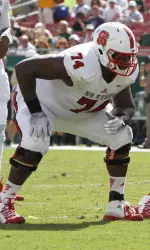
Senior Spotlight: OT Tyson Chandler
10/7/2014 12:00:00 AM | Football
RALEIGH, N.C. - Few begin with dreams of playing on the offensive line. More often, the character that makes a lineman reveals itself through years of repetition. Tyson Chandler, a 6-7, 345-pound, right tackle from North Plainfield, N.J., by way of Fork Union Military Academy, didn't start out as an everyday lineman.
"My first start came at left tackle," said Chandler. "I gave up three and a half sacks, one of the lowest feelings of my life. We probably haven't given up that many sacks this season, and I did that in one game."
Chandler's talking about his breakthrough role as a fill-in left tackle during his redshirt-sophomore season, in 2012. A Wolfpack line tasked with protecting future NFL QB Mike Glennon, ravaged by injury, needed Chandler's help.
"It's a scary feeling, but that's what makes the game so much fun, and so motivating," said Chandler. "You know it's me versus you for 70-80 plays a game. My will against your will. My will wins."
Chandler's will proved to be formidable to say the least. Since being pressed into action that sophomore season, Chandler has logged snap after snap and has started the last 14 games at right tackle entering the showdown with No. 1 Florida State.
"That's what makes it so rewarding to play line," said Chandler. "What trumps all of those feelings are the relationships you develop with your teammates on the line. There's only one quarterback on the field at a time, and there are DBs spread around, but on the line, I have a 12-18 inch split next to someone I'm talking to every day.
"I don't even think about the split anymore. I'm not even sure I could figure out how many times I've lined up next to Alex [Barr]. There's 80 plays scripted in a practice. In any given week, we're lining up together 500 times. Over the course of the season that's 5,000. We ran 210 plays on Tuesday and Wednesday last week. For my career, I have a couple thousand snaps in games. At the end of the day, maybe I've lined up next to those guys 10,000 times."
Talking to Chandler, it's evident the value NC State's line puts on chemistry and communication. Pads and helmets collide every play at the intersection of offensive and defensive lines. The men that play there are the heartbeat of the game, and the first indicator of which team will succeed on that given Saturday. Chandler knows this, and he speaks poetically when asked why we should think playing on the offensive line is cool.
"It's not cool, and that's what makes it cool," said Chandler. "Offensive linemen don't get plays off.
"Every snap, you're multi-tasking. You're listening to the quarterback calling the play, the center calling protections, the guy next to you discussing blitzes and stuff you went over. One thing Coach U [Mike Uremovich] does is go over blocking sheets. He draws up all the formations with all of the possible blitzes both frontside and backside. I love that about Coach U.
"That preparation helps, because there's a lot going on before the play. One guy moving in a certain direction, another guy walking up, that could mean you're moving a total opposite way. If you think a guy's going to rush from somewhere, then someone else moves inside, I'll have to pass it off, one of us will have to pop up and get the guy moving up. It's fun to have to think about so many factors at one time. It puts you in a zone."
Chandler describes that zone in an interesting way, given his route to NC State. Now a postgrad student at State, Chandler had to work his way through Fork Union Military Academy to get there.
"My parents dropped me off, coach was really mean, they put me in a small sweatsuit that didn't fit," Chandler says of his first day at Fork Union. "My parents left, and I'll never forget, I didn't have a TV. My roommate was [49ers running back] Carlos Hyde, and he didn't have one either, but at the last minute I got my parents to agree to ship us a TV."
"We had practice that first day, and once that was done, all I had left was a card from my parents. That card brought me to my knees, because they told me how much they loved me, how proud they were. The TV didn't come on Monday, and I remember sitting in that bunk bed thinking my parents forgot about me. I give my parents grief for it all the time. I don't think anyone understands how that feels at 18 years old. I don't want to be an extremist, but it was like being locked in a coffin. I always had a lot of freedom that I suddenly didn't have. It made me a better person. I played with a lot of great players. I studied to improve my SAT scores. I never remember working so hard in my life, because my back was literally against the wall. Everyday was a grind. That made me a better person."
Chandler made it home once in the first four months away, and saw his family exclusively at football games, with little or no contact for the first 30 days. He said the time was hardest on his mother, that it "seemed like she cried all the time."
The sacrifice she made, and the separation they endured together helped sharpen Chandler into a composed leader of the trenches. For Chandler, as the snap nears, the game becomes individual, about clarity, and total separation.
"There's a look you need to have, and see from your teammates. It's a stare that, if your mother was on the field, she'd be scared of you. Not because you're threatening, but because it's a side of you that she's never seen. Nobody's mom has been out there to see it. That's the air that you have to develop to take care of your job.
"When the ball is snapped, it's blank. It's like being in a videogame. You're in this scene, the stands are full, but you're empty. If your mind is racing at the snap, you're not prepared."