North Carolina State University Athletics
How Sweet It Was
3/21/2012 12:00:00 AM | Men's Basketball
March 21, 2012
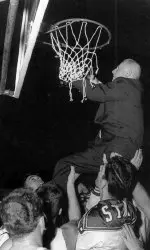
RALEIGH, N.C. – The first Sweet Sixteen was borne from something that can’t be sugar-coated: The feud between stubborn coaching legends Everett Case of NC State and Adolph Rupp of Kentucky.
Back in 1950, long before multi-billion-dollar television deals and below-the-knee shorts, the NCAA Tournament had only eight teams and all bids were given out by geographically based districts. It was hardly comparable to the modern-day March Madness and the excitement surrounding 11th-seeded NC State’s success in this year’s 68-team tournament, which the Pack hopes to continue on Friday in St. Louis when it faces Kansas
Part of that early madness came from a little bit of fury between Case and Rupp, who both wanted badly to be part of the 1950 postseason at a time when the NCAA event had become more popular than the older National Invitation Tournament. Both coaches were convinced their teams deserved to be in the eight-team field.
The Wolfpack, behind the scoring of All-America forward Dick Dickey and the guard play of Vic Bubas, had dominated the Southern Conference in the regular season, losing only one league game and winning its annual postseason tournament for the fourth year in a row. The Pack, 25-5, was waiting on a phone call from district chairman Gus Tebell, the athletics director at Virginia, for an invitation to play in the NCAA Tournament at Madison Square Garden.
The Wildcats, the two-time defending national champion who owned a 25-4 record, thought they deserved it as well, having won both the Southeastern Conference regular-season and tournament. Rupp’s team was 25-4 heading into postseason play.
Tebell came up with a novel idea: a one-game play-off to determine the district’s representative.
Case – the transformational basketball wizard who brought big-time basketball to the South – heartily agreed. He had long wanted a rematch with the Wildcats, who had eliminated the Red Terrors from the 1947 NIT, only to be thwarted by Rupp’s insistence that the game be played in Lexington, Ky., instead of Raleigh.
“We’ll play Kentucky anytime, anywhere,” Case declared to the North Carolina newspapers.
Rupp wasn’t so accommodating, pointing out that Kentucky had beaten Villanova in Philadelphia, while the Wolfpack had lost to the Main Liners in Raleigh. He thought those two outcomes alone were a convincing argument to make the Wildcats the District III representative.
The Baron thought the idea of the Wildcats playing their way into the NCAA tournament was “ridiculous.” He later claimed that Tebell hadn’t even suggested it, even though it was reported in the North Carolina newspapers.
Perhaps Rupp thought that Tebell – who had won Southern Conference football and basketball titles in 1927 and ’29, respectively, while coaching both sports at NC State – might favor his former employer. After all, Tebell had mentioned the possibility of playing the contest at Duke Indoor Stadium, in the Wolfpack’s backyard.
Tebell awarded the fifth-ranked Wolfpack the region’s NCAA Tournament bid.
Case and his team had two full weeks to prepare for its first NCAA Tournament appearance, to be played against Holy Cross at Madison Square Garden. With Dickey guarding All-America point guard Bob Cousy – the country’s top collegiate player – the Wolfpack beat the Crusaders 87-74 to advance to the national semifinals, the old-school equivalent of the Final Four. Dickey’s defense limited Cousy to just two field goals on 17 shots.
Meanwhile, junior Sammy Ranzino shattered the NCAA single-game scoring record with 32 points.
Bubas, however, suffered a sprained ankle in the opening game and was hobbled in the national semifinal game against the City College of New York, which had just won the NIT Championship in the same building the week before.
The Wolfpack lost the closely contested game when Dickey, Ranzino and Paul Horvath all fouled out in the final minute. Bubas’ shot to tie the game in the closing seconds fell short, and CCNY went on to become the first team in college basketball history to win both the NIT and the NCAA Tournaments in the same season.
The hubbub between The Old Grey Fox and The Baron over the 1950 District III tournament bid, however, caused a massive overhaul in the NCAA’s process for choosing future participants in the tournament. The field was expanded to 16 teams for 1951, with automatic bids going to 11 conference champions and at-large berths going to five independent teams. The at-large bids, the pairings and the site selection were determined by one national committee.
Each of the 11 conferences was allowed to determine its own representative. The Southern Conference – which was composed of an unwieldy 17 teams – had to play a postseason tournament to determine a champion because of an unbalanced regular-season schedule. The other 10 leagues chose to send their regular-season champions, a decision that eventually ended most conference tournaments until the NCAA finally expanded the field to include more than one team per league in 1975.
The Pack beat Duke to win its fifth consecutive Southern Conference championship and earn its first automatic bid into the NCAA Tournament. To add a little spice to the event, Kentucky was also sent to play at Reynolds, along with Frank McGuire-coached St. John’s and Illinois.
Before that tournament started, however, the Wolfpack played in the NIT, which started the week before the NCAA. It was not uncommon for the best teams in the nation to play in both events.
The long-anticipated showdown between Case and Rupp never materialized, though. At the end of the regular season, the NCAA informed Case that three senior stars – Ranzino, Bubas and Paul Horvath – would not be allowed to participate in the postseason tournament. They had all played during their freshman season of 1946-47, Case’s first year in Raleigh, when the NCAA barred freshmen from playing under its Sanity Code for Eligibility. The Southern Conference, however, still allowed freshman to suit up.
Case lost his appeal the NCAA asking that the three Wolfpack stars be reinstated since they were integral parts of the nation’s top-scoring offense. The Pack averaged 78.9 points a game and Ranzino was one of the nation’s top 10 scorers.
Just as Case and his team left for New York to play in the NIT, news broke of a federal investigation into point-shaving allegations. The coach sequestered his team in the New York Athletic Club for a full week and forced his players to bide their time taking mid-term exams. They were in a fairly foul mood when they took on little-known Seton Hall. Even with its three star seniors, the Pack lost 71-59.
Case brought his team back to Raleigh to play in the NCAA East Regional, facing old nemesis Villanova, a team that had already beaten the Pack twice that season. Newcomers Bill Kukoy, Bernie Yurin and Bobby Goss stepped into the starting lineup in place of the ineligible trio and Kukoy inspired the home crowd by scoring State’s first 11 points in the second half and leading the team to an emotional 67-62 win.
Case’s team could not replicate the magic of its first round win, as Kukoy suffered a dislocated shoulder in the early moments of the game against Illinois and the Wolfpack’s lack of depth led to an 84-71 loss. The next day, the Wolfpack lost again to St. John’s, 71-59.
That was both college basketball’s and the Wolfpack’s first foray into a 16-team tournament, though the NCAA only recognizes Sweet 16 appearances after the 1974 tournament, when the field was expanded and opened to more than one team per conference.
- By Tim Peeler, tim_peeler@ncsu.edu.