North Carolina State University Athletics
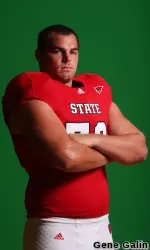
Program Spotlight: Mikel Overgaard
9/28/2011 12:00:00 AM | Football
Sept. 28, 2011
Raleigh, N.C. - The Idaho pipeline has not exactly been a staple of NC State's football recruiting over the years. Unfazed by this little nugget of Wolfpack history, offensive tackle Mikel Overgaard came to State anyway, took a circuitous route to do so, and broke a two-generation-long family tradition in the process.
A 6-foot-6, 289-pound senior from Weiser, Idaho, Overgaard comes from an athletic family. More to the point, Overgaard comes from an Idaho Vandals family, an Idaho football family. His grandfather, Wilford Overgaard, played football at Idaho from 1946-50. His father, Wil E. Overgaard, played for the Vandals from 1973-77, and was a team captain and an all-conference selection in the Big Sky Conference.
It would be an understatement to say that Mikel grew up an Idaho fan. It might be overstating things to say that he grew up always wanting to play there, not that he never entertained the thought.
"It was always kind of in the back of my mind," Overgaard says, "not that it was expected that I was going to go there, but I always thought about being the third generation of Overgaards to play there. It worked out differently."
Instead of attending Idaho after graduating from Weiser High School in 2007, Overgaard opted to walk on as a tight end at Washington State. He redshirted as a freshman, hoping to see playing time with the varsity in `08. Instead, head coach Bill Doba was let go following the `07 season, and Overgaard reconsidered his options.
A teammate at Washington State was a transfer from Snow College, a junior college in Ephraim, Utah. He contacted the coaches at Snow on Overgaard's behalf, and the following school year Overgaard went from a four-year Division I school to a junior college.
If it appears at this point in the narrative that Overgaard was walking backwards through the Idaho-NC State pipeline, fear not. All was good in the end, and Snow was an important stop in Overgaard's development.
Following Overgaard's first season at Snow, the coaches approached him about moving from tight end to the offensive line. He was primarily a blocking tight end anyway and the team had a need along the line.
"The coaches called me one day and said, we're having some issues with some guys returning and being eligible, and that might be a move that I needed to make if I was willing to," Overgaard says. "I thought about it because I wasn't real sure that was for me or not, and I decided to go with it and see what happened."
That turned out to be the right move, but it took time. Overgaard weighed in at about 235 pounds as a tight end. He spent the summer of `08 working out, trying to put as much muscle on his frame as he could. He weighs about 289 now, but that first year on the line he probably was 20-25 pounds lighter than that. And his biggest adjustment to the offensive line was not the physical part. He had to learn an entirely new position.
"Early on it was a lot of thinking about what the defense is, what I'm supposed to do," Overgaard says. "It was a lot to learn. Now, just being able to play regularly, that's been the most fun, understanding the position and being able to play without having to think about what the defense is doing and just kind of going with it."
Eventually he settled in on the line and had a strong sophomore season, earning all-conference honors and putting him still further into the pipeline to NC State. Turns out that the Snow coaches had a connection to Wolfpack head coach Tom O'Brien's staff through the earlier recruitment of quarterback Paul Peterson at Boston College. So during Overgaard's sophomore season, his coaches called NC State recruiting coordinator Jerry Petercuskie and alerted him that they had a legit prospect that on their hands, flying under the radar.
The Wolfpack coaches took a look, liked what they saw, and offered Overgaard a scholarship. And so he wound playing Division I football two time zones and nearly 2100 miles from home. The pipeline was established.
"I was excited," Overgaard said of the transition to Raleigh and the Eastern Time Zone. "It was different. I had been out here, not to North Carolina but to the East Coast, to visit, so when the opportunity came to come out here and play, I jumped on it. I'm glad I did."
Weiser is about 60 miles from Boise, the state capital of Idaho. Upon arriving in Raleigh, Overgaard found the two state capitals to be quite similar, further easing his transition. The one significant difference was the weather, and he insists he does not miss the cold winters in Idaho.
"Raleigh does remind me a lot of home," Overgaard says. "Raleigh and Boise seem very similar to me. The environment is similar here. It gets a whole lot hotter here than it gets out in Boise, but the people and the environment are similar, and the lifestyle here is kind of laid back and easygoing and friendly, kind of like Boise."
One other similarity between the two areas is their passion for sports. Overgaard pretty much did it all in high school. In addition to playing football, he was a state champion in the discus and ran the 200 meters in track and field. He also played power forward in basketball.
"I loved basketball growing up, but basketball in Idaho is a little different from out here, a little less competitive," he says. "It was something I always loved and I considered playing basketball instead of football."
Like much of the South, however, football reigns in Idaho, especially at the grass-roots level. High school football is huge in the state, and while he loved basketball, football permeated the culture and was the family tradition.
"People might not know it, but [football]'s a big deal out there," he told Raleigh's The News and Observer. "It's small towns where everyone loves football. ... I grew up around it. I grew up loving it. I always knew I wanted to play. I started as early as I could, playing flag football and everything. And it ended up being the sport for me."
Overgaard came to college to play football, for certain, but he also came to get a degree. Both parents are not only college graduates, but work in the education field. His mom, Megan Overgaard, is a high school biology teacher and track coach. His dad works for the local school superintendent. Mikel learned the importance of good grades at an early age.
He was a 4.0 student and class valedictorian at Weiser High School, then had a 3.8 grade-point average at Snow College. At the beginning of the current school year, he had a 3.65 GPA in biology at NC State. His GPA is the highest among all returning players on the team.
"With or without football, one of my goals was to get a college degree," Overgaard says. "I've worked hard to make sure I could do that. I plan to go to med school or dental school, something in the medical field, and going into that, they look at your transcripts. So I knew I had to work hard to keep my grades up. I've been able to do it, so it's been good. The offensive linemen like to tease me about it, but I can handle that."
The Idaho pipeline may not have been the most well-beaten path to Raleigh, but it turns out to have been the right path for Mikel Overgaard.
By Bruce Winkworth