North Carolina State University Athletics
PEELER: Remembering John Wooden's Pack Ties
6/11/2010 12:00:00 AM | Men's Basketball
BY TIM PEELER
RALEIGH, N.C. – John Wooden's last victory as a senior guard at Martinsville (Ind.) High School was against Everett Case's Frankfort Hot Dogs, a 30-13 whipping in the semifinals of the 1928 Indiana state high school tournament. Case's last win as a high school basketball coach was against Wooden-coached South Bend Central, a 28-24 victory in the quarterfinals of the 1942 state tournament.
The two Indiana natives were strongly bonded to the roots of Hoosier high school basketball. And Wooden, who died last Saturday at the age of 99, never forgot those ties to the many Hall of Fame coaches, players and personalities he knew as a youngster.
Wooden talked wistfully of those memories on Nov. 30, 2002, prior to UCLA's game against Duke in the Wooden Tradition, an early-season showcase game played at Conseco Fieldhouse in Indianapolis. I happened to be covering Duke at the time for the Greensboro News & Record and I pulled the coach aside just before tip-off to ask him a few questions about Case, whom I was profiling as the most important figure in the first 50 years of the Atlantic Coast Conference.
Wooden smiled at the memory of Case, the swashbuckling coach of Hoosier high school fame. They never faced each other in college, while Case was at NC State and Wooden was a player at Purdue or a coach at Indiana State or UCLA. But Wooden, at the request of former Wolfpack player and assistant coach Vic Bubas, visited Case at his Cameron Village home in December, 1965, about five months before Case died.
"But I knew him quite well," Wooden said, with a familiar smile. "He went to North Carolina State and brought players from Indiana. I'm told that some of the other schools there in North Carolina used to play "Back Home Again In Indiana" [the well-known song of the Hoosier State]. He began the turning around of basketball in the South, more than any other individual. North Carolina wanted to do better, so they imported Frank McGuire from New York. All the other schools in the ACC did the same thing.
"It all started at North Carolina State through Everett Case."
But Wooden did not have fond memories of his second encounter with one of Case's protégés, the late Norman Sloan, who handed Wooden and seven-time defending national champion UCLA Bruins an 80-77 double-overtime loss in the 1974 NCAA semifinals that the legendary coach never forgot nor forgave himself for. The Bruins had beaten the Wolfpack earlier in the season, in a made-for-television game in St. Louis, and were a little overconfident when the two teams met again at the Greensboro Coliseum.
Especially after building a seven-point lead in the second overtime.
"With the players we had, [Bill] Walton and [Keith] Wilkes, to this day, I think we had the better team," Wooden said. "And we lost that game.
With all of the great games we had at UCLA that one against North Carolina State is one I will never get over."
Wooden's life spanned most of the recorded history of college basketball, from his humble farm roots in Martinsville to the bright lights of Los Angeles, where he had unprecedented and unequalled success at UCLA.
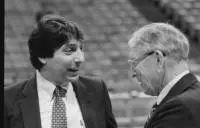
Along the way, he had a profound impact on the game. He also had a profound impact on the program here, as the hero of the late Jim Valvano and the late Kay Yow.
Valvano's most cherished memento of the 1983 NCAA championship was a handwritten letter sent to him by Wooden just after the Wolfpack beat Houston 54-52 in the championship game.
"I have said a number of times and sincerely feel that your effort in the tournament this year and that of Don Haskins in 1966 are the two finest NCAA tournament coaching jobs I have ever seen," Wooden wrote.
The two first met at Harry Litwack's summer basketball camps in the Poconos, when Wooden was the most famous coach in America and Valvano was a walk-on guard for Rutgers University. The brash Valvano ingratiated himself to
Wooden by talking about poetry and teaching, and they formed a bond that lasted until Valvano's death in 1993.
"I've said the one player I ever had that was born to be a coach was Denny Crum, who was the most inquisitive player I've ever had," Wooden said in a February of 2004 telephone interview. "The only other person I have known like that was Jim Valvano. Denny Crum and Jim Valvano were the only two people I ever knew who were born to coach."
Wooden was also close to fellow Naismith Memorial Hall of Fame inductee Kay Yow. They met in the early 1990s, only a few years after Yow survived her first bout with breast cancer and coached the 1988 U.S. team to the gold medal at the Seoul Olympics. She asked to meet him one day, and he invited her to spend the day talking about his pyramid of success at his home in Encino, Calif.
For years afterward, Yow kept a small shrine to the coach in her office at the Case Athletics Center and at Reynolds Coliseum. Not long ago, the day before Yow accepted the Jimmy V ESPY for Perseverance, she and her staff again visited Wooden in his condominium, a 45-minute exchange of praise and ideas between the two Hall of Fame coaches.
On that afternoon, July 10, 2007, Yow asked Wooden if there was a game in his career that he ever regretted.
Sitting in his living room, surrounded by all the memorabilia collected during nearly a century of unparalleled success, Wooden smiled and said, "You, of all people, being at North Carolina State, should know the answer to that."
Wooden said he would never, ever get over losing to David Thompson, Tommy Burleson, Monte Towe and company at the Greensboro Coliseum on March 23, 1974, which ended the Bruins' streak of seven consecutive NCAA titles from 1967-73. Sloan, on the other hand, thought that no one would ever remember it.
"You know, I don't ever recall that it was written that we ended UCLA's streak of national championships," Sloan said during a 1999 interview.
"People know Notre Dame ended the 88-game winning streak. But I think people forget that we ended the streak of national championships."
Wooden certainly didn't.
"In all my years in the college game that North Carolina State game stands out more to me, because in my opinion, we let that game slip away," Wooden said. "We had an 11-point lead in the second half and a seven-point lead in the second overtime, and we lost. That should not happen."
But that defeat wasn't Wooden's only regret in his well-lived 99 years. Like most people of great success, he used his failures to motivate himself and others. So he never let slip from his memory the circumstances of the 1928 state championship game. He was still bothered by it nearly three-quarters of a century after it was played.
Probably because, not surprisingly, he outcoached his own coach, and still lost.
It happened the day after Wooden and his Martinsville teammates trounced Case's Hot Dogs 30-13 in the semifinals.Wooden and his Martinsville teammates played in three consecutive state title games, from 1926-28, which were bookended by Case's first two championships, in 1925 and '29. Wooden's team won the title in 1927 and was expected to repeat in 1928.
Martinsville had beaten Frankfort in the regular season, 15-11, with Case using a slowdown strategy that he had popularized the year before. Wooden spent much of the game dribbling the ball in the backcourt and did not make a field goal in the second half, but he still managed to score nearly half of his team's points.
The two teams met again later in the season in the state playoffs, which were played for the first time in new Butler Fieldhouse, a mammoth arena that was built specifically to host the high school championship, at an unheard of cost of $1 million. From 1928-50, it was the largest basketball arena in the country. From 1928 until 1971, it was the host of the Indiana High School Championship, including the famous 1954 championship by Milan High School that inspired the movie "Hoosiers."
But the play-offs were an all-day Saturday affair, with the first of nine games beginning at 8:30 a.m. Case and his team won its 11:30 a.m. game, an upset of heavily favored Logansport, 15-11. But the coach and his team nearly missed their 3:30 p.m. appointment to play Wooden and the defending state champions in the second semifinal game.
Apparently, the new arena was lacking in food services, so Case took his team to a crowded diner in downtown Indianapolis. Service was slow, and Case and his team returned to Butler Fieldhouse just before tip-off. The full-bellied Hot Dogs did not play well against Martinsville, a game that was officiated by future Indiana senator Birch Bayh. Wooden did not score a field goal, but plenty of his teammates did as they rolled over Frankfort, 30-13, to earn their third consecutive berth in the state title game.
That game turned out to be Wooden's first great regret. The championship game against Muncie Central was a slow-down game, a tactic that Case made popular the year before and was favored by Martinsville coach Glenn Curtis.
Wooden and his teammates led 11-10 in the final minute of the game, and Muncie Central had used its three allotted timeouts. That didn't prevent Muncie's Charlie Secrist, the Chris Webber of his day, from calling a fourth timeout.
Wooden, as team captain, elected to take the ball out of bounds, a choice allowed by rules of the day. However, his coach leapt off the bench and screamed, "We'll shoot it! We'll shoot it!"
Wooden missed the free throw. On the ensuing jump ball, Secrist tipped the ball to himself (which was legal at the time) and hurled a shot from beyond half court that swished through the basket, to give his team a 12-11 lead. Martinsville had a chance to win the game. Wooden found a teammate alone under the basket, but his layup spun around the rim and popped out as the buzzer sounded.
It was the first of Muncie Central's eight Indiana state titles, and another loss that Wooden never let himself forget.
"Those are the type of games that will always stick with you," Wooden said. "When you think you are better and you lose."
That didn't happen often for Wooden, but he remembered each of them to his final breath.
You may contact Tim Peeler at tim_peeler@ncsu.edu.
Sources:
- "Everett Case and the Frankfort Hot Dogs" by Roger Robison (1998, Hot Dog Press).
- Interviews with John Wooden, Vic Bubas, Norm Sloan, Jim Valvano, Robin Pate.