North Carolina State University Athletics
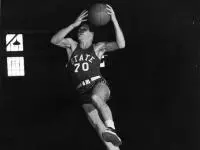
Dickey Was NC State's 1st True Super-Star
3/7/2010 12:00:00 AM | Men's Basketball
Editor's note: This story originally appeared in "Legends of NC State Basketball," by GoPack.com managing editor Tim Peeler (SportsPublishing LLC, © 2004). It is reprinted here with permission.
BY DAVID DROSCHAK
RALEIGH, N.C. – Dick Dickey was easy to overlook as a high school senior in Indiana in the 1940s.
The skinny redheaded guard was 5-foot-9 and weighed 150 pounds, and liked to play defense. Not exactly what the big-time colleges were looking for back then.
But World War II turned into sort of a blessing for his basketball career. In the first six months of Navy pre-flight training, Dickey grew four inches and put on 35 pounds of muscle.
He also worked on perfecting a shot that would help revolutionize college hoops in the South after he was recruited to North Carolina State by Everett Case, the former Indiana high school coaching legend.
While Dickey's Navy buddies looked forward to weekend liberty, Dickey would head to the gym to work on his one-handed jumper, a shot few used back in the day.
Dickey picked up the one-handed shot fooling around in the gym and kept perfecting it. He didn't know he was on to something special until he got to Raleigh.
''In the country of the Midwest during the war we didn't have much available as far as seeing other ball players,'' Dickey says. ''That shot seemed to work to my advantage so I stayed with it.''
''People in the South were still shooting free throws underhanded and using a two-handed set shot,'' adds Bill Hensley, the former sports information director at N.C. State and Wake Forest. ''But Dickey could really pop that one-handed jumper.''
Dickey first ran across Case during two Navy all-star basketball exhibition games. Case was coaching a team from Iowa, while Dickey was on a team from California. That's when Dickey realized Case would do anything to get an edge.
After Case won a close first game in Iowa, he headed to the West Coast for a rematch with Dickey's team, which had won 29 consecutive games. However, things weren't as evenly matched as when the two met on Case's home turf.
''When they came out to California he didn't play us on the base,'' Dickey says. ''He got us on a neutral court. He told me later he didn't want to play in front of 7,000 raving, yelling cadets.''
Case beat Dickey's team by a point off the base.
When the war ended, Dickey returned home to Indiana and was set to attend Purdue. But the Midwest school didn't offer him any scholarship money and Case won the recruiting battle.
The two immediately hit if off when Dickey began practice in Raleigh.
''He was one of Everett's favorites,'' says Skeeter Francis, the former publicity director for the Atlantic Coast Conference. ''He was a scorer and Everett liked him because he was flashy. And he was good.''
''Coach Case did you well if you did the right thing and played ball and didn't buck the system,'' Dickey says. ''He knew I wanted to win badly and so did he.''
Dickey, who played forward at State at 6-1, soon became a key part of Case's fast-paced offensive machine.
And his teammates didn't take long to begin to mimic his one-handed jumper in practice.
''Case put some plays in for me because I could get that shot off,'' Dickey says. ''It was one of the ways I could get open and I had fairly good jumping ability, so I could get over people.
''When we were playing in New York one time a magazine took a series of pictures of my jump shot. The reaction was the whole team wanted to work on using my jump shot.''
Dickey, also a high school and college high jumper, averaged 12.1 points as a freshman in 1947 on the first of four straight Southern Conference championship teams. A season later, N.C. State got 15.5 points a game from Dickey and rolled to another Southern Conference crown before a loss to DePaul in the first round of the NIT.
Dickey watched that NIT loss from the sideline because of the mumps.
''We would have played a different type of ball game if I was in there,'' Dickey says. ''We used to press all over the court, that whole year for the whole game. Coach Case elected not to do that when I got the mumps and we lost.''
N.C. State also lost out on a chance to play in the NCAA tournament that season, failing to get a bid despite one of the best records in the nation.
Dickey thinks he knows why.
''To get into the Final Four back then was pretty tough,'' he says. ''We were 29-2 at the time they selected and didn't even get a bid. Mr. (Adolph) Rupp was on the selection committee and we were in the same district as Kentucky so that may have had something to do with it.''
Dickey's junior year was filled with problems. He suffered a calf injury early in the season at Nevada and broke his nose later in the year against Virginia. Still, he played in 30 of the team's 33 games and averaged 11.8 points.
''I got put up into the stands in Reno and I didn't even practice that year,'' he says. ''It would take about three days for my calf to go back down to its normal size. I was kind of glad to see that season get over with.''
Dickey's final season proved to be a magical one.
N.C. State opened Reynolds Coliseum, beat defending NIT champion San Francisco and advanced to the Final Four for the first time in school history. Fans flocked to one of the best arenas in the nation to see Dickey and Sammy Ranzino race up and down the court, firing jump shots.
''For three years we watched that skeleton out there,'' Dickey says of Reynolds Coliseum. ''I was really beginning to think we weren't going to get into it.
''You always like when fans follow you. When I first got to Raleigh there wasn't that much activity. It was just after the war and people didn't care about basketball that much. Plus we were all new. Nobody recognized anyone. But it sure came around during that 1950 season.''
The Final Four back then was hardly the Super Bowl-style spectacle it has become. In fact, N.C. State walked from its hotel in Manhattan to Madison Square Garden for games and the only television coverage was local in New York. But it was still a big stage, and Dickey said the Wolfpack was more than prepared under Case.
''We had played in New York ever since my freshman year, so we were used to that,'' he says. ""And we had played against good ball players from all over.''
N.C. State beat Baylor and Holy Cross before losing to eventual national champion City College of New York in a close game. The highlight of that Final Four trip for Dickey was beating Holy Cross and its first-team All-American Bob Cousy.
''With the way the referees let people get by with palming the ball and everything else there is no telling what he could have done today,'' Dickey says of the star guard who later became his teammate with the Boston Celtics. ''He sure had a lot of moves and didn't palm the ball or carry it.''
Dickey played in N.C. State's first Final Four and was indirectly responsible for the team's second trip in 1974, convincing then coach Norm Sloan to take a chance on another Indiana player: 5-foot-7 Monte Towe.
Sloan wasn't too pleased to find out that Dickey was recommending a player who was so tiny.
''I said, 'Look at the pub you've going to get. You have Tom Burleson at 7-5 and Monte at 5-7,''' Dickey says.
N.C. State ended up winning the national title with Towe as its diminutive point guard.
Dickey was the first N.C. State player drafted in the NBA, going to Baltimore. However, he was sold to the Celtics during a preseason training series in New England in 1951.
''I went up there with one team and came back with another,'' he says.
But like with so many of Case's stars from Indiana, Dickey didn't pan out in the pros. He soon left the team for real life.
''I really wasn't playing much and the money wasn't like it is now,'' Dickey says. ''I was making a little over the minimum of $4,500. I would have stayed there and gotten splinters for the minimum salaries they have now, but I just walked in and quit one day.''
After more than five decades, Dickey remains the only four-time all-conference player for N.C. State and is just one of three three-time All-Americas.
''I had a fair amount of ability,'' says Dickey, who is approaching 80 and lives in Indiana. ''Heck, I don't know if I could make the team now, but at the time I was pretty good and I played defense.''
And Dickey played the game the way few did at the time, making him one of the more special players in the program's history.
''I can still see that little guy. I can see his facial expressions and his haircut,'' says Francis of the ACC. ''He was some flashy player.''