North Carolina State University Athletics
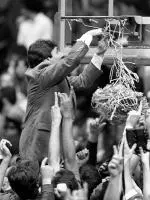
Valvano's Legacy Lives On Long After His Passing
2/20/2010 12:00:00 AM | Men's Basketball
Editor's note: This excerpt was originally published in "When March Went Mad," by GoPack.com managing editor Tim Peeler (SportsPublishing LLC, © 2004). It is reprinted here with permission.
BY TIM PEELER
RALEIGH, N.C. – When Jim Valvano said good-bye to his 1983 NCAA championship team, he did not have to run around looking for someone to hug. Most of his players were standing right in front of him on the afternoon of February 21, 1993, in Reynolds Coliseum, for a 10th anniversary reunion for the players and the Wolfpack's former coach. It was a difficult, exhilarating day for the dying coach, who was losing his public battle with bone cancer. Just three years earlier, he and the school went through a bitter divorce, the result of a trumped-up NCAA investigation and a media witch-hunt that put his basketball program on probation for minor violations and forced Valvano to resign his position as coach and athletics director.
Despite the palpable acrimony that still existed between the school's administration and coach, Valvano could not refuse the opportunity to celebrate the anniversary of his greatest achievement with the guys who helped him win the school's second NCAA title. So prior to a nationally televised game between Duke and NC State – the last game the coach-turned-award-winning television analyst ever worked – Valvano struggled onto the court of Reynolds, the site of so many wonderful moments, to bid farewell to his players and to the Wolfpack nation, which never really stopped adoring the coach, despite a two-year investigation into the way he ran his program. In the winter of 1993, those fans needed a heavy dose of inspiration, as a trying 8-19 season was drawing to a painful close. NC State graduate – and future athletics director – Les Robinson was suffering through his worst season as a head coach and the school's worst record in men's basketball in 26 years.
A sell-out crowd cheered uproariously – while Duke coach Mike Krzyzewski pitched a fit in the locker room for the game's delay – as Valvano hummed the fight song, acknowledged the friends and fans gathered in his honor and, most of all, reunited with his players. The hurt of the previous five years, when Valvano was raked over the coals in the media for losing control of his basketball program, was a distant, though still painful, memory.
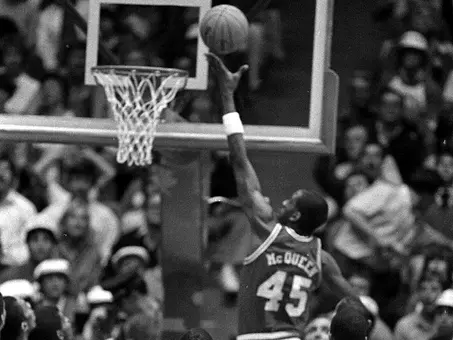
Not everyone from the '83 championship team could be there. Sidney Lowe, then the head coach of the NBA's Minnesota Timberwolves, had to attend mandatory league coaches meetings. Lorenzo Charles and Cozell McQueen were still playing professional basketball overseas. Walter "Dinky" Proctor chose not to participate, spending the afternoon working his day shift at a Triangle convenience store. Thurl Bailey arrived a little bit late because a snowstorm delayed his flight from Utah.
Everyone else, however, lined up on the court of Reynolds, waiting to give the stiffly moving ex-coach the hug he was denied in Albuquerque a decade before. Valvano bowed in front of Dereck Whittenburg. When he got to the end of the line, he climbed onto a folding chair to hug the six-foot, eleven-inch Bailey. Valvano was not yet sick enough to pass up a comedic moment. What he whispered in Bailey's ear, though, was heartfelt and simple: "I love you, Thurl."
As he addressed the crowd, Valvano managed to put together the words that put the 1983 championship into the perfect context: It was more than just a string of basketball wins. It was more than just a collection of guys doing what their coach told them to do. It was more than just a bunch of college kids winning a few close games. It was then – and remains today – a team that inspired others to do unimaginable things.
"They are special, not because they put that banner up there," Valvano said. "They're special because they taught me and the world so many important lessons. No. 1: Hope. What does hope mean? Hope that things can get better in spite of adversity. The '83 team taught us that. When Dereck Whittenburg went down and everybody said ... there was no way we could win and a kid named Ernie Myers stepped in and we lost a few, then we won a few, and then Dereck came back and every sportswriter in America said that – I remember my favorite quote –that 'trees would tap dance, elephants would drive in the Indianapolis 500 and Orson Welles would skip breakfast, lunch and dinner before NC State figured out a way to win the NCAA [championship]' This team taught me that elephants would drive in the Indianapolis 500 one day.
"The '83 team taught me about dreaming and the importance of dreams, because nothing can happen if not first a dream. ... If you have someone who never gives up, who has great hope ... Don't ever give up, don't ever stop fighting! The '83 team gave you hope, gave you pride, told you what hard work was about. It gave you the meaning of believing in a cause, and lastly what they taught me is to love each other. They taught me what love means. When you have a goal, when you have a dream, and when you have belief, and you throw in that concept of never stop believing in and loving each other, you can accomplish miracles."
Reaping the Rewards
Valvano reaped most of the glory and practically all of the financial rewards in the aftermath of the 1983 championship, using it to promote himself and NC State University on a national stage. In the weeks following the championship, he made two trips to the White House to meet with President Ronald Reagan. The players were not allowed to go with him on the first trip because of a never-before-invoked NCAA rule that prevented teams from traveling more than 100 miles away from campus for a championship celebration. While Valvano sat in the Oval Office with Reagan and North Carolina senators Jesse Helms and John East, the players were hooked up to the White House by a satellite hook-up from Raleigh television station WRAL, just across Western Boulevard from campus. On the second trip, Valvano took Lowe and Whittenburg with him.
In the months following the season, Valvano entertained writers from the Washington Post, the New York Times, Sports Illustrated, Sport Magazine, Scholastic Coach Magazine and just about any other reporter from a national or local outlet that wanted to bottle Valvano's lightning into a couple of thousand words. No one did it completely, but almost all of them decided that Valvano, as he showed during his team's title run months before, was a breath of fresh air in the staid world of college basketball.
The hyper-active Valvano – who always spent his summers running his basketball camps, making public appearances, recruiting and handling the other off-season responsibilities of a modern college basketball coach – wrote a book chronicling the team's championship and introduced his own "Jimmy V" clothing line. He accepted a handful of additional endorsements, one for the soft drink Mountain Dew and another for the fast-food chain Hardees. He was completely unapologetic for doing the same activities he had always done, but on a grander scale.
"It was different from every other summer only in the amount of publicity I received," Valvano said in a November, 1983 interview with Technician reporter Devin Steele. "I would like to think that this is what my grandfather had in mind when he landed at Ellis Island from Naples, Italy. I am what this country is supposed to be about: hard work creating success. The last time I looked, I have been working pretty hard. I don't have a lot of hobbies. I don't play a lot of golf. I don't take weekends off. I work. But I have also had a lot of fun doing these things. I love speaking to groups. I love traveling the country and gathering the pulse of American business. I loved working for Hardees and having clinics in parking lots for little kids around the state. I shook more hands, tousled more hair, signed more autographs and talked more about NC State than a lot of other people who are in this profession. I enjoyed that. As for the commercials, I had never done one and I wanted to see what it was like. I have a very inquisitive mind. All these things help me promote my program and NC State university and help me do my job, which is to recruit the best student-athletes I can so I can have the best basketball program."
What Valvano never saw as he increased his personal-appearance load to as many as 150 per year, as he raised his fee for corporate motivational speeches to $50,000 a pop, as he began making weekly appearances on the "CBS Morning Show" with Phyllis George, was that he was taking his eye off his program. He was even offered his own television talk show, with Vanna White as his sidekick.
"What happened was a whole new world opened up to Jim," said older brother Nick Valvano. "It didn't open up to him as an outsider looking in. It was like everything came to him. Jim always said 'I can do this, I can do this.'"
And he wanted to do everything. He set up his own production company, JTV Enterprises. He became a fixture on the motivational speech circuit. His clothing line included a terry cloth wrap that basketball players could wear in post-game locker rooms that were being increasingly infiltrated by female reporters. He commissioned an artist to do a signed print every year for the team that won the national championship. Everything he touched, it seemed, was born into success.
"He was really too smart to be a coach," said Whittenburg, who eventually became a graduate assistant and assistant coach on Valvano's staff. "He shouldn't have been coaching. He should have been on Wall Street."
When USA Today revealed in 1985 that Valvano was the nation's highest paid college coach, making nearly $500,000 a year in salary and endorsements, the same media that adored him immediately after the championship decided that the air around Valvano was not so fresh anymore.
He made two critical mistakes in the aftermath of the '83 championship: he brought in a slew of talented players with questionable academic and behavioral backgrounds that created off-court headaches for the coach and his staff and he replaced Willis Casey as NC State's athletics director in January, 1986.
"Part of Jim, ever since he was a kid, was that there was not a thing he couldn't do," Nick Valvano said. "There also wasn't a thing he didn't want to do. He felt he could juggle as many balls in the air as he threw up. Later in his life, the only thing he said he would change would be to only have ten balls in the air instead of twenty. He was never going to have just one. He never lost his passion to be a basketball coach. But he never lost his passion to do other things, either."
His over-busy schedule changed the relationship he had with and the control he had over the talented players he brought to NC State in his quest to win another championship. But as he juggled more responsibilities, he was no longer able to have the same close relationship with his players, many of whom were perfectly willing to take advantage of their coach's scarcity. "The guys who came later didn't know the same Coach V we knew," said former player and graduate assistant Max Perry.
Valvano had always been a players' coach, always available to have a heart-to-heart talk or an occasional beer and pizza with kids who weren't much older than he acted. In the early days, the doors of his golf-course home in the small suburb of Cary were always open to his players, twenty-four hours a day. And incurable insomniac, Valvano was almost always awake, whiling away the night time watching game-tape or a Lenny Bruce movie on a new-fangled machine called a VCR.
"I'm an insomniac," Valvano once told Gerald Martin of the Raleigh News & Observer. "I just don't believe in sleep as an activity. My mind doesn't allow for sleep."
He was always a kid at heart, and not afraid to show it. Shortly after he was hired to replace Norm Sloan, Valvano pulled his red Mazda 300ZX into the parking lot at the College Inn, the converted hotel on Western Boulevard where most of his players lived. Many of them were out back on a grassy field playing drunken touch football – one of the many physical activities that are generally forbidden by coaches who worry about the fragile knees of their players.
"We were all thinking we were in deep ----," Perry said. "He comes walking out, right past the keg, and looks at us. 'OK, I'm the quarterback. Whose team am I on?' We all looked at each other and said 'This is going to be good.'"
For several years, it was. Valvano told his players from the day he arrived on campus that he would win a national championship. N&O reporter Chip Alexander remembers a brief conversation with the coach shortly after Valvano was hired during a quiet moment in Reynolds Coliseum. Valvano was looking around the arena and Alexander pointed at the 1974 championship banner that was hanging in the rafters. "It might be nice to put another one of those up there," Alexander said. "Oh, we will," Valvano said. "We will." There was never any doubt in his mind.
But after it happened, Valvano wanted another one. To get it, he recruited players that needed more hands-on attention from their coach than he could give them. They were supremely talented, but unable to fit into a university setting during the early days of the NCAA's academic reforms. Valvano always had trouble keeping his attention focused on his team, leaving a good bit of the grunt work – like practice – to his assistant coaches.
This is why Valvano eventually lost control of his program: as talented a juggler as he was, he just could not keep up with everything. On January 27, 1983, the coach met two writers, Barry Jacobs and Ron Morris, at Amedeo's Italian Restaurant on Western Boulevard for a long lunch. Valvano had just signed his 10-year contract with NC State and gotten a huge raise. Jacobs was working on a piece that appeared in the New York Times, while Morris was writing a profile for the Durham (N.C.) Morning Herald. The quick lunch turned into a three-hour feast of anecdotes, basketball insights and off-the-record tales. By three o'clock, the coach was still going strong and he invited the two writers to come with him to practice. They headed over to Reynolds Coliseum, just in time for the start of stretching exercises. But there were no players on the synthetic rubber surface, just a bunch of coliseum workers setting up a stage and chairs for a concert by the Vienna Boys Choir two days later. The coach had no idea that his team was practicing across the street at the Carmichael Gymnasium.
In the spring of 1990, after having nearly every detail of his program poked and prodded by the NCAA and the Raleigh News & Observer, Valvano was deemed to be a liability to the university and was forced to resign. He reached a settlement with the school in excess of $600,000. Not long afterwards, he wrote a book with Sports Illustrated's Curry Kirkpatrick entitled "They Gave Me a Lifetime Contract, and Then They Declared Me Dead." There was hardly any bitterness at all.
"What hurt Jim the most was not being able to leave coaching the way he wanted to," said Nick Valvano.
Born to Coach
Valvano grew up under the elevated train in Queens, New York, the middle of three sons of Rocco and Angelina Valvano. The biggest talker in a loud, Italian family – his mom declared that her middle son was immunized by a phonograph's needle – Valvano was more than a dinner-table comedian. He was also the best athlete in the family. When his family moved to Long Island, Valvano played football, basketball and baseball at Seaford High School, earning ten varsity letters in football, baseball and basketball. He also won the election for student body president.
"Jimmy was a hell of a baseball player and a pretty good quarterback," Nick Valvano said. "He broke his leg as a high school junior and didn't get to play football, but he was back for basketball. He was a tough kid and he loved football. But he threw kickoffs: all of his passes were end-over-end. In baseball, the Kansas City A's and the San Francisco Giants wanted to draft him, but our dad wanted him to go to college. So he played basketball, which was probably the sport where he achieved the least in high school."
At six-feet, 155-pounds, Jim Valvano did not have many recruiters beating a path to the family's home in Long Island. So he chose to attend Rutgers and walk on to Bill Foster's basketball team. By the time he was a senior, he was both the team's starting point guard and co-captain. Along with roommate Bob Lloyd, he helped lead the Scarlet Knights to the finals of the National Invitation Tournament. He finished his career with 1,122 points, which at the time was among the top ten totals in school history.
Valvano earned more than just a degree in English while he was at Rutgers. He also established a relationship with one of college basketball's biggest legends, UCLA coach John Wooden. While working the Catskills basketball camps of legendary Temple coach Harry Litwack after his freshman year of college, the ever-bold Valvano struck up a conversation with Wooden, another English major who believed there was more to being a basketball coach than just Xs and Os.
"I have often said that the one player I ever had that was born to be a coach was Denny Crum," Wooden said of his former pupil who won the 1980 and '86 NCAA titles as the coach at Louisville. "He was the most inquisitive player I ever had, wanting to know not just why we were doing something, but the reason behind why we were doing everything. The only other person I have known like that was Jim Valvano. He wanted to know about everything. He and Denny Crum are the only two people I know who were born to be coaches."
Following the Wolfpack's 1983 championship, Wooden sat down to write his young friend a letter of congratulations, as he did to every coach that won the NCAA title. But this one meant a little more than the others, because of a relationship that went back to those long-ago basketball camps in the Catskills.
"As one English Major, albeit quite older and non-Italian, 'Yuh dun good!' Seriously, Jimmy, congratulations on an outstanding coaching job and best wishes for continued success in all ways. I have said a number of times and sincerely feel that your effort in the tournament this year and that of Don Haskins in 1966 are the two finest NCAA Tournament coaching jobs I have ever seen. You are great for the profession, Jimmy. Please do not change. Sincerely, John."
Heartbreaking End, New Beginning
In the spring of 1992, while playing golf at a Spanish course overlooking the Mediterranean Ocean, Valvano did not feel like himself. He lacked energy. He went to bed at night and actually slept. There was a tight feeling in his testicles that would not go away.
After an MRI test at Duke University, a doctor told Valvano that the black mess that was supposed to be the lower vertebrae of his spine was most likely cancer. Soon after, Valvano heard the doctors tell him that the official diagnosis was metastatic adenocarcinoma, an aggressive form of cancer that is almost always fatal when detected – as Valvano's was – in its later stages. The tightness in his testicles was nothing compared to that kick in the balls.
The last 12 months of Valvano's life were a blur of chemotherapy, hospital visits, empty afternoons at home in his bathrobe and a few basketball games as a color commentator for ESPN and ABC. He was so sick that his former gunning guard, Terry Gannon, was on 24-hour call to replace Valvano in the broadcast booth. He was bitterly disappointed that all the other things he wanted to do would not get done, that his eternal dreams would be packed into less than half a century of life.
"I remember sitting upstairs in his room when he was sick and he had thrown everybody out of the room but me," Nick Valvano said. "He would say 'I have so much more I want to do. I am so pissed off about this.' But the thing is, and I told him this, if it was 20 years later and he was not sick, we would still be having this same conversation, that he still had so much more that he wanted to do. We actually laughed about it, and he said 'Yeah, you're right.'"
Pam Valvano, Jim's wife of 25 years, was used to finding 3X5 index cards in her husband's clothes, with simply stated life goals listed on them. For years, that's where he wrote down his dreams. There was one that said "Become Division I head coach," one that said "Get an NCAA bid" and one that said "Win the national championship." The last one she ever found read simply: "Find a cure for cancer." Valvano's dreams were always bigger than the cards he used.
On March 4, 1993, at the inaugural ESPY Awards, Valvano announced that ESPN was establishing a charity that would bear his name. The V Foundation for Cancer Research. His speech from that night - when he implored the audience "Don't give up. Don't ever give up" - has defined Valvano's legacy.
A year later, the V Foundation gave away its first grant, a modest $100,000, to Dr. Gerold Bepler, a young investigator at Duke who was looking into the causes of lung cancer. Bepler is now the leader of the Thoracic Oncology Program at the H. Lee Moffitt Cancer Center and Research Institute in Tampa, Fla. In the years since receiving the V Foundation's first grant, he has raised more than $13 million in additional grants to fund his research lab, which has recently defined several proteins that are actual cause of some forms of lung cancer. "I would expect to see Gerold and his lab produce some sort of therapeutic drug very soon," Nick Valvano said in 2007.
Through the fundraising efforts of Nick Valvano, who serves as the charity's executive director, the V Foundation has raised more than $60 million for cancer research. Rated as a four-star charity for four years in a row, it is one of the few non-profit organizations that has an endowment large enough to fully cover all of its operating expenses, which means it can give away 100 hundred percent of all the money it raises. In 2006, the V Foundation gave away more than $8 million in grants ranging from $2 million to $100,000.
The foundation has completely changed the way Valvano – once vilified for his lack of institutional control and raked over the coals for the way he ran his program – is remembered.
"What I think is ironic is that Jimmy's legacy isn't basketball anymore," said Bobby Cremins a long-time friend and competitor of Valvano's. "It's not the '83 championship anymore. It's fighting cancer and the V Foundation. Jimmy had incredible foresight. He was always ahead of his time. His mind operated always in the future. That was one of his problems too. He wasn't in the present too much. He was rarely in the past. But he was always in the future."
That foresight ended at 10:30 a.m., April 28, 1993, barely ten years after Valvano reached the pinnacle of his coaching career and only seven weeks after he struggled to the stage to make his legendary ESPY's appearance. He slipped into a coma and died peacefully at the Duke University Hospital. He was just 47 years old.
"You know what Jimmy'd say about the V Foundation?" Nick Valvano said. "He would say, 'Jesus Christ, Nick, can't you do a little better? What the hell is taking you so long? I got you started. I gave you the speech. And this is all you have done?'"
Jim Valvano was more than just a dreamer - he forced others to work just as hard as he did to make his dreams come true.