North Carolina State University Athletics
PEELER: An Old Tradition With Pack's Oldest Rival
2/19/2010 12:00:00 AM | Men's Basketball
BY TIM PEELER
RALEIGH, N.C. – On Jan. 9, 1961, NC State basketball coach Everett Case arrived for his annual appearance at the Winston-Salem Tip-Off Club, with a crumpled chair in his arms and a solemn look in his eyes.
He held up the pieces of the chair, which had previously been seen on the sidelines of Reynolds Coliseum during the Wake Forest-NC State game a few weeks earlier, and began reading a letter from his boss, athletics director Roy Clogston.
"During our Dixie Classic game, Mr. McKinney willfully and maliciously demolished this chair, which I produce as evidence," Case said, before breaking into his sly grin. "However, since Bones is a former State player, the University is willing to settle for the damages as suggested by our athletics director ... in this letter to Wake Forest President Dr. Harold Tribble."
With that, Case handed McKinney the pieces of the chair and an invoice for $14.33.
The room howled, knowing that Case and McKinney, two of the ACC's premier showman, were going at it again, as they had many times when their teams faced one another.
McKinney, prepared to pounce on the promotional opportunity, claimed that his anger was caused by the game officials, all of whom were close friends of Case. So he refused to pay the bill. (That never would have happened had Willis Casey been NC State's athletics director instead of Clogston.)
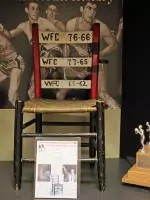
Instead ol' Bones, who played at NC State College prior to World War II before spending his senior year at UNC, suggested that the Wake Forest maintenance department piece the chair back together and from that game forward, the winner of the annual contests would get to keep the chair until the other team managed to win it back.
McKinney had the bottom half of the chair painted Old Gold and Black and the top half painted in State's traditional Red and White.
It was a great gimmick, at the time, for the game played against NC State's oldest rival.
Saturday's 2 p.m. game at the RBC Center will mark the 100th consecutive year the two teams have faced each other in basketball. The first time was on Feb. 16, 1911, on the old Wake Forest campus, which was just 20 miles north of Raleigh in the town by the same name.
It was the first intercollegiate game ever played by the North Carolina College for Agriculture and Mechanic Arts, as NC State was then known. Wake Forest, under the leadership of Richard "Red" Crozier, had been playing college basketball for five seasons. So the Farmers were overmatched, losing 33-6 in a contest that was more curiosity than rivalry.
Five days later, in the only other game played that inaugural season, the Farmers got their revenge, beating Wake Forest 19-18 in a game played at Pullen Hall, a place ill-suited for basketball. The teams had to avoid the stage on the shortened court. To make matters worse, the floor was freshly polished for a Thalarian German Club dance a few days before. With both teams wearing non-vulcanized, rubber-soled shoes, the players slid all over the court.
That's what you call a home-court advantage.
Over the years, particularly when the schools were next-door neighbors, the Baptists/Demon Deacons and the Red Terrors/Wolfpack have played some classic games. Saturday's game will the the 231st contest in the series, with the Wolfpack holding a 131-99 advantage.
Once, in a regular-season finale for both teams, Wake Forest scored 89 points against the Pack - and lost by 41. That was 1983, when Sidney Lowe, Dereck Whittenburg, Thurl Bailey and Quinton Leonard celebrated Senior Day at Reynolds Coliseum. That afternoon, Jim Valvano's Cardiac Pack looked like the best team in the nation, winning 130-89.
The two teams played the longest game in ACC history in 1989, a four-overtime contest in the final game played in the old configuration of the Greensboro Coliseum. The Wolfpack, thanks to an unbelievable performance by the school's all-time scoring leader, Rodney Monroe, won 110-103.
Wake Forest has had its moments as well. Murray Greason and his team ended Case's hold on the Southern Conference championship, beating the Wolfpack 71-70 at Reynolds in the 1953 title game.
And Mr. and Ms. Wuf will always remember the NC State-Wake Forest game on Feb. 28, 1981. On that afternoon, at halftime of a game played at Reynolds, the two were married in a traditional ceremony officiated by the Demon Deacon mascot. The groom wore red, the bride wore white, and the minister went home unhappy after a Wolfpack win.
Happy anniversary, you crazy carnivores.
The tradition of the Old Wicker Chair didn't last very long. Wake Forest, led by All-America center Len Chappell and guard Billy Packer, dominated the series, as NC State and North Carolina both de-emphasized basketball following a 1961 point-shaving scandal.
Wake won the first game for the chair, 76-66, on Jan. 14, 1961, and went on to win the first of its back-to-back ACC championships. The next season, the Deacons made their only trip to the NCAA Final Four.
McKinney's team won seven of the nine times the teams played for the chair.
On Dec. 5, 1964, Case and the Wolfpack traveled to Winston-Salem to face the Deacons in an early-season ACC contest. When McKinney shook Case's hand prior to the game, he thought something might be wrong.
"I asked him if he was feeling all right," McKinney told Frank Weedon in 1996. "Everett replied, 'I just feel so poorly. I don't think I can coach any longer.'"
The Deacons won the game 86-80, and the next day Case, citing health concerns, retired from coaching after 16 years at NC State. He turned the team over to his coach-in-waiting, Press Maravich. The Wolfpack beat the Deacons in Raleigh later that season, then honored Case by upsetting nationally ranked Duke for the 1965 ACC Championship.
McKinney retired from coaching after the 1965 season as well, and the tradition of playing for a piece of broken furniture faded from memory.
But the repaired chair is still around. It rests in a sealed trophy case at Wake Forest, along with the two ACC Championship trophies McKinney's teams won not long after the coach destroyed it.
You may contact Tim Peeler at tim_peeler@ncsu.edu.