North Carolina State University Athletics
A Gift That's Still Giving
12/25/2010 12:00:00 AM | Men's Basketball
Dec. 25, 2010
BY TIM PEELER
RALEIGH, N.C. - Joe Harand picked up the newspaper one morning in May 1966 and was shocked to see his name in an article about his former basketball coach, Everett Case.
To his utter amazement, Harand learned he was one of the 57 former NC State basketball who had been left a portion of Case's sizable estate, a gift back to the college players who helped make the Naismith Memorial Hall of Fame coach the "Father of the ACC."
Case left two-thirds of his money, which he tightly hoarded from his NC State salary, his many business ventures and his wise investments to his spinster sister Blanche. The rest, a total of $69,525, was split into 103 equal shares and given to a list of players Case hand selected.
"I never thought about him leaving any money to any of us," Harand said.
While several other players received as many as three shares, Harand split a single share, worth approximately $675, with Nick Horvath. That was just enough for Harand and his wife Nell to purchase their first color television.
With the few dollars he had left over, Harand had a small plaque made for the television console that read: Through the generosity of Everett N. Case.
In the 45 years since the coach passed away, Harand has owned several more televisions in his home in Shelby, N.C. But he always moves the plaque to the new set, in memory of the gracious gift the late coach made to his players.
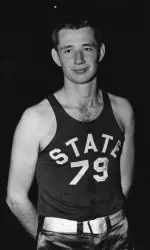
Harand, now 84, is the last link to Case's first team at NC State. The native of Tenafly, N.J., earned a spot on the freshman team in the fall of 1946 through an open tryout. He took a back seat in the early days of Case's program, serving as a scout squad member and a player on Case's first junior varsity team. At the time, Case relied on his "Hoosier Hotshots", the seven players he brought to Raleigh from his home state of Indiana that helped the Red Terrors win the 1947 Southern Conference championship.
Attrition opened the door for Harand to work his way into the lineup. As an end-of-the-bench reserve on Dec. 8, 1947, Harand scored the final three points in State's 100-35 victory over the Chatham Blanketeers, the first time in history a Southern Conference school topped the century mark. He continued to contribute, and became a starter as a junior, shortly after his close friend Eddie Bartels was booted from the team for running afoul of Case's team rules.
When the Wolfpack went to New York in 1950 for the school's first appearance in the NCAA semifinals, in today's lexicon, The Final Four, Harand was in the starting backcourt with Vic Bubas. They were joined by forwards Dick Dickey and Sammy Ranzino and center Paul Horvath. He was on the court when Bubas missed a critical shot in overtime that allowed the City College of New York to hand the Wolfpack a 78-73 loss in Madison Square Garden.
Harand was also in the starting lineup with Bubas in the first game ever played in Reynolds Coliseum on Dec. 11, 1949, and remains connected to those earliest years of Wolfpack's basketball success. He has his medal for playing in the inaugural Dixie Classic in 1949. He has the watch he and his teammates received for reaching the NCAA semifinals. And he has all of Case's old scrapbooks, which chronicle the coach's 18 years of unprecedented success, including nine conference championships in his first 10 years at NC State and a total of 10 overall.
A high school football star, Harand played only one year of basketball as a youngster growing up in New Jersey. But he learned the game while serving in the Navy on Martha's Vineyard during World War II, when the sport was the primary pastime of bored soldiers, sailors and Marines.
Harand picked up the game quickly enough that one of his teammates wrote a letter to his former high school coach, who had become the head coach at Kalamazoo College in Michigan and the coach offered him a scholarship. He declined, primarily because he was set on going to textile school in Philadelphia or Massachusetts.
When the war ended, Harand's best option was to enroll at North Carolina State College in Raleigh, even though he scarcely knew the difference between it and the University of North Carolina. He mistakenly thought he might bump into football star Charlie 'Choo-Choo' Justice in between classes.
Harand tried out for the football team, and earned both a spot on the roster and a room on campus, which was more difficult in those days right after the war than being admitted into school for the thousands of veterans looking to take advantage of the GI Bill. Even though his parents wouldn't let him play for first-year coach Beattie Feathers' football program, Harand maintained his spot in the dormitory.
He shared a room with two other new students, a football player and a newly enrolled basketball player from Indianapolis named Norman Sloan, a feisty guy who once kicked the football player out of the room for using his fancy, and noisy, electric shaver at 6 a.m.
Though he wasn't allowed to play football, Harand was one of the 200 or so students who showed up for Case's first tryout at Thompson Gym. Competition for the few spots on the roster was ruthless. Case cut the previous season's leading scorer, two previous team captains and a Pearl Harbor survivor. Mostly, Case kept the 15 players he recruited from Indiana and other parts of the country through his contacts as a U.S. Navy commander and coach of the all-military championship team.
But Harand survived long enough to make the scout team and begin his college basketball career, as a member of the team that introduced Case's fast-breaking, high-scoring style of basketball to the South.
After college, Harand used his textile chemistry degree and knowledge of the textile industry to start his own company, Dundee Chemicals. He and Nell settled in Shelby because of its proximity to North Carolina's once-rich textile industry and because he wanted to live in a place that was warmer than New Jersey.
Though he and Sloan had their run-ins while living together, the former teammates remained close until Sloan's death a little more than seven years ago. Sloan always called or stopped by when he was recruiting a kid from Shelby's Crest High School named David Thompson.
Harand and Bubas are also still close. They talk frequently on the phone and visit whenever they can.
And Harand still loves NC State basketball.
He watches it every time he gets a chance, always on a descendant of that first color television he bought "Through the Generosity of Everett N. Case."
You may contact Tim Peeler at tim_peeler@ncsu.edu.