North Carolina State University Athletics
Holtz, Bowden Bade Farewell at 1975 Peach
12/22/2010 12:00:00 AM | Football
Dec. 22, 2010
Editor's note: This story was originally published in "The Wolfpacker" (Copyright 2009). It is reprinted here with permission of Coman Publishing Co.
BY TIM PEELER
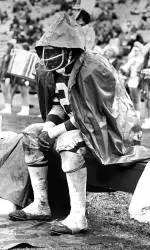
RALEIGH, N.C. - Bobby Bowden had something up his sleeve going into the 1975 Peach Bowl and because of it, he ended up on his players' shoulders, bending down to shake hands with NC State coach Lou Holtz as his team carried him off the field at Atlanta Stadium.
No one knew, on that rainy and cold New Year's Eve, that neither Bowden nor Holtz would return for their respective teams, as both were off after the season to find greener pastures. For Holtz, the green of the New York Jets - where he coached only 13 games during the 1976 season - was not enough. He went on to spout his coaching philosophy, his oft-used one-liners and his magic tricks at Arkansas, Minnesota, Notre Dame, South Carolina and on ESPN Game Day.
For Bowden, the once-hung-in-effigy coach who had a shaky relationship in Morgantown, W.Va., it was the last victory before he headed to his final coaching stop, Florida State.
So it seems appropriate as the 80-year-old Bowden prepares for his final game - against West Virginia, no less, in the Gator Bowl - to remember a couple of games between the old friends, when Bowden was still at West Virginia and Holtz was at NC State.
It was neither the first time they met, nor the last. The two first met in 1961 at a coaching clinic and developed as good a friendship as an Ohio Ynkee and an Alabama rebel could forge. In their first meeting, Bowden's Mountaineers whipped Holtz's William & Mary 43-7 in the 1970 season-opener.
"We had too many Marys and not enough Williams," Holtz said afterwards, and it was neither the first time nor the last time he used that line.
Holtz, who came to NC State in 1972, paid Bowden back in the fifth-annual Peach Bowl, turning a 14-13 halftime nail-biter into a 49-13 blowout, thanks to precocious quarterback Dave Buckey, who made his first career start as a replacement for injured Bruce Shaw. Buckey led the Wolfpack to four second-half touchdowns and earned the bowl's most valuable offensive player award by directing an offense that rolled up 535 yards.
Much of that was gained by the rushing trio of Willie Burden, Charley Young and Stan Fritts, but it was Buckey who mastered Holtz's veer offense and made the decisions when to keep the ball and when to give it away. Fritts scored three touchdowns on the day.
A few days after that game, Bowden had to issue a cryptic apology for his team's play and, apparently, its behavior during its time in the big city of Atlanta. That was the first of Holtz's 13 career bowl victories.
But on Dec. 31, 1975, Bowden returned the favor for the first of his 22 victories as a head coach.
On a raw, damp Wednesday afternoon at Atlanta Stadium the two teams met in what was expected to be a high-scoring shoot-out, with the Wolfpack relying on the experience of the now-senior Buckey brothers to decimate a mediocre Mountaineer defense.
But the Wolfpack (7-3-1 coming into the contest) had a couple of major pre-game distractions. Not only was leading rusher Ted Brown, another precocious freshman who emerged as a star shortly after the Wolfpack's 3-3 start, suffering from a painful thigh injury, there were news reports that Holtz, one of the nation's hottest coaching commodities, was being considered to become head coach of the NFL's New Orleans Saints.
"I'm happy at [fill-in-blank], and I have no intentions of leaving," Holtz said, and it was neither the first time nor the last time he used that line.
The Mountaineers (8-3 prior to the game) relied primarily on running back Arthur Owens, a scatback who averaged 6.9 yards per carry in 1975, and powerful Ron Lee. But Bowden was also toying around with a more pass-oriented attack behind the arm of freshman Dan Kendra (father of a fullback by the same name years later at Florida State).
Brown proved he was ready to go from the opening kickoff. He ripped off a 26-yard run on his first carry and added a 54-yard romp in the second quarter, en route to 159 yards on 21 attempts. He was a big part of the Wolfpack's opening drive, which resulted in a one-yard touchdown run by Rickey Adams.
But the Wolfpack defense suffered a major loss on the game's fourth play, when middle guard Tom Higgins limped to the sidelines with an ankle injury.
The stadium also suffered a major loss in the second half, when the scoreboard began to malfunction. Game officials manually had to tell the coaches on each sidelines how much time remained throughout the first half.
Brown's longest run set up the most important sequence of events of the contest. He was brought down at the West Virginia 26-yard line, with a little more than two minutes remaining. Buckey led the Pack down to the 6-yard line, but threw an incomplete pass on third-and-three. Thinking time was about to expire, Holtz rushed his kicking unit onto the field and Jay Sherrill booted a 21-yard field goal - with 53 seconds remaining before intermission.
"Had we known we'd had that much time, we might have tried to run for the first down [on the third down play]," Holtz said. "As it was, we had enough time to do that. But I'm not going to use that as an excuse."
The Mountaineers used the remaining time on the clock judiciously, with Kendra hitting Owens with a 39-yard touchdown pass with just four seconds remaining on the unseen clocked. You might say the 18,000 Wolfpack fans in the stadium were a little ticked off, even if the Mountaineers did miss the extra point.
"I think that play just before the half was the turning point," said Bowden, who was pretty good at mastering the obvious even then.
Both offenses had costly fumbles in the third quarter, with the Wolfpack losing the ball on the West Virginia 19 and the Mountaineers giving it up on the NC State 2-yard line.
The game's decisive play came with 8:04 remaining in the third quarter, when Kendra dropped back to throw. His pass to Scott MacDonald - who had played four years of basketball for the Moutaineers and was moonlighting his fifth season as a wide receiver -- was tipped twice by Wolfpack defenders before MacDonald hauled it in on a 50-yard scoring pass.
The Wolfpack did have one more opportunity to overtake Bowden's Mountaineers. Trailing by three, the Wolfpack took over the ball on its own 11-yard line with just under four minutes to play. Quarterback Dave Buckey led his teammates all the way down the field and seemed poised to compose another fairytale ending. But two big plays undermined the Pack's comeback.
First, Buckey was sacked by West Virginia's Ray Marshall, knocking the Pack back to the West Virginia 42-yard line. On the next play, Buckey hit tight end Elijah Marshall with a 30-yard pass to the West Virginia 12. But the play was nullified by an illegal procedure call, the Wolfpack's eighth penalty of the day. It was a season-high for Holtz's team and the most ever called on one team in the first eight years of the Peach Bowl.
Apparently, as the team scrambled to get to the line of scrimmage, both Marshall and wide receiver Don Buckey were lined up off the line of scrimmage and the penalty was for having too many men in the backfield.
And the Wolfpack was unable to get any closer to the goal-line.
"We had our chances and we didn't cash in," said Holtz, who had won two bowl games and tied another at NC State before losing to the Mountaineers. "You can see five million reasons why it happened. But I think three things were critical: the touchdown they completed right before the half, the 50-yard scoring play that two of our players deflected, and the penalty we had on our last drive when Elijah caught a pass at their 12."
The Mountaineers carried Bowden off the field on their shoulders, not knowing that just a few weeks later he would be off to Florida State to build a dynasty that included two national championships, the most wins in ACC history and nearly two dozen bowl victories.
Nor did the Wolfpack players know that the Holtz rumors were about to come true: he bolted soon after for the New York Jets, which he coached for 13 games in 1976 before abruptly quitting with one game remaining in the regular-season.
The important thing that New Year's Eve was to celebrate Bowden's first career bowl win.
"This was one of my greatest wins ever," Bowden said in the post-game, and it was neither the first time nor the last time he used that line.
You may contact Tim Peeler at tim_peeler@ncsu.edu.