North Carolina State University Athletics
PEELER: A Seminal Moment Against Seminoles
10/28/2010 12:00:00 AM | Football
Oct. 28, 2010
Carter-Finley's Greatest Game: NC State 24, No. 2 FSU 7
When Pupil Beat Mentor: NC State 33, No. 10 FSU 28
Game That Launched A Hollywood Career: NC State 7, FSU 0
HAYNES: A Big Game Feel
Limited Tickets Available
Editor's note: NC State athletics and the ACC have partnered to create a great visual promotion Thursday night. All students seated in the permanent student seats will receive either a red or white tee shirt depending on the section in which they are seated. With alternating sections of red and white in all of the student sections, NC State will showcase our pride in the school colors by creating a red-and-white checkered effect in front of the nationally televised audience. All students are asked to participate in this promotion by wearing the shirts. ... The Cardinal Gibbons High School lot opens at 4 p.m.
BY TIM PEELER
RALEIGH, N.C. – The ground shook one more time, and the final Southern Railway train drowned out the crowd, the cheerleaders, the marching band and the “hut-hut-huts” of the quarterbacks at old Riddick Stadium.
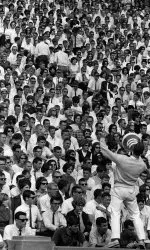
It was the afternoon of Nov. 13, 1965, the day college football, many times absent from NC State’s campus, went away for good. More than 22,000 people, most of them wearing jackets and ties, with a few scattered fedoras, squeezed into the concrete bleachers one last time at the doomed and crumbling home of Wolfpack football . The two teams, NC State and Florida State, sauntered out of the two-story fieldhouse in the south end zone, more than ready to say good-bye to the ACC’s most outdated venue.
It certainly isn’t the most memorable game played in this series between the two ACC foes, in a series that dates back to 1952. It featured no superstars, like the 1957 game that ended FSU defensive back Buddy Reynolds’ football career and pushed him into acting – right after he changed his name to Burt. There have been many more high-scoring games in the series, including last year’s 45-42 FSU win in Tallahassee.
There have been more important games, like the November evening in 2001 when NC State became the first ACC team to win at FSU’s Doak-Campbell Stadium. Or the biggest win in Carter-Finley Stadium, on Sept. 12, 1998, when NC State picked off six passes by future Heisman Trophy winner Chris Weinke and the Wolfpack beat the second-ranked Seminoles. And it definitely wasn’t the most exciting, like the double-overtime fracas won by the Seminoles 50-44 in Philip Rivers’ senior year.
But it was the last home game the Wolfpack played near classrooms and lecture halls.
The school, which had recently been renamed the North Carolina State University at Raleigh, was more than ready for a new home, and fans watched with interest as the gleaming concrete of $3 million Carter Stadium rose some three miles away, adjacent to the North Carolina State Fairgrounds.
Yet, there were a few tears shed as the field where Jack McDowall, Dick Christy and Roman Gabriel became legends was lined off for the last time. Even the reporters, who constantly had their notes whipped around by the wind and their pencils roll off the warped wooden tables in the open-air press box, waxed poetic about the old place, with the strains of “State College Goes Rolling Along” bouncing between bleachers.
Two elderly gentlemen joined the 1965 Wolfpack captains at midfield for the pregame coin toss: John Sexton and John D. Grady, the last two surviving players from Riddick’s first game, a 20-0 victory over Randolph Macon in 1907. Back then, the field had no name, no bleachers, nothing other than an open place to play football and baseball, just behind Pullen Hall and the YMCA building, two more iconic structures on campus that have been lost to time. It was given its name in 1912, in honor of Wallace Carl Riddick, an civil engineering professor, one-time football coach and future school president who was most responsible for the growth of varsity athletics at the North Carolina School of Agriculture and Mechanic Arts.
The stadium was improved over the years, as the school replaced the original wooden bleachers with concrete grandstands in 1916 (eastside) and 1928 (westside). After more than 30 years of tinkering, it was finally completed with the addition of the tile-roofed field house in 1938. By then, however, it was woefully small for college football, seating about 18,000 on a normal afternoon and some 4,000 more when there was enough interest.
There was little sentimentality about the old stadium, at least from Grady in his comments to the November/December 1965 edition of The Alumni News: “It’s a damned good thing [Riddick is being replaced]. Should have happened 30 years ago. Was never big enough to start with.”
And that’s why the Wolfpack never played more than four home games in any of Riddick’s final 10 years. Head coach Earle Edwards found he could make more money to run his program and help fund the construction of the team’s new state-of-the-art stadium adjacent to the North Carolina State Fairgrounds by traveling all over the country – for a substantial share of the ticket sales.
In the final five years of Riddick Stadium’s life, the Wolfpack traveled to Wyoming, Alabama (twice), Mississippi Southern (twice), Nebraska, Georgia, Florida State (twice), Florida and Iowa just to get away from its own home field.
Despite having to eat sometimes sour road cooking from its out-of-conference opponents, the Wolfpack won back-to-back ACC championships and was in contention for its third consecutive title when play began on that cool afternoon. The Seminoles, however, were a nemesis for the Wolfpack. FSU twice beat head coach Earle Edwards’s team in Tallahassee, thanks to the play of All-America wide receiver Fred Biletnikoff, in 1963 and ’64.
Edwards and his team overcame those setbacks to win the ACC titles, earning a bid to the 1963 Liberty Bowl in the process.
Sophomore players like defensive tackle Dennis Byrd, linebacker Chuck Amato and defensive end Pete Sokalsky joined the veteran defense. There were some growing pains. After five games, the team was just 1-4 overall and 1-3 in the Atlantic Coast Conference, with losses to Clemson, South Carolina, North Carolina and Florida.
But by midseason, the defense was drum-head tight and the offense was able to put some points on the board. The Pack entered the Florida State game on a three-game winning streak and stuffed the Seminoles all day long, to the delight of the Homecoming crowd.
Just after intermission, Florida State made a serious miscue when a center’s snap went over the head of the Seminole punter. The Wolfpack recovered on the FSU 44-yard line and advanced the ball far enough for placekicker Harold Deters to make a 41-yard field goal, the only score in the Wolfpack’s 3-0 win.
Fittingly, the field closed like it opened, with a shutout victory.
A week later, in the regular-season finale, the Wolfpack set a national record for interceptions in a single game, picking off an NCAA record seven Iowa passes in a 28-20 victory, to finish the season on a five-game winning streak.
Even better for Edwards, who earned the third of his five ACC Coach of the Year awards, not long after the season ended, South Carolina announced it had played the season with two players who were ineligible under ACC academic guidelines and the Gamecocks forfeited its six conference wins.
Both Clemson and NC State gained victories because of those forfeits and vaulted over Duke, which had tied with South Carolina in the regular-season standings, to claim a share of the conference championship. The Wolfpack was not invited to a postseason bowl game for the second year in a row, despite winning its third straight league crown.
Demolition of the old stadium began soon after the season, though the westside grandstands stood for another 40 years before finally being demolished in 2005. The playing surface was turned into a parking lot, just another obstacle to navigate for East Campus students as they made their way from the tunnel at the quad to Poe Hall. In the spring of 2009, NC State's new mathematics and applied sciences building, SAS Hall, opened on the former site of Riddick Stadium.
It's been 45 years since that last train whistle echoed down the tracks and Riddick Stadium closed its gates with a shutout win over the Seminoles. The season ended with another conference title for Edwards and, just over the horizon, a new home waiting to be filled.
You may contact Tim Peeler at tim_peeler@ncsu.edu.