North Carolina State University Athletics
Bailey Did Unexpected Things As A Basketball Player
1/8/2010 12:00:00 AM | Men's Basketball
Editor's note: This is an excerpt from When March Went Mad: A Celebration of NC State's 1982-83 National Championship (Sports Publishing LLC © 2007), by Tim Peeler. It is reprinted with permission of Sports Publishing LLC.
Thurl Bailey came to NC State as more of trombone player than a power forward. Some would say he was a better actor and student leader than a rebounder and shot blocker. Few who saw him on the day he arrived in Raleigh as a lanky, somewhat green basketball player, would have believed that Bailey would play professionally longer than anyone in NC State basketball history.
There has never been any doubt, however, that by the time Bailey was a college senior that his leadership and his unique athletic abilities on the court made him the heart of the Cardiac Pack.
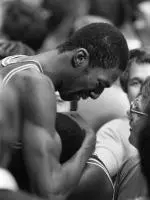
No NC State fan will ever forget Bailey weeping openly at mid-court the afternoon he helped the Wolfpack beat defending national champions North Carolina in Reynolds Coliseum, the game that jump-started the team's run to the national championship. It was an out-pouring that he would repeat continuously throughout the next six weeks, as Bailey unabashedly let his emotions stream down his face as his college basketball career came to an end.
The simple fact is that Bailey spent most of his early years in basketball, from the moment he was first approached by Washington, D.C.,-area AAU coach Sterling Parker while walking home from the grocery story one afternoon, proving that he could play basketball at the highest level.
He had to prove it to Herb Gray, the junior high basketball coach who twice cut Bailey after open try-outs, even though Bailey, at nearly 6-feet-5 inches, was the tallest student in the school. Today, Bailey considers Gray – a guy who told him to give up the game and stop wasting his time, that he didn't have what it takes to be a basketball player – one of the biggest influences on his life.
"He helped me more than I could ever imagine," Bailey says now. "He helped me realize who I was and what I wanted."
He had to prove it to his parents, especially his head-strong mom, Retha, who was reluctant to let any of her sons play pickup basketball games on the dangerous playgrounds near their home in Seat Pleasant, Md., a Washington, D.C., suburb that was anything but pleasant. Eventually, he was part of a federally mandated busing program that sent him to mostly white Bladensburg High School. In addition to being the president of nine different school clubs, Bailey learned the fundamentals game under respected high school coach Ernie Welch.
He had to prove it to former NC State coach Norm Sloan, who wasn't convinced that Bailey, despite his athletic 6-foot-11 frame, would ever become a significant college basketball player. Sloan, who was recruiting Brooklyn's Sidney Green, and Washington, N.C., superstar Dominique Wilkins at the time, wasn't all that upset that Bailey considered following former Wolfpack assistant Eddie Biedenbach, the Wolfpack's chief recruiter, to Davidson when Biedenbach got his first job as a head coach.
"Norm wasn't sold on him at all," says Biedenbach, the former Wolfpack player and assistant coach who landed talents like David Thompson, Kenny Carr, Charles "Hawkeye" Whitney for Sloan's program.
And, finally, one last time, he had to prove it to Green, who ended up choosing Nevada-Las Vegas over NC State and made the fateful comment that Bailey "hasn't shown me much" before they faced off in the second round of the 1983 NCAA Tournament. That became Bailey's inspiration in one of the many miracle wins during the Wolfpack's improbable journey to the championship. Bailey's tip-in at the buzzer of a missed free throw over the top of Green allowed the Wolfpack to beat UNLV in the team's fifth consecutive last-second, post-season victory.
Today, after a professional basketball career that spanned 16 years and three countries, Thurl Bailey is still living a life that is unexpected and, to some, unusual, proving to everyone that he can thrive and inspire others in a Christian faith that is less than one percent African-American. Bailey grew up singing in the choir and attending weekly Sunday school at a Baptist church in Maryland, but converted to the Church of Latter Day Saints on Dec. 31, 1995, a little over a year and a half after he was married to the former Sindi Southwick, a former Utah Valley State basketball player he had met when she was working his basketball camp in 1989.
They quickly became one of the highest profile interracial couples in the 175-year history of the Mormon faith, as Thurl traveled far and wide to conduct dozens of "fireside talks" for the church. Bailey's retired from basketball, living a bucolic life with Sindi and their three children, but he's busier than ever.
In addition to his charity work – he's held the same non-profit youth basketball camp for nearly two decades – Bailey is an accomplished businessman. In the summer of 2006, he made an exploratory two-week trip to China to pursue business opportunities. He does post-game television commentary for the Utah Jazz and radio color commentary for University of Utah basketball. He has his own clothing line, has released three CDs of inspirational music and, like his former college basketball coach Jim Valvano, is extremely popular as a corporate motivational speaker, whose $10,000-per-appearance fee is always negotiable for worthy causes.
Bailey's path to this bucolic life was hardly as smooth and silky as his baritone singing voice.
In his early years, Bailey was not allowed to play basketball on the playgrounds near his home. His parents didn't want him hanging around the rough element that was frequently on the courts. So he never really developed the same kind of passion that either his father or his brothers had for the sport.
One day, however, a local basketball coach named Sterling Parker saw Bailey walking home from the grocery store. Here was an exceedingly tall (6-foot-5 at the age of 13) adolescent, walking with a bag of groceries. Do you play basketball, Parker asked. Nope, Bailey answered. How about giving it a try?
"He basically talked me into giving it a shot," Bailey says.
He had already learned to play the trombone, the baritone and the tuba. He could act and he could sing. Why not play basketball?
But the sport never became – even when he was playing in Salt Lake City and Minnesota in the NBA and in Italy and Greece in the European professional leagues – his overwhelming passion.
"Basketball, I don't think, has ever been the most important thing for me," Bailey says. "I knew if I had a big game coming up, at that moment, at that time, it was the most important thing going on in my life. It was something I gradually fell in love with as I gradually improved and got better and learned from my brother and my dad. The nice thing is, when I decided I wanted to do it, I always had really good teachers and coaches."
One of those teachers was Welch, the head coach at Bladensburg (Md.) High School. Bailey found inspiration after being cut by his junior high coach, arriving an hour early at school to work on the basics of basketball. He spent two years playing junior varsity at Bladensburg, becoming more and more coordinated and more skilled in basketball. But he wasn't good enough to make the varsity team and he didn't have a lot of self-confidence.
He changed that by becoming more involved in things at school. He still remembers the day during his junior year that he excitedly told his mom that he was going to run for student-body vice president.
"Why not president?" she asked.
"I didn't think I could win," he answered.
But he did. He gained more confidence playing in the school band and performing in school plays. At some point in his high school days, he was the president of nine different clubs, including the obscure Flag-Raising Club, which consisted of just Bailey and another younger student.
"That was a great club, man," Bailey said. "There were only two of us in it. We were responsible for raising and lowering the flag every morning and afternoon. The other guy was a little fellow. I told him 'Welcome to the flag-raising club. I am the president and you are the vice president.' It was as simple as that."
Things were not simple at home, however, and that is why Bailey turned to music, acting, student government, basketball, even flag-raising. Bailey's parents struggled to stay together, and there was domestic violence in the home. Bailey's father, Earl, had been briefly paralyzed not long after Thurl was born in a construction accident. Money was tight. Tempers were always on edge.
Twice, Bailey's mom shot at his father. When Bailey took Sindi on her first visit to the family's home, he showed her the bullet hole that remains in the dresser in his now-divorced parents' bedroom. On a couple of occasions, Bailey's brothers and sisters had to call the cops to calm things down in the home.
"I would see them fight – a lot – and not just with words," he says. "My mom got mad when she read a story one time when I talked about the bullet holes, but I just told her 'Hey, mom, that's how you and dad were.' The best thing that could have happened to them was to split up. It was a tough environment."
Millions of kids grow up in a broken home, and some of them never get over that trauma. Bailey wasn't going to be like that. That's why he learned to play the trombone, then the baritone, then the tuba. It's why he learned to act. It took him to different places. As a member of the high school band, he performed at Walt Disney World. As a senior in the drama club, he once played a king in a Shakespearean play and a pregnant woman in another.
"I knew I could be a product of my environment, or I could be different," he says. "A lot of the other things I did were an escape, so that I would be away from that as much as I possibly could. There was a part of me that loved creating things, that loved being a leader."
Bailey was expected to walk a straight-and-narrow path.
"All of my activities were an escape," Bailey says. "My parents, especially my mom, did a very good job of keeping us sheltered from some of the stuff that was going on in our neighborhood, even though we lived right in the middle of all of it. Some of the guys I grew up with, by the time we were in high school, were in jail, or dead. I think she did a really good job of keeping us busy enough that we weren't involved in a lot of bad stuff.'
By the time Bailey was in high school, he had become a talented basketball player, one who was beginning to get attention from college recruiters. NC State was one of the first to contact him. He came to Raleigh for basketball camp after his junior year in high school and Biedenbach, the assistant in charge of recruiting the D.C. area, kept a constant eye on his growth spurts.
"You could tell he was going to be a good player," Biedenbach says. "He grew a couple of inches and just got better and better."
Bailey, however, was hardly a hot commodity. When Biedenbach left NC State for Davidson following the 1978 season, Bailey almost decided to go there, mainly because Maryland coach Lefty Driesell didn't seem to be all that interested and Sloan wasn't convinced that Bailey, who was tall but extremely skinny, would be an impact player on the collegiate level.
But, like every step of the way in the spring of 1983, a bit of destiny stepped in. Bailey got a last-minute spot in the Capital Classic, a national high school all-star game played at the Capital Centre in Washington. It was a game that was filled with marquee players in what might have been the best senior class in the history of high school basketball. Bailey was on a team that was seemingly out-manned, even though it had the nation's top-rated high school player, a fellow by the name of Ralph Sampson, along with Quintin Dailey and future NC State teammates Dereck Whittenburg and Sidney Lowe. On the opposing team were Green and Wilkins, both of whom had decided to go elsewhere, with Sam Bowie, James Worthy, Clark Kellogg, John Paxon and Dirk Minniefield.
In 21 minutes, Bailey scored six points and had three rebounds in a game that was billed as the ultimate matchup between Sampson and Bowie. But Whittenburg hit the game-winning shot, just as he had a week earlier in Charlotte, N.C., in the third-annual McDonald's All-Star Game in Charlotte, a pair of baskets that were a precursor to the most famous air-ball in NCAA Tournament history.
He went to NC State, not knowing that his neighbors, Lowe and Whittenburg, would be going there as well.
"When Thurl came to NC State, he was a skinny kid, not much more than a musician who played basketball," says Lowe, laughing at the memory of the long-and-lanky Bailey trying to push Lowe's fireplug frame into the lane. "He had trouble posting me up. He could shoot over me, but he had trouble backing me down. It wasn't long until that changed. He worked on his game while he was here. He always approached the game like a pro. He was very serious about improving his game. He has always been like that."
Lorenzo Charles, two years behind Bailey, quietly watched how Bailey and emulated his game.
"Thurl led by example," Charles said. "He worked hard in practice every day. What he did in practice led to production. He was our quiet leader. He just went out there and laid it on the line every night and every one else just tried to follow. You could tell playing basketball meant a lot to Thurl. He was a little on the emotional side. That's what basketball should be for a player. You can't just throw on you sneakers and go out there and play. The game has to mean something. It's got to be one of the most important things in the world to you. And it was for Thurl.''
Bailey remained involved in other activities. After his sophomore year at NC State, he served as a Congressional page for North Carolina Congressman Walter B. Jones. As a junior at NC State, he played Crooks in a campus production of John Steinbeck's "Of Mice and Men." On the basketball court, he led the Wolfpack in scoring and rebounding three consecutive seasons.
NC State's magical run in the NCAA Tournament was a huge economic boon for Bailey. When the season ended, Valvano implored Utah Jazz president Frank Layden to take Bailey early in the 1983 NBA draft. "This kid is one of the best-kept secrets in the country," Valvano said mid-way through Bailey's senior season. "Speed, quickness, he's got all that. But he also has character. He works hard, he goes to class, he listens, he's coachable. He might fill out to be a monster."
Valvano told Layden: "Don't think of Thurl as just a player. As a person he will be good for your team and the community."
Layden took Valvano's advice, and the Jazz made him the No. 7 pick in the 1983 NBA draft. He spent 10 years with the team, became the fifth-leading scorer in franchise history and quietly was the team captain on a squad that included perennial NBA All-Stars John Stockton and Karl Malone.
Bailey has lived a life that he never expected, doing things that were never expected of him. Even though he has a different faith than he had in college, Bailey still believes there was something spiritual about his career at NC State and that there was something born from that 1983 championship that continues to bless him now.
"I just always believed in a higher power, especially during the year of the championship," Bailey said. "There is no way that anybody could ever tell me that there wasn't divine intervention involved. We had to do our parts and use our God-given talents, but it wasn't just luck. I think we were instruments. I think we transcended normal basketball."
And Bailey, all heart still, continues to transcend what people believe is a normal basketball player.