North Carolina State University Athletics
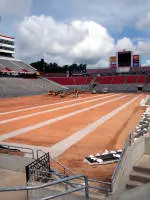
PEELER: Carter-Finley Renovations Update
5/25/2009 12:00:00 AM | Football
BY TIM PEELER
RALEIGH, N.C. With any construction or renovation project, there are always a few surprises.
In the replacement of the crowned field at Carter-Finley Stadium, NC State Assistant Athletics Director for Outdoor Facilities Ray Brincefield didn’t expect to find so many drainage pipes and gravel to prevent water-table seepage from the ground up.
“We tapped into a couple of small springs and a lot gravel and such that was keeping the water from coming up onto the field,” Brincefield said.
Considering that the original Carter Stadium was built on the site of a lake that was drained nearly 50 years ago, the extraneous water probably isn’t really a shock. But the whole purpose of replacing the Carter-Finley Stadium playing surface was to remove the 2 1/2-foot crown that helped drain the water from the playing field.
The $1 million project began on April 20, two days after 21,200 Wolfpack fans watched the Kay Yow Spring Game at the stadium. The old sod was scraped away and, for 10 days, contractors hauled some 500 tandem dump truck loads of topsoil out of the North End Zone tunnel.
In all, hundreds of thousands of cubic feet of earth was hauled away.
Over the next 10 days, the field was re-graded, properly shaped and surveyed. Workers had to hand-dig around the sideline infrastructure, which includes all the cables necessary for television production and all communication from the press box.
Currently, new irrigation pipes are being buried underneath the playing surface, a two-week process that was slightly delayed because of rain. Once all irrigation and drainage pipes are installed and approved which should happen by the end of the month the field will get a layer of gravel for drainage.
Once that is completed and approved, the time-consuming process of testing the sand-peat mixture will begin, Brincefield said. Everything will go through a particle-size analysis for organic content, infiltration rates and other important data that will help determine how well the flat field will drain water.
Throughout May and June, the synthetic sidelines, which will be different than the playing surface, will be installed. It will include a layer of gravel, a rug and a sand/rubber surface mixture.
The Tiftway-419 hybrid Bermuda sod for the field is being grown on a sod farm and has already begun a regimen of mowing and fertilizing that will minimize the shock of transplant, Brincefield said.
“We may choose to fly over the selected grass, once it’s mowed at the proper height, to check its purity,” Brincefield said. “That’s really the only way to see if the strain is pure from up above.”
From July 1 through Aug. 1, the growth of the sod will be carefully monitored to make sure the root depth reaches between six to eight inches.
There is some built-in wiggle room to allow for inclement weather, Brincefield said, but if all goes as planned the entire project should be completed by the time football coach Tom O’Brien and his team holds their first scrimmage on the field in mid-August.
After that, the turf will have a busy fall, with eight home football games, a U2 concert in early October and several high school championship football games in early December.
Last summer, a region-wide drought forced the facilities staff to build water-retention wells to collect rain runoff to use as irrigation. All of Raleigh was praying for rain.
Now, the drought is officially over and Brincefield would like to have a dry summer to make sure the field replacement project stays on its timeline.
“Tell all the Wolfpackers to keep the rain away,” Brincefield said.
You may contact Tim Peeler at tim_peeler@ncsu.edu.