North Carolina State University Athletics
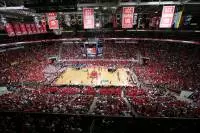
NC State's Home Sweet Hardwoods
11/12/2009 12:00:00 AM | Men's Basketball
This story was originally published in The Wolfpacker and is reprinted here with permission from Coman Publishing Co.
BY TIM PEELER
RALEIGH, N.C. – Basketball at NC State has long been defined by the people that coached or played the game: Everett Case, Sammy Ranzino, Ronnie Shavlik, Lou Pucillo, Norm Sloan, Tommy Burleson, David Thompson, Jim Valvano, Sidney Lowe, "Fire and Ice," Julius Hodge, Kay Yow, just to scratch the surface.
But the sport grew on campus and around the region for reasons other than the personalities involved. Throughout its century of intercollegiate basketball, NC State has been devoted to building multi-purpose facilities that served as the homes for its basketball teams, from Thompson Gymnasium to Reynolds Coliseum to the modern-day RBC Center.
In the earliest days of the sport, there couldn't have been a more versatile venue than the old marching grounds across the street from Main Building (now called Holladay Hall). It was an open, flat field that was eventually turned into Pullen Park.
That's where the first "basket-ball" teams at the school – representing the four classes and the agriculture short-course students – played a 10-game round robin schedule to identify the best players of the new sport on campus. But many of those outdoor contests had to be postponed because cold, rainy weather in the fall turned the fields into a muddy quagmire.
When the campus YMCA finally put together a varsity team in the winter of 1911, it played its first home game in Pullen Hall, the original gathering spot for NC State students. It contained a large upstairs assembly room with a stage, the first library and the school's mess hall. On Feb. 15, 1911, the day after the popular German Club held its winter dance on the same floor, NC State hosted Wake Forest in the first college basketball game ever played in the city of Raleigh.
The two teams met five days earlier at Wake Forest's gym, and the Baptists crushed the Farmers 33-6. But on the non-standard, slickened floor of Pullen Hall, the Farmers pulled off a 19-18 upset in front of 550 spectators, thanks in part to a bucket of kerosene in which the Farmers soaked the soles of their shoes to gain a little traction.
That was the only basketball game played in the building, which was destroyed by a student arsonist in 1965.
In 1912, NC State played all four of its home games at Municipal Auditorium in downtown Raleigh. The facility, with a large stage jutting into the open court, was not exactly suited for playing basketball, but it held more than 2,000 spectators. At the end of that first season - even though the Farmers finished 0-6 - the athletic association saw a profit of $175, all the encouragement the school needed to continue supporting the sport.
In 1913, the school opened an on-campus YMCA, with half of the $40,000 construction costs coming from John D. Rockefeller. The building included a gymnasium where the basketball team could practice.
The varsity squad cruised along during its first decade, playing against other state schools and making a few road trips. The home schedule was expanded to as many as 11 games, and NC State had dibs over Wake Forest for hosting home games at the downtown auditorium.
The highlight of the Farmers stay in Municipal Auditorium came in 1919, when NC State and North Carolina were both undefeated against schools in the state athletics association. But, since the two schools had not played each other since 1913 because of an eligibility dispute, there was no other recourse than to play a game after the regular season to decide the state championship.
They put their differences aside to play a special game on March 15, 1919, to decide the state championship, in front of a sold-out crowd at the auditorium. NC State rolled to a 39-29 victory against their rivals from "over the hill" in a game described in the Raleigh News & Observer as "hotly contested from beginning to end and full of thrills and pretty basketball."
Thus began post-season basketball in the state of North Carolina.
In 1921, NC State was one of the charter members of the Southern Conference, which began conducting an end-of-season tournament in Atlanta.
But the sport's growth on campus was hindered because of a lack of an on-campus gymnasium, other than the undersized one attached to the YMCA building. So the school gained approval in October, 1922, for the construction of an on-campus facility. The multi-purpose building – designed by renown New York architect Hobard B. Upjohn – cost $215,700 to construct.
The school's first building on the south side of the railroad tracks included a 110X30 basketball court, a small gym for non-basketball activities, a 25X75 indoor pool and an elevated running track around the inside perimeter that wreaked havoc with set jumpshots from the deep corners.
Capacity for basketball was 2,500, an ample size for a school with an enrollment of 1,200 in 1925.
The facility was named after Frank Thompson, a 1910 NC State graduate who was killed in combat during the final days of World War I. Thompson, captain of both the football and baseball teams his senior year, had been an early hero at NC State for his exploits on the field, but was seen as a villain after he left his alma mater to become the head baseball coach at rival Wake Forest.
But students voted to name the new facility in his honor after the legislature approved construction in 1923. Over the years, the school used the building for dances, concerts and commencement exercises.
Still, its primary function was for athletics and physical education classes. The first contest played there was between the freshman and varsity basketball teams in December, 1924.
The first game against an outside opponent was played against the Durham Elks team, with the State College team wearing its new bright red uniforms. Those togs, along with the play of junior Rochelle "Red" Johnson, earned the team the nickname the "Red Terrors," which was used by all teams other than football until 1949.
Fittingly, Johnson scored the first basket at Thompson Gym against the Elks, a game that was called with 14 minutes remaining in the game because the visiting team accused the game officials of favoring the home team.
The first intercollegiate game was against Duke, which the Red Terrors won 29-22. For the next two dozen years, Thompson Gym was State College's home. During the school's first conference championship season, when Gus Tebell was the head coach, the Terrors put together an 18-game home winning streak, which stood until Everett Case arrived in 1946.
By then, the gymnasium was well-used, shoddy and way too small for the post-World War II student population that had swelled to nearly 6,000. Case called it "The Lions Den" and reckoned it was worth about 10 points per home game.
In February, 1947, a game against North Carolina was canceled by Raleigh fire marshal R.W. Butts because too many fans sneaked through the backdoors, windows and bathrooms in an effort to see Case's team play against the school's biggest rival.
The next year, a January game against Duke was postponed because the city building inspector said there were insufficient exits. The final intercollegiate game at Thompson Gym was played behind locked doors. Only a couple members of the media were allowed to witness the game in the condemned gym. The Terrors rolled to a 110-50 victory, the highest scoring game in school history at the time. The rest of the home games that season were played at Raleigh's Memorial Auditorium, the 3,400-seat arena built in 1932 as a replacement for Municipal Auditorium.
The effort to build a new home for NC State basketball actually began long before Case arrived in 1946. Influential booster David Clark pushed for a new multi-purpose facility, after watching the annual gathering of some 5,000 farmers from around the state at Riddick Stadium during the late 1930s. When rain began to fall, the crowd had no choice but to get soaking wet - there was no indoor hall big enough to hold such a large crowd.
Copying plans from the newly constructed Duke Indoor Stadium, members of the NC State architecture school began planning a new multi-purpose home for the school. The state legislature contributed $100,000, the federal Works Progress Administration offered $100,000 if the building could be used as an armory and ROTC training facility and Mrs. Charles Babcock of Greenwich, Conn., agreed to contribute $100,000 in honor of her uncle, tobacco magnate William Neal Reynolds, as long as the school named the building in his honor.
But not long after the first load of structural steel arrived on campus and was assembled on a concrete foundation, World War II broke out in Europe. For some seven years, the sad skeleton stood on the south side of the railroad tracks, waiting for construction to resume.
Everett Case heard about the construction project, and it was one of the main reasons he decided to come to Raleigh to be the head coach at NC State College, even though he never visited the campus before he accepted the job.
What he didn't realize was that the coliseum was a long way from being done. But his initial success and the explosive growth of post-war enrollment at the college was the impetus for completing the job.
First, however, Case asked that some changes be made. He wanted the arena to be elongated, to accommodate more than 12,000 people. He wanted the building to have a basement for storage and for lockerrooms. It wasn't exactly easy to dig around the firmly established foundation, but that storage space – which also doubled as Raleigh's largest fallout shelter – was one of the keys to the successful life of Reynolds Coliseum.
Even though the original cost ballooned from $300,000 to nearly $2.5 million, the investment was well worth it. For exactly 50 years, Reynolds was the home of men's basketball and continues to be the home of women's basketball.
The futuristic facility opened on Dec. 2, 1949, against Washington & Lee, even though not all the seats were installed. For that first game, some fans were happy to sit on the concrete risers, as long as the Raleigh fire marshal and building inspector stayed away.
Vic Bubas scored the first basket in the new arena – after missing the first two shots and grabbing the first two rebounds.
Case's new toy allowed him to build the South's first big-time basketball program. He was happy to host the Southern Conference and ACC tournaments, the Dixie Classic and NC AA Tournament games. By the mid-1980s, Reynolds had hosted more basketball games than any building in the country other than Madison Square Garden.
It also hosted ice skating exhibitions, rock-and-roll and classical concerts, an annual visit by the circus and presidential addresses, not to mention commencement exercises and the crowded nightmare of change day for students.
In 1984, Raleigh mayor Avery Upchurch commissioned a study to explore the possibility of building a multipurpose facility in downtown Raleigh, an idea that was eventually decided to be unfeasible.
When Jim Valvano became the athletics director in 1986, he began to think about the future home of the men's basketball program. He looked into renovating and expanding Reynolds, but the costs of upgrading it to modern codes seemed too prohibitive at the time.
In 1988, the NC General Assembly and the university contributed $1.5 million each to plan for a new arena adjacent to Carter-Finley Stadium and the next year the NC State Board of Trustees approved plans for a 23,000-seat arena that would cost $58.5 million. The project was delayed with Valvano's messy departure from the school in 1990, but restarted two years later, with a strong push from Raleigh real estate developer Steve Stroud.
Ground was broken in November, 1993, and was graded into a large bowl by the next spring, but the site sat idle for nearly four years while the Centennial Authority - the joint group that oversaw the arena's construction and operations - explored the option of having an NHL franchise to share the building with NC State basketball.
In 1997, Harford (Conn.) Whalers owner Peter Karmanos announced he would move his franchise to North Carolina, playing two seasons at the Greensboro Coliseum while plans for the Raleigh arena were retro-fitted for hockey purposes and construction began after a second groundbreaking on July 22, 1997.
Pushed by Raleigh real estate developer Steve Stroud, the new facility was little more than a hole for five years, as the city, state and school squabbled over all the details. But in 1997, the NHL's Hartford (Conn.) Whalers began looking for a new home down south. They agreed to help finance major changes to already-designed coliseum, committing some $40 million for facility upgrades and offices.
By the time the facility - then called the Entertainment and Sports Arena - opened on Oct. 29, 1999, with a game between the newly named Carolina Hurricanes and the New Jersey Devils, the cost had risen to nearly $160 million, some 780 times the cost of Thompson Gymnasium and 64 times more than Reynolds Coliseum.
NC State – after 589 victories in Reynolds Coliseum – made its debut in its new home on Nov. 19, 1999, in front of a sold-out crowd of 19,722 spectators with a 67-63 victory season-opening victory over Georgia.
For three years, the building was simply known as the ESA, but in 2002 the Royal Bank of Canada agreed to a 20-year naming rights deal for a reported $80 million to rename the building the RBC Center.
Again, the building is more than just a basketball arena, with a collection of concerts and other events like the circus, monster truck shows and community events. The Hurricanes have twice hosted the Stanley Cup finals, claiming the franchise's first championship on June 19, 2006, with a 3-1 victory over the Edmonton Oilers.
NC State has hosted both NCAA men's and women's basketball tournaments at the RBC Center.
As with all of its permanent homes over the years, the Wolfpack may share the stage, but is always the featured attraction when it's time for basketball.
You may contact Tim Peeler at tim_peeler@ncsu.edu.