North Carolina State University Athletics
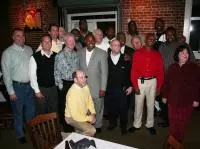
TIM PEELER: Celebrating the Cardiac Pack 25 Years Later
2/16/2008 12:00:00 AM | Men's Basketball
BY TIM PEELER
RALEIGH, N.C. -- They met, appropriately enough, in a place called "The Pit." Only this time it was an upscale barbecue restaurant, not the University of New Mexico's basketball arena.
Friday night, members of NC State's 1983 NCAA Championship team gathered for a reception and reunion on the night before they will be honored at Saturday's NC State Clemson basketball game. Thurl Bailey flew in from Utah. Harold "World" Thompson arrived from Texas. And Sidney Lowe and current Wolfpack assistant Larry Harris came by to greet everyone.
Every player had a favorite memory of every teammate.
They watched the game they played against Pepperdine in the first round of the NCAA Tournament, and even some of them -- the players that made it happen -- weren't sure how they could have possibly won that double-overtime victory, with Lowe on the bench. But it happened, right there on the video screen. And they cheered and slapped each other on the back, almost as if it had just happened all over again.
They gazed at posters that showed a bunch of tall, skinny kids in shorts they wouldn't let their sons or daughters be seen in public wearing.
There were a few things missing on this evening. Namely, head coach Jim Valvano, who would have keep the bar tab and the story-telling going all night long. And Quinton "Q-dog" Leonard, who died too early at the age of 44, almost two years ago. And neither Terry Gannon nor Dereck Whittenburg could make it, though they were toasted and remembered throughout the evening.
Saturday, they will be cheered again, when the team is honored at halfime of the NC State-Clemson game at the RBC Center.
Here, culled from excerpts and out-takes of "When March Went Mad," is what that improbable championship meant to the players and coaches of the "Cardiac Pack" and what everyone is up to these days.
COACHES
JIM VALVANO, head coach
In his last appearance at Reynolds Coliseum, just a few weeks before he died of bone cancer, the ever-optimistic coach boiled down the importance of his most famous coaching accomplishment. The school celebrated the 10th anniversary of the championship on Feb. 21, 1993, prior to an NC State-Duke game. Most of the members of the team were there, though Lowe was at an NBA coaches’ meeting and both Lorenzo Charles and Cozell McQueen were playing professionally overseas. Dinky Proctor was in town, but chose not to attend. Here are some of Valvano’s final thoughts about his 1983 team and its remarkable run to the NCAA Championship. He died on April 28, 1993, though his spirit lives on through the V Foundation for Cancer Research, which has given away more than $70 million in research grants to young researchers over the last 15 years and hopes to fulfill his dream of one day finding a cure for cancer.
“They are special, not because they put that banner up there,” Valvano said, pointing towards the banner hanging from the roof of Reynolds Coliseum. “They’re special because they taught me and the world so many important lessons. No. 1: Hope. What does hope mean? Hope that things can get better in spite of adversity. The ’83 team taught us that. When Dereck Whittenburg went down and everybody said ... there was no way we could win and a kid named Ernie Myers stepped in and we lost a few, then we won a few, and then Dereck came back and every sportswriter in America said that I remember my favorite quote that trees would tap dance, elephants would drive in the Indianapolis 500 and Orson Welles would skip breakfast lunch and dinner before NC State figured out a way to win the NCAA [championship]’ This team taught me that elephants would drive in the Indianapolis 500 one day.
“The ’83 team taught me about dreaming and the importance of dreams, because nothing can happen if not first a dream. ... If you have someone who never gives up, who has great hope ... Don’t ever give up, don’t ever stop fighting! The ’83 team gave you hope, gave you pride, told you what hard work was about. It gave you the meaning of believing in a cause, and lastly what they taught me is to love each other. They taught me what love means. When you have a goal, when you have a dream, and when you have belief, and you throw in that concept of never stop believing in and loving each other, you can accomplish miracles.”
ASSISTANT COACHES
TOM ABATEMARCO is the assistant general manager and radio announcer for the WNBA's Sacramento Monarchs. RAY MARTIN is an assistant coach at
TRAINERS
JIM REHBOCK is a physicians assistant who lives in
PLAYERS
THURL BAILEY, forward, Seat Pleasant, Md.
Bailey lives in
“I live near
“When I watch the game, I think, Man, it must have been fate, because anything could have happened at the end of that game.’ I watch the clip and memories just start rushing back. It’s like when hear one of your favorite tunes, the song that was playing when you met your sweetheart, and it puts you in a place and makes you feel a certain way. But it wasn’t that we just won the championship. It was the whole ride.
“I had a great NBA career, but somehow people remember that championship more. People related to what we were doing. They were riding along with us. I think it goes far beyond sports.
“My favorite memory? Honestly, I think we were playing
ALVIN BATTLE, forward, Rocky Mount, N.C.
for First Citizens Bank. He played for little over one season at NC State, but graduated in 1985, fulfilling promise he made to his grandmother shortly before she died.
“I am proud that my example catapulted my brothers and sisters and cousins to do what I did,”
“I spend a lot of time talking to young people about basketball and the things you can accomplish. Young boys, especially when they hear I was all-state, I was the national junior college player of the year, that I played on the 1983 national championship team their ears perk up a little bit. It opens up some doors for me to tell them some other things like how important it is to go to school. That’s the message I always share about the 1983 team.”
LORENZO CHARLES, Forward,
Charles will be forever famous for dunking Dereck Whittenburg’s errant shot in the final seconds of the championship game against Houston, one of the few last-second shots to ever win a national championship. He now lives in
“That shot is obviously more recognizable here in
“It's still kind of amazing to me that ... people are still talking about it. I remember when if first happened, I figured I would have my 15 minutes of fame and that would be it. Here we are and it is still a conversational piece. I don’t really think that was the only great Final Four finish that has been played since then, but for some reason people just single out that game and talk about it. Maybe because it was such a David and Goliath thing.
“Whenever I see the play, it brings back memories of the atmosphere, the situation, that last time out, with coach diagramming the play, and me thinking about what is going to happen in the next 10 seconds. I haven't seen it many times, but when I do, it does bring back certain thoughts.
“One thing I will say, a lot of people looked at us as the underdog, but we didn't really feel that way. Playing in the ACC, our mentality was that anybody else from any other conference just wasn't really that good. If you take that same
WALT DENSMORE, forward, Tuscaloosa, Ala.
Densmore played only one season for the Wolfpack before he transferred back to the
“More people than you would think knew that I was on that championship team. I lived in
"But with each passing year, that season just grows. The older we get, it becomes bigger and bigger."
TOMMY DINARDO, forward, Jamesville, N.C.
DiNardo won a spot as a walk-on member of the 1983 team during an open try-out in the fall of 1982. He spent two years at Louisburg (N.C.) Junior College before transferring to NC State, where his father Phil DiNardo was a co-captain under legendary coach Everett Case. DiNardo took a year off, tried out for the team and spent two years in the program. He now lives in
“Coach Valvano used to tell us all the time, in 1983 and the next year, that you will never experience the highs and lows as you will in college athletics. That was definitely the case with some of the wins and losses we had. As I was getting out of college, there were opportunities I had that all came about because of me being a college athlete. At the time, it seemed very enticing. I thought maybe I should ride the coattails. At the same time, I knew I had worked hard to get an engineering degree and I really wanted to see what would develop with that. One of the things being on the basketball team did was give me a strong work ethic. I felt like it was pretty strong to begin with, but it improved it through playing basketball at State. Even though I didn’t get into a lot of games, I got into what my role was and tried to be as good as I could at that role.
“I think that helped me in the long run step out into the professional world and kind of deal with some of the adversities, so that I wouldn’t just throw my hands up and say I can’t handle this.’ It kind of allowed me to say, I have to bear down and find a way to get through these tougher times. Kind of the way we did in that regular season. We had some low points in that season.
“It has kind of given me the motivation, to keep on striving through some of the tougher times I have faced in the professional world.
“One of the things I was impressed with, with that group, there was not a feeling from the starters, the six or seven guys Valvano used, it wasn’t like those guys looked down on us, like we weren’t worthy of being there. We were all one group, and all of us benefited the team.”
TERRY GANNON, guard, Joliet, Ill.
Valvano encouraged Gannon to pursue a career in broadcasting. It began on a local cable access channel and on P.M. Magazine, shortly after his playing career ended at NC State. Now, Gannon is a national broadcaster for ABC/ESPN Sports. He does figure skating, college football and basketball, golf, horse-racing and a variety of other things for the network. He lives in
“Even today, whereever I travel, whatever walk of life I am in, if someone in the group says, Oh, yeah, Terry played on a national championship basketball team’ They may not care. But when they say, Oh, he played on that team that won the game at the buzzer that beat Phi Slama Jama,’ I have never encountered a person who didn’t know what that was. It’s like the Kennedy assassination, the man walking on the moon, or 9/11 in the sports world, in that people remember where they were and are willing to convey what they were doing. Most of the stories start with I was in a bar...’ I always talk to people who were in school at State at that time and they always say Oh, man, it was great. I had the best time. I got like a 1.8 (grade point average), but it was worth it.
“What we did was come together to create a run that I don’t think could exist today, because college basketball is so much bigger. There was an innocence that team had tht doesn’t exist with the major programs now. An ACC school is not going to be able to do that again.
“I also believe that there is no other coach and I say this with the hindsight of having covered college basketball for the last 20 years that could have won a national championship with that team. He created a belief, an aura, and environment, for that team to do things that even we did not know we were capable of doing without him.”
QUINTON LEONARD, forward,
A walk-on who was recruited from
“When we were dating I had this book, called the “Book of Questions.” We were talking about getting married and it was full of questions that helped you to get to know each other better. One of the questions was, What one moment was the changing point in your life.” I said I know what that is for you in the NCAA Championship. But he said that wasn’t it. He said that maybe if he was a professional basketball player, maybe it would have been. He said, It was a great moment, one that I will always remember, one that I was thrilled to be a part of, and one that I wouldn’t want taken away from me. But it didn’t change my life. There is nothing that is so much better for me because of it.’ It was just one moment.”
SIDNEY LOWE, point guard, Washington, D.C.
Lowe returned to NC State in May, 2006, to follow in the footsteps of his two head coaches, Norm Sloan and Jim Valvano. He is constantly reminded of the ’83 championship team. But that began long before he became the head coach of the Wolfpack.
“It had an impact on so many people, much more than what I thought. It wasn’t just in the
“We had no idea that we would affect people the way we did. I still have people today to come up and tell me exactly where they were when that ball went in. To me that is amazing. It’s fun. I enjoy it. Sometimes people think I don’t like hearing those stories, but I love it. The first thing they will say is that, I know you get tired of hearing these stories, but ... No buts, just tell me where you were and what happened. It was special and I hope it continues.”
GEORGE MCCLAIN, guard,
McClain, then a freshman, had the dubious distinction of nearly dying from a bout with spinal meningitis early in the 1982-83 season. He got sick on Christmas Eve and spent the holidays in the hospital. Once thought to be the heir-apparent to Sidney Lowe, McClain was supplanted in the Wolfpack’s rotation by the sharp-shooting Terry Gannon. He returned to action in late January, but never become a consistent contributor. He left school after his junior year, a year after Spud Webb was recruited to be the Wolfpack’s point guard. He now lives in his hometown of
“The whole ride was fun, especially
“I wish I would have stayed for my final year of eligibility. It hurt me more than it hurt the team. I would probably be better off, at least from the basketball point of view. But, if I had stayed, I might not have my family. I probably would have never met my wife if I stayed at State and wouldn’t have had my family.
“I still love State. I talk junk about them all the time around work. The only bad thing is, my boss is an
COZELL MCQUEEN, center, Bennettsville, S.C.
No player in NC State history played up to the competition than the 6-11 sophomore center. He not only went toe-to-toe with Ralph Sampson in the ACC Tournament Championship game and the NCAA West Regional Championship, but he also had 25 rebounds in Final Four games against Georgia and Houston. And he made some critical free throws when he needed to. He was the 91st pick of the 1985 NBA draft and enjoyed a long professional career overseas. McQueen now lives in
“The best team just won, that's all," McQueen once told Caulton Tudor of the Raleigh News & Observer. “One player usually doesn't make that much difference not even one or two players. It's a team game, always has been, always will be. We had the best team, but I guess we were the only ones who knew it.
“I have bumped into (Akeem) Olajuwon and (
“But I have no regrets. I've been fortunate. Basketball has given me a good, happy life.”
ERNIE MYERS, guard, Bronx, N.Y.
Had Myers not come off the bench to replace an injured Dereck Whittenburg, NC State may never have made the NCAA Tournament. Myers, at times, was a scoring machine. The freshman from St. Tolentines High scored 18 points in his first ACC game, twice had 27 points against Clemson and set the ACC freshman scoring record with 35 points against Duke, a record that still stands. But after Whittenburg returned, Myers playing time diminished and he played only one minute of the NCAA title game. Without the shot clock and 3-point shot, Myers’ skills weren’t as important and the rest of his career was spent trying to find the right place for him in the lineup. He dabbled in coaching, in social work and in sales, primarily in
“Coach Valvano called me in his office after Whit got hurt, and he was like Ernie, we’re just going to need you to score more.’ I was like, OK, I can do that. I averaged 30 points a game in high school.’ Then, when Whit came back, he called me in and said that Whit was going to play more. I can remember this like it was yesterday. It was in his office at
“I’m not going to lie to you. I wanted to play. I wanted to play like I played before. But it was just a different type of game. But in the end, we won it all. We got a ring. Coach Valvano wrote in his book, “Too Soon To Quit,” that if it hadn’t been for Ernie Myers, this book might never have been written. That tells me right there that I was a big part of the championship season.”
WALTER “DINKY” Proctor, forward,
Proctor suffered a career-ending knee injury in the semifinals of the ACC Tournament when he landed on
“I made the decision not to come back in 1985, based on top of who was being recruited. The year I got hurt, Coach Valvano brought in three small forwards: Rodney Butts, John Thompson and Bennie Bolton. I just decided I was going to go to school and do my own thing.
“I regret not transferring. I could have gone to Nevada-Reno just like that. I didn’t go, and I should have. That would have given me that year to get right with my knee. I probably could have done something out there.
"In the end, though, I let it all go. My final chapter was getting that piece of paper. Once I got that, I closed the door. It was what it was, it is no more. I am a college graduate, even after all I have been through.”
HAROLD THOMPSON, forward, Raeford, N.C.
Valvano named Thompson his defensive stopper off the bench. He had an impact on two big games, against
“Playing basketball at NC State change my outlook on things. Being part of the ’83 championship team showed me that life has some crazy turns to it. Sometimes, it can be an emotional rollercoaster. That is what that season was. Sometimes in life, you can also just get on a roll and win all the time. But the main thing is, knowing that when things are bad, they won’t always be bad. Things can change. That’s what I learned that year.
“It’s on my mind almost every day. I have a lot of NC State stuff on my desk, in my office at my home. I think about it every day.
“Overall, it was a very positive experience, even if I didn’t play that much. The question you ask yourself is would you trade being on a national championship team versus going to some other place where you could play. I tell you, I was hounded a lot about leaving. I would go work these summer camps and coaches would ask me “Why are you there?’ I don’t know if I would want to trade that experience. It was a lot of fun.”
MIKE WARREN, forward, Raleigh, N.C.
“Coach Valvano told us at the time, You can’t possibly grasp what this championship means. And, at the time, we didn’t. I am so glad I was a part of it. I knew early on I wasn’t going to be a professional basketball player. I could have gone to another school and played more. But, ultimately, you are going to end up in the same position, graduating and going to work, regardless of where you go to school. To be able to say I was connected to this team and to all of my teammates is something I will always have.
“Even in all the years afterwards, we are all just members of the team, who all had specific roles. Some of us just played more than others. That was one of the reasons that team was so special. None of the teams I played on afterwards was like that. We had some fun times, but never like we did in 1983.”
DERECK WHITTENBURG, guard, Glenarden, Md.
Whittenburg’s injury during the second half of the Jan. 12, 1983, game against
“Looking back, the dream he had and the goals we had were always the same. Our focus was to win the national championship. It was brought up every year. It was no different in 1983. This is what we have to do, one game at a time, one practice at a time. We believed it. Coach Valvano believed it. So that made it possible for us, no matter what had happened in the regular season. We were playing in the top conference in the country. If we could survive that, we certainly had a chance to go the tournament and win six games. That was the whole focus of it. The man believed in us and we believed in him. We could say a lot about all the stories and we could tell about all sorts of things, but in the end, it was that simple. He looked at me as if I could kick Michael Jordan’s butt every time we played. It doesn’t matter if he’s one of the greatest players all time now.
“Any team, back then, in the top five teams in the ACC had a chance. It was the top conference in the country. Playing
“I think the key to it all is, you’ve got to have some luck, some things that go right. We worked our tails off, so I think you create your own luck. Nobody talks about mental toughness. All the adversity we had to deal with throughout the year. I think guys stepped up and we just ... Jim told us to run up the mountain, and we did. We believed it.
You may contact Tim Peeler at tim_peeler@ncsu.edu.