North Carolina State University Athletics
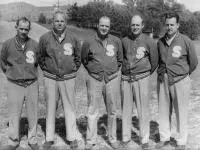
TIM PEELER: Edwards is Wolfpack Football's Forgotten Hero
8/2/2007 12:00:00 AM | Football
BY TIM PEELER
RALEIGH Sometimes it seems that Earle Edwards is NC State’s forgotten football hero.
Edwards, who won more games and served longer than the other 32 men who have held the position of Wolfpack football coach, was more than just a guy with a whistle around his neck and a clipboard in his hands. He is the very foundation of NC State football.
He had an overall losing record 77 wins, 88 losses but numbers alone can’t explain how he managed to take a school that was on the verge of dropping football altogether and was nearly kept out of the original Atlantic Coast Conference because of its lack of football success and turned it into a competitive program. He did it despite playing with fewer scholarships and a smaller coach staff than any team in the ACC. The Wolfpack played all its home games in undersized, decrepit Riddick Stadium, using the basement of Reynolds Coliseum as the home lockerroom. The team marched together, through a tunnel, to the sidelines before every home game. To help raise funds for a new stadium and to help pay the athletics department’s bills, Edwards agreed to play nearly two-thirds of the Wolfpack’s games on the road from 1954 through 1965, traveling to Wyoming, Arizona, Mississippi, California or wherever a good guarantee called.
Still, with a basic offense and a solid defense led by long-time defensive coordinator Al Michaels, the Wolfpack was successful despite the program’s lack of amenities. In 1967, Edwards guided his team to a No. 3 ranking in both the Associated Press and the United Press International weekly poll, before losing the final two games of the season and falling out of the Top 10. But the highlight of Edwards’ career came a year earlier, when his team kicked off its first game at gleaming Carter Stadium, adjacent to the NC State Fairgrounds.
The soft-spoken Edwards, with his trademark twitch of smacking his lips together as he pondered a problem, proud watched most of the truckloads of concrete that was poured into the then-41,000-seat stadium, making good use of the industrial engineering degree he earned from Penn State in 1931 to make suggested improvements along the way.
He wasn’t a colorful character, though former player and assistant coach Greg Williams insists that the coach’s dry sense of humor was “funny as hell.” Neither he nor any member of his long-standing coaching staff ever uttered a profanity at least within earshot of their players. But Edwards had plenty of favorite euphemisms like “Holy balls!” he used to get his point across. “Coach Edwards wasn’t one that screamed or yelled or hollered, but if you got called into his office, your [butt] was in trouble and you knew it,” said Chuck Amato, who played for Edwards in the 1960s and oversaw the first improvements to Edwards’ beloved Carter Stadium in 35 years when Amato was named NC State’s head coach in 2000. “I was in trouble too often, and he always intimidated me. If you messed up, you were punished.”
Edwards, a native of Huntington, Pa., made sure his players also matured into gentlemen. Every season before the Wolfpack played its first road game, he hired an etiquette instructor to teach his players table manners so they wouldn’t embarrass themselves at restaurants or in pre-game meals. Throughout his career, he stressed academics as much as he stressed football fundamentals. In 17 years, almost 94 percent of his players graduated from NC State College, a number that gave Edwards more pride than his 77 career wins and his 55 ACC victories, both of which are school records.
Players knew they had to go to class and to study hall. Their coach would withhold portions of the players’ NCAA-allowed $15 monthly laundry stipend for every class or study hall they missed. But he gave it back at the end of the semester if they made a C in the class. He’s still absolutely adored by his former players. One of his most famous players, Dick Christy, named his first child Richard Earle Christy in honor of the coach who allowed him to marry his high school sweetheart early in his college career. That’s the reason Christy turned down Notre Dame and Michigan, because they recruited the halfback but not the bride.
Christy and Dick Hunter were among the first players Edwards recruited to NC State. They matured into backfield stallions who helped the Wolfpack win its first ACC Championship a half century ago this season. Edwards led NC State to four more titles (1963-65, ’68) Edwards was an active member of the American Football Coaches Association, and served as its president in 1970, the year he retired from coaching. In 1974, he was elected to the North Carolina Sports Hall of Fame. In 1991, he was given the Watauga Medal for distinguished service to NC State.
Edwards enjoyed a long retirement, staying in Raleigh with his wife Mary. He was a frequent visitor at area golf courses and a regular at NC State football practices, scrimmages and games. He died on Feb. 25, 1997.
This year, as NC State completes more than seven years of improvements and expansion of Carter-Finley Stadium, the school is making plans to raise money for some visible honor to Coach Edwards. More information will be available in September, as the Athletics Department plans to honor the 1957 & 1967 Wolfpack Football teams at the Sept. 22 home game against Clemson.
Former players and all Wolfpack supporters are invited to support the fund-raising effort. All contributions will be included in Wolfpack Club members' cumulative giving totals. Any additional money raised will be added to the Wolfpack Club's Earle Edwards Endowment for scholarships.
For more details on the Edwards’ project, check www.gopack.com and www.wolfpackclub.com in late September.
You may contact Tim Peeler at tim_peeler@ncsu.edu.