North Carolina State University Athletics
TIM PEELER: 60 Years Later, Case's Dream Lives On
3/6/2007 12:00:00 AM | Men's Basketball
But it was exactly 60 years ago that tournament madness was born in Raleigh, North Carolina, the child of a Lieutenant Commander in the Navy looking for work after World War II as a college basketball coach.
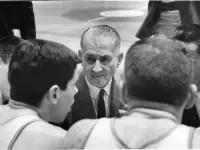
His name was Everett Norris Case, and he came to North Carolina State College in April, 1946, having accepted the job of basketball head coach without ever stepping foot on campus. The famed Indiana high school coach. He won five titles in the Hoosier State, accepting one of the awards from James Naismith himself and beating a whippersnapper named John Wooden en route to his final championship. He had heard about this skeleton sitting across the railroad tracks at North Carolina State College campus, a mass of exposed steel girders that was supposed to become a multi-use facility for the farmers and engineers who were the predominant patrons of the school. One of those uses was as a replacement for Thompson Gym, the small on-campus facility where the Red Terrors, as the basketball team was known prior to 1949, played its home basketball games.
Case, who began his coaching career as an 18-year-old high school senior, didn't have much to work with in the post-war era at State College. Only one letterman, the late Leo Katkavek, returned from the 1945-46 team and Case began the season with one junior and nine newcomers. Seven of the new guys were from Indiana, the old stomping grounds of Case and his assistant coach, Carl "Butter" Anderson. They included forward Dick Dickey, Norm Sloan, Jack McComas and Pete Negley. The Terrors also had a handful of military veterans that Case had either coached or competed against as the coach of the DePauw University Naval Training Unit in Greencastle, Ind.
All the newcomers, especially the coach in the dapper threads, created quite a stir on the NC State campus. By the time the season began in 1946, students were curious about the Midwestern imports over at Thompson Gymnasium. That curiosity turned into a basketball passion that enveloped the old Southern Conference and was morphed into the Atlantic Coast Conference. Heading into this week's 54th-annual ACC Tournament in Tampa, Fla., that passion still burns fervently.
Thanks, primarily, to the vision of Case. His inaugural team wasn't great, at least not until it went on a five-game Christmas barnstorming tour of the Midwest, which concluded with a 58-42 victory over Holy Cross, a team led by guard Bob Cousy that would go on to win the 1947 NCAA Championship.
"People began to notice us," Case told NC State athletics historian Frank Weedon in 1965.
By the time the Southern Conference season rolled around, the buzz around Case and his "Hoosier Hotshots" was immense, winning 10 of its first 11 league games, including a thrilling overtime victory against North Carolina in Chapel Hill, in Case's first meeting with the school's arch rival. But a victory over New York University, led by center Dolph Schayes, in Raleigh really put NC State on the national map of college basketball. The Terrors lost another league game to Wake Forest, but avenged an earlier loss to Duke.
That set up a long-anticipated contest against North Carolina, set for Feb. 25 at Thompson Gym, which had enough seats for just 3,200 spectators. The problem was that the post-war enrollment at NC State was 4,900 and every pass for the NC State home games were snapped up by students. So there was no room for faculty, staff, alumni or family. No one was permitted to bring a guest to the games.
Typically, that wasn't a problem, but crowds swelled to standing room only in the games against NYU, Duke and Wake Forest. For the Carolina game, students filled Thompson Gym long before the 8 p.m. tip-off time. Thirty minutes before the game, fire marshal R.C. Butts canceled the game because the tiny gym, now the campus theater, was bursting at the seams.
It was a dream come true for Case, a master showman and marketer. In fact, interest in basketball was so great during the winter of 1947, the Southern Conference Tournament had to be moved from the Raleigh Auditorium downtown, to the Duke Indoor Stadium in Durham, which could handle the expected crowds of 9,000 spectators.
"They never had anything like that before," Case said.
The Terrors rolled to victories over Maryland and George Washington, only to face North Carolina in the finals. It was the culmination of a perfect storm of possibilities for Case, NC State playing North Carolina in Durham for a conference championship. The White Phantoms, UNC's nickname at the time, had advanced to the NCAA championship game the year before and had won 10 consecutive games going into the title game.
They jumped out to a 20-7 lead in the first seven minutes of the game, forcing Case to go to something that would become a trademark of his early teams: a full-court press.
"We took a gamble by having our defense cover Carolina all over the court," Case said in The News & Observer afterwards. "We were just hoping our boys would have enough left at the end."
They did, and held on for a 50-48 victory that would give Case the first of his 10 conference titles over the next 13 years. Afterwards, he instituted a little tradition he brought with him from his Indiana high school days, having his players climb up to the rims and cut down the nets from the baskets. They then carried him off the court on their shoulders.
It was a ritual that Case and his team repeated often, winning six straight Southern Conference championships between 1947-52, the first three ACC Championships from 1954-56 and the 1959 ACC title. He also coached the first two games of the 1964-65 season before handing the team over to Press Maravich, who would eventually led the Wolfpack to the 1965 ACC title with Case sitting on the sidelines of Reynolds Coliseum.
Case accepted an invitation for his inaugural team to play in the 1947 National Invitation Tournament, which at the time was on equal footing with the NCAA Tournament. The difference was that the NIT chose its field prior to conference tournaments, and the NCAA chose its field afterwards. Case, a showman who arrived at a send off pep rally in front of the belltower with a pair of overalls pulled over his tailored suit and wearing a straw hat, wanted the opportunity to showcase his team in front of 18,000 fans at Madison Square Garden. He also wanted the possibility of facing Kentucky coach Adolph Rupp en route to a championship.
The Terrors beat St. John's in the first round, but loss to Rupp 60-42 in the semifinals. NC State whipped West Virginia, 64-52, in the consolation game for third place, Case's best finish in a national post-season tournament.
So, as the college basketball world gets ready to steal the national sporting spotlight with conference tournaments and the three-week spectacle of the NCAA Championship, remember that it was Case who trumpeted the importance of tournament basketball. He not only dreamed up the famed Dixie Classic as a holiday showcase between eight teams at Reynolds Coliseum, he also insisted that the ACC, when it was formed in 1953, select as its champion the winner of the post-season league tournament. Only the Southern Conference did that in those days. Now, all but two leagues select their champions via a post-season tournament.
The ACC tournament has been to Raleigh, Charlotte and Greensboro in North Carolina. It's been played in two different arenas in the Washington metropolitan area and two different arenas in downtown Atlanta. This week, it makes its first trip to Florida, a place where Case often vacationed. It will compete with the PGA Tour there, but the Tampa Bay area promises that this year's event will be a spectacle.
And that's something Case, the pioneer of ACC basketball and a posthumous inductee into the Naismith Memorial Basketball Hall of Fame, could have appreciated.
You may contact Tim Peeler at tim_peeler@ncsu.edu.