North Carolina State University Athletics
COUNTDOWN TO KICKOFF: Grounds Crew
9/3/2005 12:00:00 AM | Football
Sept. 3, 2005
BY TIM PEELER
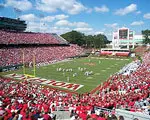
RALEIGH - What's it take to make the field at Carter-Finley Stadium green, red and white, with a little touch of black?
A year-round program of turfgrass management and a lot of paint.
In fact, every time the crew paints the field for an NC State home game, it buys about 150 gallons of red and 200 gallons of white Duron Athletic Field Marking Paint from a paint store on Hillsborough Street. And one pint of black, to outline the Block S logo at midfield.
Thursday afternoon, the crew - which includes athletic fields supervisor Joey Surratt, Dean Wade and three student workers - began the three-day process of marking Wayne Day Family Field for Sunday night's nationally televised home-opener against Virginia Tech and Monday's Aggie-Eagle Classic.
The process begins by measuring the field with a 100-yard tape measure, marking off the field yard-by-yard increments, something the crew does every time before it cranks the paint-spraying machines.
They outline the end zone, spelling out NC State in the north end zone and "Wolfpack" in the south end zone. At midfield, they outline the distinctive Block S logo that dominates the view of the field from the stands.
On the second day, they begin painting all the straight lines: yard lines, hash marks, end zone lines, and the numbers on the field. While the paint on portions of the field dries, Surratt climbs aboard his John Deere Model 2653 tractor to give the field its daily mowing, which takes about an hour and a half.
The third day of painting is Red Day, the easiest of the all the work, as Surratt and his crew colors within the lines with red paint and touching up any places that need it.
There are some changes on the Tiftway-419 Bermuda playing surface this season. The hedges that ringed the outside edges of the field near the grandstands were removed on Feb. 23, so that the grounds crew could dig trenches for television cable conduits and put in new gutters to remove water from the stands.
Previously, television production crews laid camera and electrical cables on either sidelines, creating a safety hazard during televised games. Now, all those cables are buried under the sidelines, with outlet boxes near the end zone that the television crews can plug into without putting cables on the ground.
An additional benefit is giving teams about six to eight additional feet on the sidelines for game-day equipment, benches, training tables, etc.
But there are likely major changes coming after this season for a field that has been in place ever since the Rolling Stones played at Carter-Finley Stadium in 1994. That's the last time the field was completely redone and re-sod, according to Surratt.
The athletics department is awaiting approval for the start of construction on the North End Zone addition, which will close in that end of the stadium and add some 7,000 seats, as soon as this season is over. Both the feasibility study and design of the project have been completed, and the school is waiting on approval based on a $15 million budget, according to Senior Associate Athletics Director David Horning.
NC State Director of Outdoor Facilities Ray Brincefield also hopes to put in a new $500,000 athletic turf to replace the current field, which features a significant "turtleback" hump in the middle of the field. Carter-Finley has the only remaining field in the ACC with such a mound.
"We need to get rid of that hump, that's the main thing," Brincefield said. "No other school in the conference has that and our own practice facilities don't have that. So it can be a disadvantage."
It was a difficult grass-growing season in North Carolina this year, "a constant battle," said Surratt, who graduated from NC State in 2000 with twin degrees in turfgrass management and parks, tourism and recreation. The spring was unusually cool, the summer a little dry. The over-seeded rye stayed on about a month longer than it should have and the Bermuda grass didn't get a chance to establish particularly deep roots.
So the field got a lot of wear and tear when 16 high school teams participated in the Pigskin preview on Aug. 13 and when the NC State team held two preseason scrimmages. But by kickoff Sunday night, no one will notice a flaw on the field.
"I think based on the dry summer we have had, and the amount of traffic we have had on it, it is basically in perfect shape," Brincefield said. "I think it is exactly what you would want it to be with that amount of traffic on it, which means there is a little issue with density here and there.
"But it is just beautiful. It's in great shape."
You may contact Tim Peeler at tim_peeler@ncsu.edu.