North Carolina State University Athletics
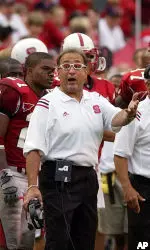
Instant Replay: Let's See that Again
6/17/2005 12:00:00 AM | Football
June 17, 2005
By Tony Haynes
Raleigh, N.C. - The Big Ten showed the way, now the ACC will follow. The instant replay system for football that was used quite successfully by the Big Ten last season will be implemented on an "experimental basis" by the ACC this fall. But from all indications, instant replay is here to stay and will likely be a common tool used by most major conferences in coming years. So how will the new system manifest itself this season? Well, there will be differences from what has been used in the NFL over the last several years.
To begin with, neither coaches nor game officials on the field will be permitted to ask for a review on a call that may be in dispute. That job will belong solely to a technical advisor working in the press box. The advisor will keep a close eye on every play and will stop action for a review on those occasions when he or she deems it necessary to review a play. In order for a play to be changed, the technical advisor must have indisputable video evidence that an error occurred.
Unlike the Big Ten model, however, every conference game - and perhaps - almost every game involving ACC schools - will use the new replay system. Even those games that won't be televised will be equipped with replay capabilities, meaning every team in the league will get a fair shake, even those schools that may not appear on television as much.
"It will cost a little more to do it that way," said NC State athletics director Lee Fowler. "But all of us are now using video boards now anyway. We'll probably have to add a camera to make sure we have enough angles for a good replay."
The Big Ten last season only used replays for those games that were televised.
For non-conference home games, the new replay rules can also be used if the visiting team approves in advance.
"I don't know why they wouldn't," Fowler said.
And if the opinion of the ACC's 12 coaches is any indication, then getting permission to utilize the system from opposing coaches of non-conference opponents probably won't be a problem. In a league that now features many intense rivalries and a high level of competition, ACC coaches and athletics directors were unanimous in their support of a replay system that could overturn missed calls.
Of course, only certain types of plays will be reviewable. Plays that are governed by the sideline, goal line, end zone or end line can be reviewed. The same can be said for pass plays that may or may not end in legal catches. Even the spotting of the ball can be changed if the administrator in the press box notices that the ball was not placed properly on plays that could determine whether a team scores or gets a first down.
And while the new replay system will likely help game officials get certain calls right, it won't put an end to controversy. For instance, the ruling on T.A. McLendon's third down run late in last year's game at North Carolina probably wouldn't have been overturned even had the play been reviewed. After the head linesman ruled T.A. McLendon had scored what would have likely been a game winning touchdown, the line judge disputed the call, claiming McLendon's knee had touched before the ball crossed the plane of the goal line. After a long discussion, referee Jim Knight agreed and placed the ball at the one. Replays available that night on a local cable feed provided by the UNC athletic department would not have been considered conclusive either way, meaning the ruling on the field probably would have stood.
Many of the other more controversial moments in ACC games last season involved questionable pass interference calls. Those types of plays are not considered to be reviewable and could not have been changed by a technical advisor had a replay system been in place.
Either way, fans in the stands this season will likely be screaming "replay, replay, replay" on calls that they consider to be borderline.
Let's see that again.