North Carolina State University Athletics
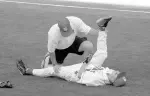
Torn Hamstring Unveils Scope Of Sports Medicine
5/25/2005 12:00:00 AM | Pack Athletics
May 25, 2005
I tore my hamstring while trying to beat out a poorly hit grounder in a slow pitch softball game. The pop I felt in the back of my leg was what I would imagine it would feel like if somebody whacked me in the back of the leg with the side of a tennis racquet. I stopped by the sports medicine center on my way into the office at the Weisiger-Brown Athletics Building the following Monday to have my leg looked at by an athletic trainer and to get some advice as to what to do.
I was aware that there was more to sports medicine than just making Gatorade and taping ankles but actually getting on a table in the training room three times a day the last few weeks has really been an eye opening experience for me. I have a new found respect for everything this group does.
"Our 18 licensed, certified athletic trainers are the entry point to the health care delivery system," said Charlie Rozanski, NC State Associate Athletic Director for Sports Medicine. "They are the ones who work with our student-athletes on a day-to-day basis. As licensed, certified professionals, they are highly skilled in injury assessment, management and rehabilitation. The thing that makes athletic trainers unique in the health care delivery system is that we have a relationship with the patient before the patient needs us.
"In virtually every other part of the health care system, you go to the health care practitioner after you have an incident," Rozanski continued. "We have a relationship already in place with our student-athletes before they need us, so there is trust there and an understanding as to who the patient is and what they are trying to accomplish. So it's not like we're playing catch-up and trying to understand that we're playing Clemson on Saturday and that this is our starting tackle. When we see the injury occur, we already know those things and we don't have to spend any energy on that part, we can get right to the treatment plan and begin treating the injury immediately from the moment that the student-athlete is laying on the field, court, mat or pool. That's what makes the athletic trainer unique from any other health care professional. It's a tremendous advantage because the athletic trainer knows the dynamic between the coach, the student-athlete and the parent, prior to the injury, which gives us a real edge."
Jamey Coll is the Associate Director of Sports Medicine and head football athletic trainer. Kevin King is his assistant. Nicole Neal is the Associate Director of Sports Medicine and heads up the Reynolds Coliseum facility. She works primarily with gymnastics and women's soccer. Stephanie Aronson handles women's basketball and also oversees softball. Darrin DeRue works with baseball and tennis and Brian Hermanowicz handles track & field and men's soccer. Mark Boatright, who is the former football head athletic trainer, now works as the rehabilitation coordinator. Rozanski describes Boatright as the lynchpin of the whole operation and says that he holds down the fort while all the athletic trainers are out at the various venues for practice. Glenda May is the administrative coordinator and she handles the daunting and unheralded tasks of billing, referrals and the mind-boggling paper trail with insurance companies. Peggy Myers is the secretary and does all of the medical transcriptions for the doctors' dictations.
A tremendous amount of medical resources are readily available to the sports medicine staff. Rozanski's working relationship with several doctors and specialists in an area of the world where some of the finest of the field live and work allows NC State's student-athletes access to an abundance of expertise.
"The athletic trainer is going to be with the student-athlete from the time that they get injured until they get well and they'll still be there well afterwards," Rozanski said. "The moment an injury occurs and the athletic trainer is formulating the injury management plan and the treatment plan, he or she can call upon our team physician or our orthopedic consultants. What is neat about our system is that while certainly a vast majority of our student-athletes need either a general practician physician or an orthopedic consultant, we also have a whole host of specialists that consult with us on a case-by-case basis and are all big supporters of our program that are really good about getting our folks in to be seen."
Dr. John Rubino serves as the team physician, Dr. Bill Jacobs is the associate team physician and Dr. Brian Goldman is the assistant team physician for NC State athletics. Dr. Dave Fajgenbaum, Dr. Mike Fajgenbaum, Dr. Paul Barrows, III and Dr. Mike Comstock from the Bone & Joint Surgery Clinic are the orthopedic consultants for football, track & field and wrestling, while Dr. Wally Andrews, Dr. Lyman Smith and Dr. Bob Wyker from the Raleigh Orthopedic Clinic are the orthopedic consultants for the rest of the Wolfpack student-athletes.
"Those doctors are all in private practice in Raleigh and see private patients," Rozanski said. "They also hold regular clinics in the athletic training room here and are available on call. They are all intricately involved with our program. They are all outstanding physicians who have excellent reputations in the Raleigh medical community. They also have a close relationship with our student-athletes because they hold those regular clinics."
There are a whole host of needs for a specialist, whether it be a dentist, dermatologist or a dietician.
"No two student-athletes have the same needs," Rozanski said. "My job is to make sure that we develop a relationship with all of the specialists so that when a student-athlete has a particular need we're able to match that student-athlete with the right specialist to assist in managing the condition and work with the athletic trainers to implement that plan. Rex Health Care is a great partner with us. In addition to being a great corporate partner with Wolfpack Sports Marketing, they have been great to us, in terms of treating us as a preferred customer. Student Health Services, here on campus, is an unbelievable resource for us. Their physicians, led by Mary Bengston, M.D., Medical Director, their physician extenders, their lab and x-ray are tremendous resources for us that we use constantly.
"The other things that most people probably would not think about are issues like nutritional needs," Rozanski continued. "The University Dining Services, here on campus, make a dietician available to us who does an incredible job. They cover eating disorders, counseling and addiction issues. We have stress management and sports psychologists available on a case-by-case basis as well. The whole key to it is the licensed athletic trainer, knowing the resources available, knowing where the appropriate referral goes and following through on the implementation of the plan, documenting the plan and keeping the coaches and parents informed."
With Rozanski's permission, I stop by the training room during non-peak hours and have one of the athletic trainers help me implement my injury management plan and treatment plan.
"Acute care and management - rest, ice, compression and elevation, if you can do those things then you don't have to wait as long to get over the inflammation and begin rehabilitation," Rozanski said. "The longer that the inflammation is out of control the longer it is going to take to get to the stage where you can start the range of motion exercises. That's the whole point of the first phase, to minimize the inflammation. Not eliminate it, because you have to have inflammation for healing, but minimize it so that you can get into that rehabilitation stage faster. You have to go through the phases of tissue healing. There is nothing magical about what we do for tissue healing, but what we do is minimize the bad parts so that we can maximize the time sequence. So instead of taking three weeks to get back; it takes 10 days to get back."
Courtney Dolphin, a graduate assistant who serves as the athletic trainer for the men's and women's swimming & diving teams, is usually in the athletic training room when I stop by in the mornings. She attaches a couple of stickers, called electrodes, to the back of my injured leg and plugs an electrical stimulation machine to the electrodes. She then wraps an ice bag over them and zips my entire leg up in an inflatable bag, called a compression boot, which has an air hose attached to the side like some kind of scuba suit. My leg is elevated and begins to get crushed by the boot, frozen by the ice and my muscles uncontrollably contract and relax with the waves of "stim." Uncomfortable at first, I have come to enjoy this ... until it's over and we have to tear those electrodes off, removing any leg hair that once was rooted in those spots.
Returning around noon, Hermanowicz puts me on an exercise bike for five minutes to warm up my muscles before he hits my hamstring with some ultrasound waves. Previously under the impression that ultrasound was for pregnant women, I now know that at a higher frequency, ultrasound waves can be an effective way of warming up muscles, making them more pliable and also helping to break up fluid buildups. I never feel anything when he does this, but when he's finished he does a massage on my tender hammy that I can definitely feel. Then I do a few sets of calf raises, leg curls and mini-squats.
Once practice has started for a majority of the teams and most of the student-athletes are out of the training room, I swing back through late in the afternoon for a little more ice. I'm very fortunate at these times to usually catch a few minutes with Boatright, who possesses a vast knowledge and a wealth of experience. The entire sports medicine staff uses him as a resource for developing rehabilitation programs.
That regimen has been a small glimpse into what high-tech treatments our student-athletes are receiving on a daily basis. It is absolutely amazing how good the sports medicine staff is at what they do. A very friendly, enthusiastic and patient group of licensed, certified athletic trainers, they know every student-athlete and their medical background. The sports medicine center is always spotless, meticulously organized, fully stocked with materials and supplies, and the whole staff is right in line with all legal, insurance, heath and confidentiality issues.
Keeping up with current technology, advancements in the field of sports medicine and improvements in rehabilitation, the NC State athletic department is building a new sports medicine center down the hall from the current one at the Weisiger-Brown Athletics Building.
"We have a state-of-the-art facility at the Murphy Center that we've been in for two years," Rozanski said. "Jamey Coll did a tremendous job designing that and it functions beautifully and gives us a huge advantage. The aquatic therapy part of that facility, which is new and different from the rest of our facilities, have given the rest of our athletes a huge advantage in terms of early resumption of activity by being able to get in the pool and do early rehab.
"This new facility gives us the opportunity to bring that water therapy to campus," Rozanski continued. "That has really come about because of Herb Sendek. When we were talking about what we needed and what we didn't need, Herb was insistent that we have state-of-the-art aquatic therapy and Lee Fowler was enthusiastically supportive. We'll have four times the hydra-therapy space as we do now and that's really a tribute to Lee Fowler and Herb Sendek foresight to not just have the building function today, but in five years to still be on the cutting edge of athletic rehabilitation."
How does one become an athletic trainer?
"In order to be a certified and licensed athletic trainer you have to graduate with a bachelor's degree in athletic training from an institution that provides the approved curriculum." Rozanski said. "NC State does not offer that curriculum, because there are enough schools in the state that do offer that curriculum. So our niche is that we usually have students that are interested in athletics and in health care. We have a great pre-med major at NC State and we have a lot of students that get undergraduate degrees in biological sciences or chemistry and go on to medical school. Our student aids usually volunteer, although we have a small amount of scholarship money available."
Most student assistants are used for football because of the volume of work and people involved.
"We're helping the student assistants to grow and understand the health care profession by exposing them to all these different groups and they are helping us by being extenders to our athletic trainers," Rozanski said. "They help with hydration, which is very important in the hot weather. By keeping someone's hydration level up they could be saving someone's life without even knowing it. Football is an army marching. There is a huge amount of equipment that is involved in that and having the organization and administration that goes along with that. We're always looking for good students who have an interest in working with us. Jamey Coll does a great job of having a system in place. It's one of those things where you have a tractor-trailer full of equipment on the road and if you need a knee mobilizer and can't find one, then you've got a problem. Our assistant, Kevin King, has great organization skills and is able to get anything at a moment's notice. Those students play a key role in that organization. That precise organization is critical because if we have to stop to look for something then there are three other athletes that we could be helping. Efficiency is the key to success. The students are a huge asset to us in staying efficient and hopefully we give them good exposure to the health care system."
There are nine graduate assistants in the sports medicine department that make up half of the licensed, certified athletic trainers. Compensated for their work with tuition for graduate school, they not only work full time, but they study very hard as full time graduate students as well.
"All of our GA's come to us as licensed, certified athletic trainers, so they come from undergraduate athletic training curriculums," Rozanski said. "Their job is kind of a transition period between their undergraduate studies and when they are out on their own. We mentor them. Each member of our staff has oversight responsibilities with the various programs that the GA's work with. They are entry-level folks that do a great job, have a lot of enthusiasm, a lot of excitement and a great knowledge. They are spending this time with us trying to apply that knowledge base to a more practical application, while pursuing a master's degree in a related field."
The graduate assistants are not the only ones hitting the books though.
"Our licensed athletic trainers are all required to have 25 hours of continuing education credits each year in order to stay licensed," Rozanski said. "And that's a great thing because technology is changing so quickly. Two things that are out there with promise are electromagnetic energy (basically magnets) and laser therapy. Both are tools that are just starting to crack the surface for us and the scientific evidence is emerging. Also as surgeons change their methods, that affects our rehabilitation. A great example of that is 15 years ago when somebody had ACL surgery they put them in a cast for six weeks. Now we immediately move them and get them going from the moment they get out of surgery."
While I gained a whole new appreciation for the scope of sports medicine while rehabilitating my torn hamstring, I come away with an even greater appreciation for the NC State athletic trainers themselves. With as much training and schooling that is required to become an athletic trainer and the demanding duties that are required of them, it makes it even more impressive to me just how upbeat, friendly and caring they are. The Wolfpack student-athletes are in good hands.
by Bill Newton, NC State assistant media relations director