North Carolina State University Athletics
Pack Finds Its Strength
9/24/2004 12:00:00 AM | Football
Sept. 24, 2004
It's no secret that strength-and-conditioning has become a large part of college athletics and NC State football is no exception. As you glance over at the impressive Murphy Center towering over the south end zone, you should be able to count the four floors by the windows. The entire second floor could be the largest strength and conditioning facility in the country devoted solely to football, as the Pack trains in a 14,000+ square-foot facility that overlooks the playing field.
The bright, open area spans the entire width of the Murphy Center and includes over 15 tons of weights, plus other machines and equipment. In addition to a 70-yard running track, the facility includes 12 self-contained power stations, 12 olympic platforms and over 30 pieces of "selecterized" equipment, all resting on a spring loaded floor. The facility also houses a 5,000-square-foot agility and quickness room and a juice bar to provide nourishment while the players are working out.
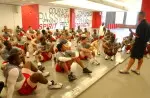
NC State head strength and conditioning coach Pat Meyer oversees the program. He and his staff work tirelessly to ensure that each Wolfpack player is able to achieve his optimum physical potential. Meyer, a former offensive lineman for the Arizona Cardinals and for Colorado State, prepares himself for game day by going on a long run early in the morning.
"Game day is all about organization," Meyer said. "I wake up between 4 and 4:30 and my pal Todd Stroud and I get mentally prepared by going on a long run. We'll go anywhere from eight to 16 miles and run from one to two and half hours."
Preparation is key in Meyer's business. What most people probably don't realize though, is the year-round commitment NC State makes to strength and conditioning and all the preparation that goes into today's game.
"We actually have four different phases of weight training here," said Meyer, who is in his fifth season at NC State. "That's the thing that has probably changed the most over the past 10 or 15 years. A lot of people think that you might lift a month or two before camp, and that's probably the biggest change for high school kids coming here. They may have been playing other sports and only trained a month or two before football season and that was the extent of their training. It's a sport in itself here. It's a 12-month commitment in the weight room. We really don't take any training breaks. A lot is asked of our guys."
The first phase of the strength and conditioning calendar started back in January.
"We call the first phase our off-season program," Meyer explained. "It starts right after the bowl game or right after Christmas break. For the month of January, all we're doing is getting them back in the weight room, pounding the weights and getting them stronger. That lasts for about four weeks. We go four days a week: Monday, Tuesday, Thursday and Friday. We get two opportunities to lift lower body and two to lift upper body."
The off-season program continues through February, but it becomes more intense. The coaches get involved and the Wolfpack players go through a grueling four-week period known as mat drills.
"This is when we add the quickness and agility part of the program," Meyer stated. "For four straight weeks the guys are dressed and ready to go at 5:45 in the morning, four days a week. We work them in different drills to get not only conditioning, but quickness and agility. It's also mental. There is a sense of accomplishment for them in getting through mat drills. We're also lifting three afternoons a week."
When the team puts the pads back on and returns to the practice field for four weeks of spring practice in March, the strength and conditioning continues as phase two begins. With conditioning being done at practice, Meyer just has the players lifting weights three days a week. The Red & White Scrimmage marks the end of spring practice, but not the end of the second phase of strength and conditioning.
"There are a couple weeks after the spring game when we take a break, but before the semester ends we'll bring them in and lift them," Meyer explained. "On the last day before final exams we have a day of nutty competitions. They have relays, tug-of-war, barrel throwing - it's kind of like a strongman competition, only it's offense versus defense. They enjoy it and it brings the team together before they get out of here."
The summer break isn't very long for most of the guys on the team. Voluntary workouts begin when summer school starts in June. That marks the beginning of phase three for strength and conditioning.
"Our third phase would be our summer phase or preseason," Meyer said. "During the summer we hit the weights heavy. We're getting them stronger and we're also working on their conditioning level, speed development, flexibility and agility. The typical summer week would be having them come in five days a week.
"Mondays are upper body, with an emphasis on bench," Meyer continued. "Then we go outside and do more interval running. That's our big running day. Mondays are more like track practice. Tuesdays are lower body days, with an emphasis on the squats. Then we work on speed and quickness. Sometimes we take them to the sand pit to do some kind of plyometric jumping. Wednesdays they do not lift weights. They practice for their conditioning test. The conditioning test is running 20 110-yard sprints for time.
"Thursdays we come back we work upper body again," Meyer continued. "We work on incline, do some dumbbells and power shrug. We go outside and pull sleds and work uphill and downhill runs, doing more speed development type stuff. Fridays we come in and work lower body. On Friday we emphasize more power clean than squat. When we get done lifting we run stadium stairs or the embankment on the stadium. We try to change things up a little bit in the summer so that it is not too monotenous."
Summer is a time to build multiple strengths, as the Wolfpack players not only get stronger individually, but stronger as a team as well.
"Summertime is a big time to build leadership and team morale. We let the seniors handle things. The seniors break it down at the end and talk to the rest of the team about staying out of trouble, going to class and stuff like that. It's a good time to build that senior leadership. We also try to do some fun stuff during the end of the week that helps build morale. We'll have a jump off competition or we'll throw on the big padded gloves and they'll go at it in the mat room."
That brings us to phase four - in-season strength and conditioning.
"The players the fans see out on the field, who play every week, are in the weight room with us three days a week," Meyer said. "They lift three days a week, as well as practicing every day and then playing on Saturdays. For the guys that don't see as much action on the field, they'll lift four days a week.
With as much time that is spent lifting weights, Meyer is careful not to lose focus as to their purpose.
"We're here to help them get better out there on the field," Meyer said. "Our philosophy is not to make them body builders, it's to make them better on the field. We stress stuff that the coaches stress out on the field, like bending your knees, or getting your body positioned. Of course we're trying to make them stronger and prevent injuries, but we're also trying to make them better football players."
An expert in a constantly changing field, Meyer is quick to point out that he is always looking to improve.
"We're certified through the NSCA and we read the articles in all the journals. We're always interested in different ways to train and the different results from different conditioning. We have contacts, acquaintances and buddies in the business who we trade notes with. We go to conventions and listen to other people talk. Those are all useful tools, but we always come back to the things that are best for our team."
Meyer estimates that he spends more time with the players that anyone else in the program.
"One of the biggest pluses to a job like this is to be around all these guys," Meyer said. "The strength coach is involved with every single player on the team, with everyone from the biggest star on the team to the brand new walk-on. You get to impact their lives, and not only in the weight room to make them better on the field, but away from football too. Typically the strength coach is a guy who players can lean on with any problems. They might feel more comfortable talking to a strength coach than someone else because we're around them all year round."
That's where the job satisfaction comes into Meyer's job.
"It's an enjoyment to see a kid come in at 17 years old and develop into a man over the four or five years," Meyer said. "Very few of these guys are going to make a career out of football in the NFL, but the things we work on here will hopefully develop different traits that will make them successful in life. Everything that we talk about in here: commitment, discipline and work ethic are things that will help them out later on in life."