North Carolina State University Athletics
The Pain of the Game
9/22/2004 12:00:00 AM | Football
Sept. 22, 2004
By Pat Norris - When game day arrives for the NC State football team in the fall, Jamey Coll is the person most responsible for having the players in the healthiest playing shape possible. While the name may be unfamiliar to the average fan, those around football operations know of the important and invaluable work that Coll and his staff put in week after week. Coll, senior associate director of sports medicine, has served as the head football athletics trainer since the fall of 1996. Coll is starting his 12th year as a member of the Wolfpack Athletic Training Staff.
In preparation for game day, Coll and his 13-member staff, work seven days a week to properly evaluate, treat and rehabilitate any of the 110 football players that may have been injured in a practice or game. In addition to Coll and his immediate staff, Charlie Rozanski, director of sports medicine, team physician Dr. John Rubino, orthopedic surgeons Dr. Michael Fajgenbaum, Dr. David Fajgenbaum and Dr. Paul Burroughs III, and neurosurgeon Dr. Tim Garner are on hand at games. Coll has a wide array of health-care professionals he calls upon to help serve the football players.
"The NC State Student Health Center's professionals have been tremendous for our sports medicine program over the years," Coll said. "The doctors, pharmacists, x-ray technicians, lab personnel and counseling center have been wonderful assets for us and our program. In our community, we have a team dentist, chiropractors, physician's assistants, team orthotist, eye care specialists and three major hospitals who provide outstanding care for our student-athletes as well."
Injuries, unfortunately, are part of any sport, and football is certainly no exception. Once an injury occurs to a Wolfpack football player during a game, Coll and his staff begin the process of evaluating and treating an injury immediately.
"My assistant, Kevin King, and one of the orthopedics will accompany me to the injured player to do an evaluation on the field," Coll said. "We check to see what is hurt, how severe it is and whether or not the player can get up and walk off the field under his own power. We have a Gator cart we can use to transport an athlete off the field if they are debilitated. Also, we have EMS personnel available in the end zone for a life-threatening emergency. Further, we have x-ray capabilities in the stadium to rule out any boney pathology quickly during the game."
Once the player is off the field, Coll and the doctors assess and diagnose the injury. They check the severity of the condition and make a decision on how to manage it. After those measures are taken, Coll informs the head coach and position coach as to the likelihood that the player will return to the game.
When the game is over, the staff performs treatments before the players leave for the evening. They provide the injured players with information about their injury and phone numbers to call if their injury or symptoms worsen.
The sports medicine staff has two treatment times on Sunday following a game. At 10 a.m., Coll, his staff and an orthopedic doctor are on hand to see the athletes who have been injured. The second treatment time is 1 p.m. If a player needs a specialized test to help diagnose an injury, such as an MRI or CT scan, then those appointments are set up by Glenda May, administrative coordinator for sports medicine.
"When the players come in for treatments on Sunday, we determine how we are going to manage the injury and begin a treatment plan for each injured student-athlete," Coll said. "We then have the injured players come in Monday morning at 7 a.m. for more treatment, working to get the student-athlete back to competition as quickly and safely as possible."
Beginning on Monday, Coll and his staff, depending on the day, are in at 6 or 7 a.m. for morning treatments. Coll then meets with the coaching staff at 8:30 a.m., in their morning staff meeting, to discuss the injured players' status for the next practice and upcoming game.
"Also, Mondays are when my staff and I come together to lay out our schedule for the week," Coll said. "We've had two days to see the players who are injured from the game. We discuss and set their treatment plans for the week. Further, we use Monday and Tuesday mornings to send our student-athletes out for any special tests, appointments and doctor follow-ups."
After the early treatments Monday through Thursday, Coll and his staff document injuries, maintain each student-athlete's medical files and restock their supply trunks that were used during the game. A round of afternoon treatments is next on the schedule, with preparations for the day's practice continuing as well. They treat, tape and stretch the players before heading out to provide medical coverage for practice.
"Out at practice, my staff, students and I wear medical packs with first-aid supplies to help with any minor cuts or scrapes. Also, we have emergency care equipment in case a severe injury occurs," Coll said. "The staff and students provide Gatorade and water on the field during practice to keep the players hydrated, stressing to the players to drink fluids, especially when it's hot and humid."
During the week, team doctors are available and one of the team orthopedics is present for Tuesday practice and a physician's assistant on Wednesday. Tuesdays and Wednesdays are the two most physical practices of the week. The orthopedic doctors will evaluate any injuries that may arise from practice, as well as re-evaluate past injuries that players may have sustained. If needed, team chiropractors are used in conjunction with daily treatment on Wednesday or Thursday afternoons.
On Thursday, team physician Dr. John Rubino is in the Murphy Center sports medicine center at 1:30 p.m. for any medical issues or concerns.
On Friday, the athletic training staff catches up on paperwork and prepares for the game. Whether on the road or in Raleigh, the athletic training staff reports four hours before the game. Coll's staff arrives to prepare the locker room, sideline and training room for the competition.
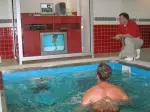
"When the players arrive at the Murphy Center, they have the opportunity to heat, stretch, swim, get taped, get warmed up in the Jacuzzi pool or take care of any last-minute things that they need before playing in the game," Coll said. "Then, after the game, we are back where we started."