North Carolina State University Athletics
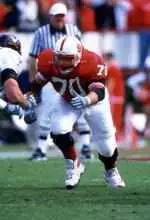
Coming Full Circle
11/29/2004 12:00:00 AM | Football
Nov. 16, 2004
By Bruce Winkworth - A year ago, Chris Colmer's football career was in limbo and his life was miserable because of it. A fifth-year senior in 2003, Colmer was sidelined that August by a mysterious ailment called Parsonage-Turner Syndrome and missed the entire season.
Parsonage-Turner Syndrome is a disorder that affects the brachial plexis, which is a group of nerves that emanates from the neck, passes underneath the shoulder and divides into various nerve groups in the upper body. The symptoms include burning and numbness in the arm. When Colmer pulled himself out of a scrimmage that August, he figured he might be out for a few days, maybe a few weeks. Doctors told him otherwise, that he would fully recover, eventually. That was the good news. The bad news was that no one could say exactly when.
After missing all of the 2003 season and only participating in non-contract drills during spring practice, Colmer was medically cleared to play in June and finally got back on the field for the start of preseason camp in August. He was out for 50 weeks, but at times it felt like 50 years. At times, in fact, it felt as though it might last until forever.
"It's good to be back," Colmer says. "I never thought I'd be able to come back. I really thought it might be over. It's a great feeling to be back."
Colmer's return never was assured merely by a return to health. Because he sat out his first year in Raleigh, the 2000 season, his eligibility expired at the end of the 2003 campaign. But since his redshirt season was forced by an injury, NC State officials appealed to the NCAA to grant Colmer an extra year of eligibility, and that appeal was granted this past spring.
The return to the practice field and to games was not without its knocks and bumps. Colmer had to go through a bit of a transition period to knock off about 19 months worth of rust. Aside from spring practice and two weeks of preseason camp a year ago, he had been out of action since the Wolfpack's Gator Bowl rout of Notre Dame on New Year's Day 2003.
"It really hurt a little bit at the beginning of two-a-days, but after that I kind of got into the flow of things," Colmer says. "I think it just kind of shocked my body to get back out there and start hitting again. After that, it got better pretty quickly.
"I feel good. I'm sure I can probably get a little bit better, but I feel as good as I did before."
Colmer felt great before the injury, which explains why it was such a frustrating experience. In 2002, he and guard Sean Locklear led a powerful NC State offensive line that helped the Wolfpack roll up yardage at a breathtaking clip. Thanks to that line, quarterback Philip Rivers was sacked just 10 times all season and had all the time in the world to get the ball to the likes of tailback T.A. McLendon, wide receiver Jerricho Cotchery and tight end Sean Berton.
The result was a then-school-record 5,485 yards of total offense, a school-record 11 wins, and the aforementioned 28-6 drilling of Notre Dame in the Gator Bowl.
All signs pointed to 2003 as the year it would all come together for Colmer, who earned second-team All-ACC honors in '02. He was listed as a preseason all-conference pick, a preseason All-America candidate, and was projected to be a high pick, possibly as high as the second round, in the 2004 NFL Draft.
Instead, Colmer had to watch from the sidelines as Rivers and Locklear, probably his two closest friends on the team, reaped all the honors and awards. Colmer was left to contemplate a very uncertain future.
"Having not gotten better for so long, I was real frustrated," Colmer says. "And last year I really thought it was going to be my year. A lot of my friends, Phil and Sean, with these guys moving on and going to the NFL and playing and getting on with their lives, I was kind of stuck in time."
Following spring drills, Colmer embarked on a conditioning program. With the extra year granted, he wanted to be sure he was in the best possible condition for fall camp, assuming he would be able to go in the fall. Although the condition was noticeably improving, it still affected him at times. When camp opened in August, he was able to practice, but was not 100 percent.
Following a hit on his shoulder early in two-a-days, he felt the numbness and burning return to his arm. He wondered then if he would make it back or not.
"I was hesitant at first," Colmer says. "It was painful and would burn, and I thought it was going to happen all over again. I talked to a couple of the coaches, and they said to hang in there and see what happens. My family and friends back home, I talk with them all the time, and they really helped me through everything, through all the hard times. Hopefully I won't have to go through anything like that again.
"That one day [when it started burning], I stopped practicing. I thought I was done. I just didn't think I could go anymore. The coaches told me, `You do what you can do and hopefully it will get better,' and it did."
Things improved rapidly after those early scares, and Colmer once again has been a mainstay along the Wolfpack's offensive line. And he is thankful he is back. During his year of forced inactivity, he helped with the coaching staff, serving as an extra pair of eyes and advising the offensive linemen. It wasn't an easy role to play.
"It was frustrating, but mentally it helped me to understand the plays and the game and to understand what's going on," Colmer says. "It helped to be out there, but it didn't make me the player I am right now."
Translation: Watching and coaching is not as much fun as playing.
Not going out with Rivers and Locklear last year was tough for Colmer, and he said at the time that even if he did return it might not be the same playing without them. But football probably breeds a closeness among teammates like no other sport. That may especially true along the offensive line, where the work is the dirtiest, and the rewards and recognition the hardest to come by.
"Every year you grow a different kind of love and respect for the man next to you," Colmer says. "You don't think it's gonna happen. You think, `That was the best squad. We were the tightest,' especially as an O-line. We really come together and bond as the year goes on. You don't think it's going to happen. You're not gonna be as tight as you were the year before, and it always becomes tighter."
Being a sixth-year player makes Colmer unique. He'll turn 24 later this month, which makes him considerably older than all but a handful of his teammates. He is now a college graduate taking course in preparation for a graduate program he will begin at Hofstra in the spring. All of that makes him the target of some serious ribbing, from teammates and coaches alike, but Colmer hardly minds. In fact, he enjoys the give and take. After what he's been through, being the oldest guy on the team sure beats not being on the team at all.
"It's been tough," Colmer says. "It's a long road. I'm just thankful that I'm able to be back. I really wouldn't know how to put it into words. I'm just happy to be here."