North Carolina State University Athletics
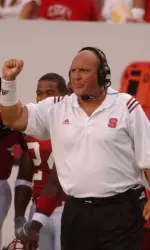
Back To Basics
10/8/2004 12:00:00 AM | Football
Oct. 8, 2004
By Bruce Winkworth - Two years in the National Football League was all it took to make Reggie Herring realize there's no place like home. And for Herring, home was college football.
"I missed coaching college kids," Herring says, "and I missed the college atmosphere. The NFL was a great experience, but it was different. It's something I can see myself possibly doing after my children leave the house. I still have a young man in high school and a daughter in college. The NFL will devour you and your life if you're not careful. I found out that I needed to come back to college."
Herring spent 21 years -- 21 very successful years -- in college coaching before leaving for the expansion Houston Texans of the NFL in 2002. A 1981 graduate of Florida State, Herring made stops at Oklahoma State, Auburn, Texas Christian and Clemson before leaving college for Houston. He was a linebackers coach at Oklahoma State and Auburn, then served as defensive coordinator and linebackers coach at TCU and Clemson. Along the way, he built a reputation for an intense coaching style and for building defenses that surrendered yardage and points very grudgingly.
In five seasons as defensive coordinator at Clemson, Herring's defenses ranked in the top 20 nationally in rushing defense three times, including a No. 6 ranking in 1997. Twice the Tigers finished in the national top 25 in scoring defense under Herring. Facing a schedule that featured five of the top eight rated quarterbacks in the country, the 1999 Tigers finished 17th in the nation in pass defense and eighth in interceptions, and set a school record with 47 quarterback sacks. A year later, Clemson ranked 18th nationally against the rush and was 23rd in scoring defense.
Timing and coincidence helped bring Herring to NC State. He was looking to get back into the college ranks, and Wolfpack head coach Chuck Amato was looking for a defensive coordinator who fit his attacking style of coaching. The fact that Herring was well-versed with the ACC after his eight years at Clemson (1994-2001) and played for Bobby Bowden, Amato's boss at FSU for 18 years, made NC State and Herring seem like a perfect fit.
"He's very aggressive and very intense," Amato said in August on media day. "Discipline is important on his radar screen. A lack of loafing is important on his radar screen. Knocking ball carriers back is important on his radar screen. I've left the field these last 15 practices or so with a voice because he's an extension of me. I'm excited for our team."
Much has been made of the concept that Herring is an extension of Amato. Some assistants might chafe at such an idea, preferring to cut their own path, but not Herring. One of the biggest reasons he was drawn to NC State and Amato was because of the synergy he saw between Amato's style and his own. While Amato might not be as outwardly demonstrative on the sidelines as Herring often is, no one can accuse the Wolfpack head coach of lacking intensity.
"When he hired me, I made sure that he knew that I would be an extension of him, that my job was to make him happy and to carry on his vision and his plan," Herring says. "I've coached with a lot of people, and he is the one coach I find that the background, the basics of football, your beliefs and your foundation, are very similar to mine. He's very hard-nosed, he's disciplined, he's demanding, he's high-energy, and he holds people accountable. Some people might call that a tough guy to work for. Personally, I find it very inviting. It's natural for me to work for a coach like Chuck."
In case anyone wonders whether Herring shares the traits he ticks off to describe Amato, just ask the Wolfpack's defensive players.
Asked on media day about his improvement as a player, sophomore linebacker Stephen Tulloch gave much of the credit to Herring's demanding coaching style.
"I think Coach Herring has a lot to do with it," Tulloch says. "He pushes me to be the best I can be, and I appreciate that."
Also on media day, senior roverback Andre Maddox was asked how things would change for the defense with Herring aboard as coordinator. Maddox cited Herring's intensity as a reason why the defense would be better in 2004.
"Coach Herring's approach isn't that different; he's just very intense," Maddox says. "Now we have that one head man on defense who is in charge of everything. That authority figure is the main thing we needed."
Herring grew up in a military family, which explains his penchant for discipline. Thanks to demanding but loving parents, he learned responsibility at an early age and came to understand the importance of structure and teamwork. Those lessons have served as the guideposts of his life, including football, and help explain his tremendous success in the sport.
Herring started at tailback and defensive back at Astronaut High School in Titusville, Fla., in the mid-1970s. He gained more than 1300 yards as a senior, topped the central Florida area in scoring, and led the team in interceptions. He later was inducted into the Astronaut High School Hall of Fame along with offensive backfield mates Chris Collinsworth, who was the quarterback, and Joe Voor, the fullback.
Following high school, Herring went to Florida State, where he helped a young Bobby Bowden establish the Seminoles program as a national power. Florida State finished the 1979 season ranked sixth in the nation, and improved on that to finish fifth in 1980. Those were the first two top-10 finishes in Bowden's career. Herring was a defensive standout for Bowden, earning All-America honors as a senior captain in 1980.
"He was as intense a football player as I think I've ever coached," Bowden told Florida Today in a 1999 interview. "He was intense. I mean, buddy, you better hang onto your hat. If every defensive player had his temperament -- woo! -- it would be unsafe."
Bowden was the first of several outstanding head coaches to influence Herring's future. Following his playing career, he went to Oklahoma State and worked under Jimmy Johnson as a defensive graduate assistant, and later as linebackers coach. At Auburn, he worked for the legendary Pat Dye. All shaped his career, and along with Amato, they all shared the traits he considers so important.
"They've each given me different ways on how to do things," Herring says. "Each had different personalities and philosophies. Coach Dye was old school. Jimmy [Johnson] was more flash. Coach Bowden was old school and flash. They all had unique qualities within themselves, but they all knew how to win. I go back to the fact that they were all demanding, they held people accountable, and they were passionate about their jobs."
Through the first three games this season, the Wolfpack leads the nation in total defense and passing defense, is eighth in rushing defense and 11th in scoring defense.
Herring's players clearly understand what their defensive coordinator is asking of them. The Wolfpack defenders are demanding great things of themselves. They are passionate about their jobs. And they are holding opposing offenses accountable.