North Carolina State University Athletics
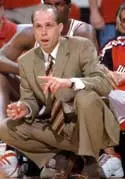
Q&A With Men's Basketball Coach Herb Sendek
8/30/2001 12:00:00 AM | Men's Basketball
Aug. 30, 2001
Tony: Your incoming recruiting class has been highly acclaimed. To what do you attribute your recruiting success?
Coach Sendek:Recruiting is a top priority which, in large part, determines the future of any program. This year's recruiting class is ranked among the nation's elite. Sports Illustrated rated our incoming class third and ESPN.com rated us number six. One service even rated us number one. We have also been rated as the best recruiting class in the ACC.
There are several key factors that enabled us to recruit this year's class. First, it was the diligent work by our coaching staff. Secondly, it was being able to offer prospects one of the premier basketball arenas in the country and thirdly and most importantly, it was the tremendous support of our fans. Finally, it was the result of the young men who were here and those who committed to the Wolfpack in my first years at NC State. Their dedication, all-out effort and success formed a critical bridge to our future.
At NC State, we have one of the best products in the country to offer a young man. NC State has dynamic leadership, a tremendous faculty, top-rated educational programs, and a beautiful campus. When you believe in something as much as we believe in NC State University, it's easy to sell it to other people.
We all realize that recruiting is the life-line of any program. In its purest form, recruiting is a result of having a great product to present, working hard with a highly organized, systematic approach and connecting with young people and their families. My staff and I do something related to recruiting almost every day of the year. We have been fortunate to attract some quality young men and players who have been also been highly recognized, but let me assure you that we are not satisfied or complacent. We still have to continue to attract more quality players to continue to improve our talent and depth and help us accomplish our goals.
We have firmly established NC State's national recruiting presence, but we know that each year will produce different results. Sometimes the makeup of our recruiting classes and the number of recruits will vary due to our changing needs and available scholarships. Although we might not always have the numbers, I'm optimistic that we will maintain the level of recruiting that we've now reached.
Tony: I know you feel the program has made other improvements, despite an off-year last season. What are some of those improvements?
Coach Sendek:There are numerous areas I can cite where we continue to improve, some which can be easily seen and measured and some that are more subtle. Our recruiting efforts are certainly a big part of that improvement as we've already discussed.
Academics is another area we're very proud of. We have graduated all of our seniors. This year, we had four more seniors earn their degrees. Furthermore, seven of our nine returning players have a 2.5 or better and all nine are making satisfactory progress toward their degrees.
Our facilities have improved dramatically with the completion of the ESA, in addition to major overhauls to our locker room and strength training areas in Reynolds. All of the facilities enhancements have been a huge factor in recruiting and contribute to the sense of pride of our team. These projects took the time and dedicated efforts of many people.
Also with the facilities has come great attendance at our games. We've set national records and the support of our Wolfpack fans continues to be enthusiastic and loyal. In 1999-2000, with the move to the ESA, we ranked first in the nation in increased attendance and ranked seventh nationally in overall average attendance. In 2000-2001, we still ranked 17th in the nation in overall attendance.
But one of the things I'm most proud of are the improvements we've made in individual player development. I believe that coaching is teaching and caring about the physical and mental development of our players. If we look at statistics and trends in a sampling of our players, we can see that many of our players made marked improvement throughout their careers. And these improvements were made despite some of the well-documented injuries that have plagued some of the players' careers.
Prior to last season, we had four consecutive winning seasons in which our number of wins and number of ACC wins increased each year. We had our first 20 win season in almost a decade, played in four consecutive post-season tournaments and reached the semi-finals or finals of the ACC Tournament for four consecutive seasons. All of those accolades show improvement.
Tony: Let's talk about demeanor on the sidelines during a game. Some coaches are very animated with their behavior during a game, while others, like yourself, prefer a more reserved approach. Is one way better than the other?
Coach Sendek: Whenever you try to be somebody that you're not, it comes off as phony and you really lose more than you would ever gain. You lose self-respect and the respect of others. I believe it's important to have the courage to be who you really are in life and not make apologies for it. You can improve on certain actions and attitudes, but those changes can't run counter to your basic God-given personality.
If I were to try to manufacture more animated behavior on the sidelines, it would be counter-productive because it would be distracting and energy draining. A lot of movement, emotion, and gesturing may be natural for some personalities. It isn't with mine. I am more reserved outwardly. Unfortunately, some people may misinterpret my style as being less assertive, intense, or competitive, which I can assure you is not the case.
I expect our teams to play with poise and composure since we compete in pressure-packed environments and situations. I want our team to be able to look over to the sidelines and see my deportment reflecting poise and composure. That's my basic nature and style.
I've studied great coaches in many different sports and they have a variety of personalities. So there's no one right style. Many of the giants that I grew up admiring and respecting were some of the least demonstrative coaches. John Wooden in basketball and Tom Landry and Tom Osborne in football are coaches that come to mind.
Their style was obviously effective. And they certainly had as much competitive fire as other great coaches. They just weren't as animated. I always had a special admiration for the way those men carried themselves. They consistently came across to me as in control, as gentlemen, and as being the kind of coaches that I would want my son to play for.
Tony: There are those who say that you would improve your team's chances of winning by working officials more and by getting more technical fouls. Do you believe that's true?
Coach Sendek: I think I can get my point across by respectful communication. I can be as assertive as needed depending on the circumstances. If there is a situation that calls for me to get more involved with the officiating, I definitely do that. And I will always defend my players when necessary. However, I don't think you gain anything by antagonizing or berating anybody, in any walk of life.
If we're to be role models for young people and represent our university with class, I think you have to treat others, particularly those in positions of authority (which officials are) with basic respect. Heated exchanges may occur in the course of a game, and at times, may even be necessary. But I always try to maintain my respect for the officials, while taking ultimate leadership responsibility for our team.
Regarding technical fouls, sometimes the technical is used by coaches as a strategic tool. Other times it may simply reveal emotions out of control. I've watched a lot of games in my life and I've seen technical fouls go both ways. I've seen a team that had momentum pick up a technical foul and then get totally sidetracked. They would completely lose focus while the other team was able to go down, make the free throws, get the ball out of bounds and score a three. All of a sudden, they've lost possession and given up five straight points to lose momentum. On other hand I've seen a technical foul bring a team together, get them on track and re-focused.
It really is about having a feel for the situation, although none of us has a crystal ball. The bottom line though is that when you get a technical foul, you afford the other team the opportunity to get points. In close games, that very well could be the difference.
Tony: NC State's uniforms have been an issue since you've been here. Last season, you agreed to add the player's names to the back of the uniforms for the first time. Will there be any changes this season?
Coach Sendek: I really believe that the game of basketball is the ultimate team sport, and from the very beginning we tried to integrate that concept into our program. In fact, we adopted the slogan "One Heartbeat" here at NC State. One of the many ways we tried to emphasize the concept of teamwork and unity was to remove the names from our uniforms. Understandably, our fans found it easier to follow us with player names on the backs. So, in the interest of our fans, last year we decided to put the names on the backs of the uniforms. And by the way, our players and their parents liked that as well.
Going into this season though, I really want to underscore the importance of us being One Heartbeat out on the floor. We have to do a better job of playing together than we did last year. We need to be more unified and cohesive. So we're going to compromise on the uniforms. At home, we're going have the names on the backs. That will appeal to our fans (and I really do care what they think). On the road, we're going to go back to not having names on the back of our jerseys. We need to be more of a team that plays with One Heartbeat and not just talk about it.
Tony: The black road uniforms also generated some conversation when they were introduced two years ago at Maryland. What can we expect this season?
Coach Sendek:We are very proud of our Wolfpack red and white. A couple of years ago we introduced a black uniform, and I would say that I probably got a 50-50 response. In recruiting circles, the black uniforms were very popular. The young people we have been recruiting really like them, they're drawn to them. As insignificant as it may sound, subconsciously, things like that do make a difference in people's decisions. Our players and our recruits really, really like them. And certainly we're not the only school with great tradition to have introduced a third color into our scheme. Duke and UCLA, two programs with great traditions, have done the same thing.
Respecting and honoring our rich basketball tradition is very important to me. We've worked hard to hang a lot more jerseys from the rafters and we've had reunions for our past players. We've done a number of things to recognize and embrace our glorious past. But at the same time, we want to make sure that the players that are wearing the uniforms feel good about themselves. Styles change. Sometimes wide ties are in and narrow ties are out. Bell bottoms and leisure suits aren't in anymore. Right now the people that we're recruiting--our market segment if you will--like them. In an effort to be as appealing as possible, we made that step.
Tony: Let's discuss transfers. Much has been said and written over the last few years about the players that have transferred. Do the numbers concern you?
Coach Sendek: Any time we bring a basketball player into our program, our hope and plan is that he will stay with us for the duration of his college career. We go to great lengths to assess our recruits for compatibility with our program. We look at many factors that help us predict their chances for success at NC State. Having said that, yes, we have had too many transfers, certainly more than I would have liked. We need to do a better job in certain areas with that.
I will say this in our defense. I think transfers are at an all-time high in college basketball. I do think what's happened here reflects a trend nationwide. Even successful, high-profile players like Michael Bradley, who started on a final eight team and won a national championship at Kentucky before transferring to Villanova, or a guy like Ryan Humphrey, who was Big Eight freshman of the year at Oklahoma before transferring to Notre Dame, are part of the trend.
If you breakdown the different reasons players transfer, here or anywhere else, it isn't always a function of there being something wrong with the coach or the program. People change schools as they do jobs, for any number of reasons. They may discover that a program is not the right fit for them academically, competitively, socially, or for personal reasons.
Some of the young men that are tallied against my transfer count are players that I never coached. Any time there's a coaching change, you frequently have transfers. And, as we've improved, playing time has gotten more competitive.
Some have left because they think they have a better chance to play elsewhere so they transfer to another level of college of basketball that's not as high as the Atlantic Coast Conference. Most of these young men have played regularly their entire athletic careers and they want to play regularly at the collegiate level. Or, a transfer can also be caused by something as simple as being homesick or wanting to be closer to their family for any number of reasons.
The second part of Tony Haynes' discussion with coach Sendek will appear Friday.